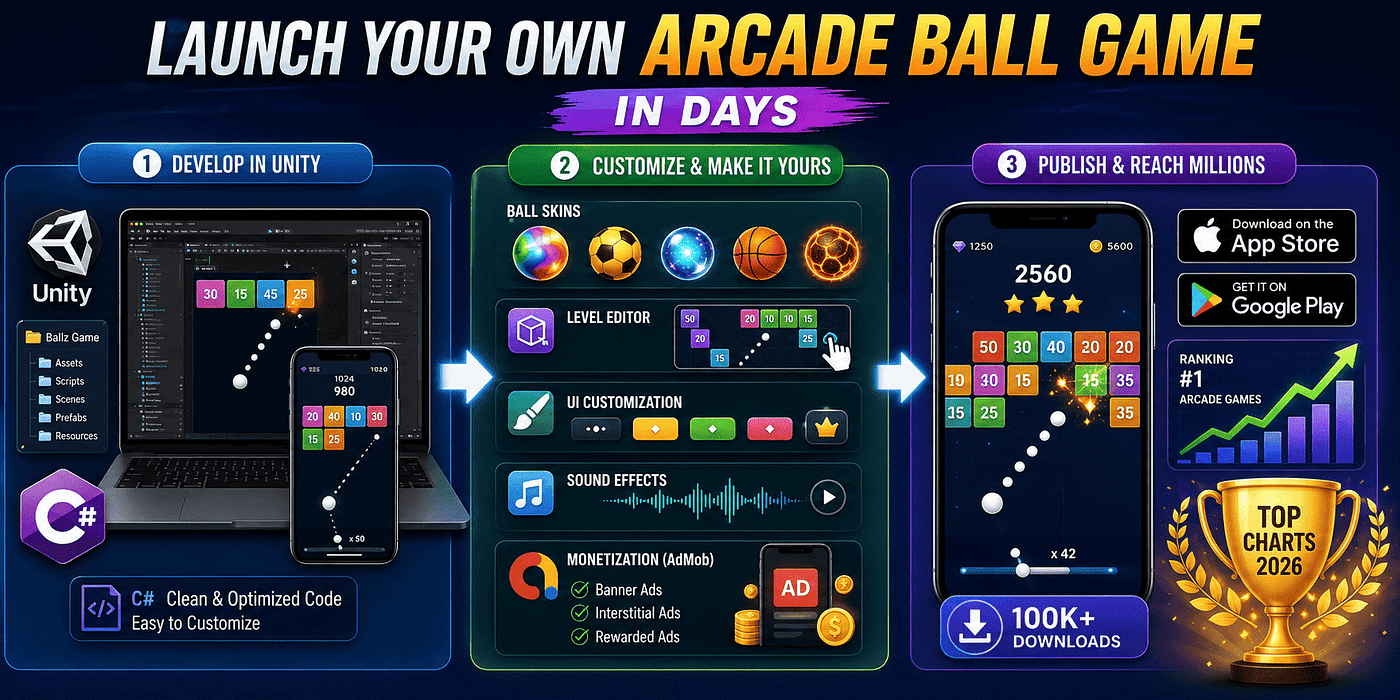
How to Turn a Simple Unity Game Idea Into a Downloadable Hit in 2026
Every year, thousands of indie developers open Unity, sketch out a “genius” hyper-casual idea, spend three weeks building it — and then…
How to Turn a Simple Unity Game Idea Into a Downloadable Hit in 2026
Every year, thousands of indie developers open Unity, sketch out a “genius” hyper-casual idea, spend three weeks building it — and then watch it sit at 42 downloads on the Play Store. Meanwhile, someone else takes a mechanic that already exists, reskins it intelligently, markets it properly, and hits six figures in downloads within a month.
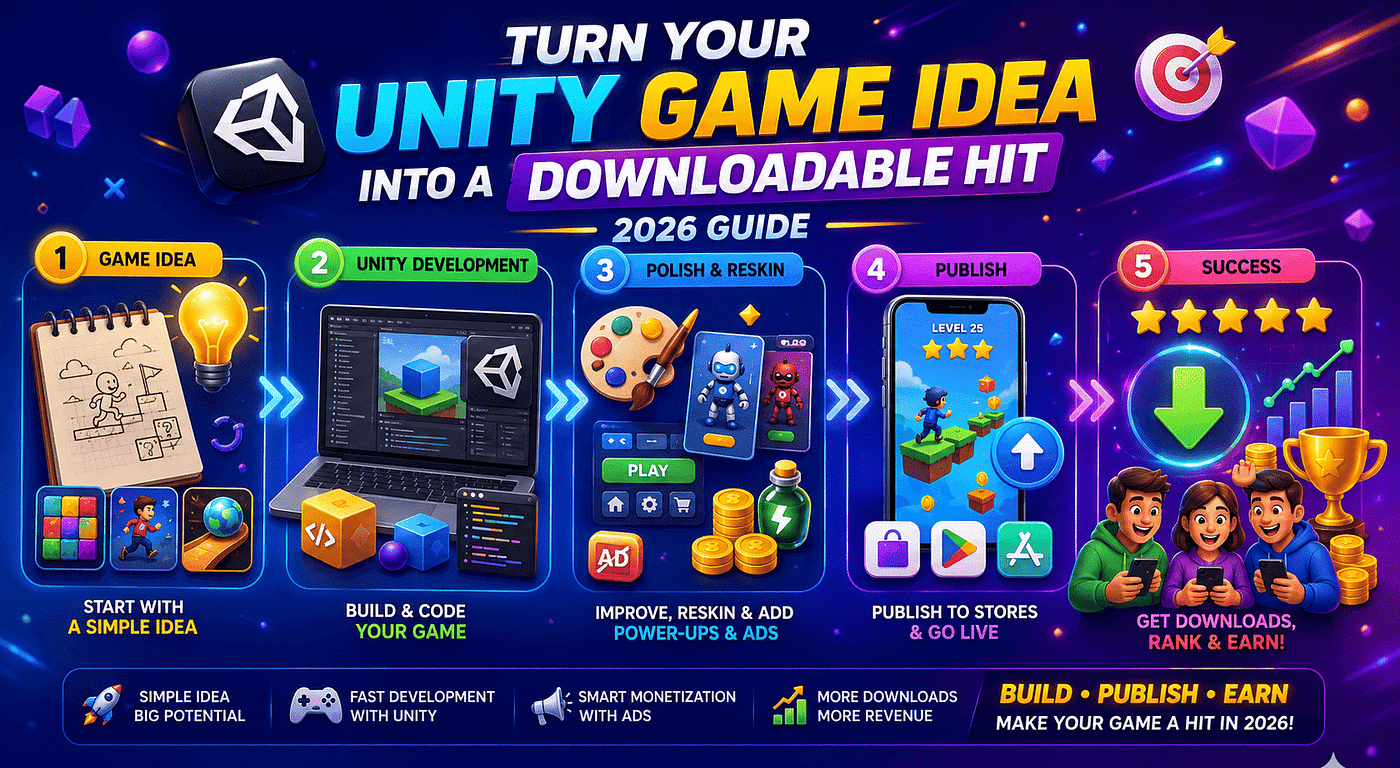
The difference almost never comes down to raw coding skill. It comes down to decision-making — which genre to build, which mechanics to borrow, how to package the game, and how to actually get it in front of players who are ready to tap “install.” If you’re serious about publishing a hyper-casual or hybrid-casual game in 2026, this article walks through the entire journey, from picking a concept to shipping something that has a real shot at ranking on the charts.
This isn’t theory. It’s a practical breakdown based on what’s actually working in the current hyper-casual market — and I’ll point you to some deeper resources along the way if you want to go further into any specific step.
Why Most Hyper-Casual Games Fail Before They’re Even Built
Before we talk about what works, let’s talk about what doesn’t.
The biggest mistake new developers make is treating game development like a solo art project instead of a product. They spend weeks perfecting an original mechanic nobody asked for, ignore what’s currently trending in the App Store and Play Store charts, and only think about marketing after the game is finished.
Here’s the uncomfortable truth: in the hyper-casual space, the mechanic matters more than the art, and market validation matters more than originality. Players don’t care if your game is “innovative” — they care if it’s satisfying, fast to understand, and fun for 60 seconds at a time.
That’s why so many successful studios don’t build from scratch anymore. They start from a proven Unity source code with a mechanic that’s already been tested by the market, then reskin it into something fresh.
Step 1: Validate the Mechanic Before You Touch Unity
The single highest-leverage thing you can do before opening the Unity Editor is spend a few hours validating your game idea against real market data. Here’s how:
- Check the top charts in the “Casual” and “Arcade” categories on both the App Store and Google Play.
- Search TikTok and Instagram Reels for gameplay clips using hashtags like #hypercasualgame or #mobilegame. If a mechanic is showing up repeatedly with high engagement, that’s a signal, not a coincidence.
- Look at ad creative libraries like the Meta Ad Library or TikTok Creative Center to see which game mechanics are currently being pushed hard by UA (user acquisition) teams. If big studios are spending money advertising a specific mechanic, it’s because that mechanic converts.
- Compare genres against your skill level and timeline. Not every trending mechanic is realistic for a solo developer to build in a few weeks.
This validation step is exactly why so many developers now start from existing, proven Unity source codes instead of original concepts — you skip months of guessing and start from a mechanic that already has evidence behind it. A full roundup of currently high-performing hyper-casual Unity game source codes is worth bookmarking if you’re at this stage of your process, since it breaks down why each mechanic works, not just what it looks like.
Step 2: Choose Your Genre Strategically, Not Emotionally
It’s tempting to build the game you personally find fun. But hyper-casual development isn’t about your taste — it’s about matching a mechanic to an audience that’s actively searching for that kind of experience.
Broadly, hyper-casual and hybrid-casual genres fall into a few buckets in 2026:
- Reflex/skill-based mechanics (color matching, shape morphing, timing-based taps) — these are cheap to market because the gameplay is instantly understandable in a 5-second video clip.
- Retro-arcade revivals (maze runners, brick breakers, classic platformer mechanics) — these benefit from nostalgia-driven searches and a built-in audience that already knows what to expect.
- Physics-based destruction games (stacking, smashing, collapsing) — highly satisfying to watch, which makes them extremely shareable on short-form video platforms.
- Idle/tycoon hybrids — slower-paced but with significantly better long-term retention, since players build attachment to their in-game progress over days and weeks.
Each of these genres has different implications for your development timeline, art requirements, and monetization strategy. If you’re unsure which bucket fits your resources and goals best, cross-checking the current top-performing mechanics in this breakdown of top hyper-casual Unity game source codes for 2026 can help you lock in a direction before you invest development time — because switching genres halfway through development is one of the most expensive mistakes an indie developer can make.
Step 3: Don’t Build From Scratch — Reskin Smart
Once you know your genre, the next decision is whether to code the entire game from zero or start from an existing, structurally sound Unity source code and reskin it.
For 95% of indie developers, reskinning is the smarter path — and not because it’s “cheating.” It’s because:
- You inherit a tested core loop instead of guessing whether your mechanic is actually fun.
- You save weeks or months of development time, which you can redirect toward marketing and ASO (App Store Optimization).
- You reduce technical risk — a well-built source code has already solved the annoying edge cases (save systems, ad integration, performance optimization) that eat up so much indie dev time.
- You can produce multiple variations quickly, testing different themes and art styles against real install and retention data instead of betting everything on one version.
If you’re new to the reskinning process specifically for Google Play publishing, this complete beginner’s guide to reskinning a Unity game for Google Play in 2026 covers the entire pipeline — from picking a source code, to swapping assets, to configuring your build settings, to actually submitting your APK/AAB for review. It’s worth reading end-to-end before you start your first reskin project, since Play Store policies and review requirements shift often, and getting it wrong can delay your launch by weeks.
Step 4: Build a Feedback Loop That Feels Good in the First 10 Seconds
Regardless of which genre or mechanic you choose, there are universal principles that separate hyper-casual games that retain players from ones that get uninstalled after a single session:
Instant Clarity
Players should understand what to do within 2–3 seconds of the game loading — no tutorials, no walls of text. If your core mechanic needs a paragraph of instructions, it’s too complicated for this genre.
Juicy Feedback
Screen shake, particle bursts, satisfying sound design, and haptic feedback on mobile devices all contribute to what the industry calls “juice.” A tap that feels good is often more important than the underlying mechanic itself.
Fast Failure, Fast Retry
Hyper-casual players expect to fail quickly and restart immediately — no long loading screens, no unnecessary menus between attempts. Every second of friction between “you lost” and “try again” costs you retention.
Visible Progression
Even in the simplest games, players need to feel like they’re getting better or unlocking something. This can be as simple as a high score counter, a level number, or a cosmetic unlock system.
Step 5: Plan Your Monetization Before You Launch, Not After
A common mistake is treating ad integration as an afterthought — something you’ll “figure out later” once the game is built. This almost always leads to poorly placed ads that hurt retention and lower your lifetime value (LTV) per user.
Instead, map out your monetization strategy during development:
- Rewarded video ads should be tied to meaningful in-game value — reviving after a fail, doubling a reward, or unlocking a new skin. Players should feel like watching the ad was their choice, not a punishment.
- Interstitial ads work best at natural pause points, like between levels or after a run ends, but should never interrupt active gameplay.
- Mediation platforms (AppLovin MAX, ironSource, Google AdMob mediation) let multiple ad networks compete for each impression, which typically increases your effective CPM compared to a single ad network.
- Light IAP layers — even in a pure hyper-casual game, offering an “remove ads” option or cosmetic purchases can meaningfully boost revenue per user without hurting the free experience.
The key is designing your monetization touchpoints as part of the core loop, not bolting them on after the fact.
Step 6: Market Before, During, and After Launch
Even the best-built hyper-casual game will fail commercially if nobody knows it exists. A few non-negotiable marketing steps for 2026:
- Create short-form video content early. Record gameplay clips during development and start testing them on TikTok/Reels before your official launch to gauge organic interest.
- Optimize your store listing (ASO). Your title, icon, screenshots, and preview video all directly affect your conversion rate from store visit to install. Test multiple icon variations if your budget allows.
- Run small paid UA tests. Even a modest budget ($50–$200) spent on Facebook/TikTok ads can tell you whether your creative-to-install conversion rate is healthy before you scale spending.
- Cross-promote across your own portfolio. If you’ve published multiple reskinned games, in-game cross-promotion banners cost nothing and keep users inside your ecosystem.
- Watch your Day 1 and Day 7 retention closely. These numbers tell you whether it’s worth scaling your marketing spend or going back to adjust the core loop first.
Putting It All Together: A Realistic 2026 Launch Timeline
Here’s a rough, realistic timeline for a solo or small-team developer following this process:
- Week 1: Market research and mechanic validation.
- Week 2: Select and license a Unity source code that matches your validated mechanic.
- Week 3–4: Reskin — new art, sound, branding, and any small gameplay tweaks.
- Week 5: Ad network integration, testing, and QA across multiple devices.
- Week 6: Soft launch in a smaller market or limited ad test to gather retention data.
- Week 7–8: Full launch with ASO optimization and scaled marketing spend based on soft-launch data.
Compare this to the 3–6 months (or more) it typically takes to build an original hyper-casual game from scratch, test it, fix it, and then market it — and it’s easy to see why reskinning proven source codes has become the dominant strategy among successful indie hyper-casual developers.
Final Thoughts
Building a successful hyper-casual game in 2026 isn’t about having the most original idea in the App Store — it’s about combining a validated mechanic, clean execution, smart monetization, and consistent marketing. Skipping any one of these steps is usually why promising games quietly disappear after a few hundred downloads.
If you want to go deeper into specific proven mechanics currently performing well, it’s worth studying this curated breakdown of top hyper-casual Unity game source codes that are actually getting downloads right now — it’s a good way to shortcut the research phase covered in Step 1 of this article.
And if you’re planning your first reskin project specifically for Google Play, there’s a complete, beginner-friendly guide to reskinning a Unity game for Google Play in 2026 that walks through the entire technical and submission process in detail — highly recommended before you submit your first build.
Ship smart, validate early, and remember: in hyper-casual gaming, execution speed and market timing usually beat originality.
FAQ
Q1: Is it legal or ethical to reskin an existing Unity game source code? Yes, as long as you’ve purchased a proper commercial license for the source code and are not copying another developer’s branding, trademarks, or copyrighted assets. Reskinning is a standard, widely accepted practice across the hyper-casual industry, and most Unity source code marketplaces explicitly sell templates for this purpose.
Q2: How much does it typically cost to reskin and launch a hyper-casual game? Costs vary widely, but a modest budget covering a licensed source code, custom art assets, and a small initial marketing test can range from a few hundred to a few thousand dollars, depending on how much of the work you do yourself versus outsource.
Q3: How long does it take to get a reskinned game approved on Google Play or the App Store? Google Play review times are typically a few hours to a couple of days for most apps, while Apple’s App Store review process can take anywhere from 24 hours to a week, especially if your app needs additional clarification during review. Following platform guidelines closely from the start significantly reduces rejection risk.
Q4: Can one Unity source code really be reskinned multiple times profitably? Yes — this is one of the most common business models in the hyper-casual space. Developers frequently license a single well-built source code and publish 5, 10, or even 20+ reskinned variations across different themes, markets, and audiences, each generating independent ad revenue.
Q5: What’s the biggest reason hyper-casual games fail to get downloads? In most cases, it’s a mismatch between the mechanic and current market demand, combined with weak store optimization (poor icon, screenshots, or preview video). Even a well-built game can underperform if its store listing doesn’t convert browsers into installers.
Q6: Should beginners build an original game or start with a reskin? For most beginners, starting with a reskin of a proven source code is the smarter first project. It teaches you the full publishing pipeline — Unity build settings, ad integration, store submission — without the added risk of an unvalidated, custom-built mechanic failing to resonate with players.
메타데이터
- post_id
- d3bf97d853a1
- slug
- how-to-turn-a-simple-unity-game-idea-into-a-downloadable-hit-in-2026-d3bf97d853a1
- url
- https://medium.com/@unitysourcecode2026/how-to-turn-a-simple-unity-game-idea-into-a-downloadable-hit-in-2026-d3bf97d853a1
- canonical_url
- https://medium.com/@unitysourcecode2026/how-to-turn-a-simple-unity-game-idea-into-a-downloadable-hit-in-2026-d3bf97d853a1
- author_url
- https://medium.com/@unitysourcecode2026
- status
- ok
- fetched_at
- 2026-07-07 04:24:22