The Rise of Umami and the Fifth Taste Reshaping Food
The Rise of Umami: How the “Fifth Taste” Is Reshaping What We Eat
Kikunae Ikeda isolated monosodium glutamate in 1908, named the taste it produced, and built a company around it. That company, Ajinomoto, is now one of the largest flavor manufacturers in the world. The market Ikeda seeded has taken over a century to reach genuine scale, but the trajectory now is steep.

According to SDKI Analytics, the global **umami flavor market** stood at USD 4.1 billion in 2025 and is projected to reach USD 6.7 billion by 2035, expanding at a CAGR of 5.6% across the forecast period from 2026 to 2035. What is driving that growth has less to do with cuisine trends and more to do with the convergence of public health policy, plant protein demand, and reformulation pressure on food manufacturers.
Umami Is the Workaround for Salt Reduction Demand
The World Health Organization set a target in 2013 for a 30% relative reduction in global population sodium intake, a goal the World Health Assembly reaffirmed and then extended to 2030.
According to WHO’s own 2023 Global Report on Sodium Intake Reduction, the world remains off-track in the pursuit of the goal as only 5% of member states have mandatory, comprehensive sodium reduction policies in place. That gap between policy ambition and food industry compliance is, paradoxically, an opportunity for umami.
Glutamate and nucleotide-based flavor enhancers allow food manufacturers to cut sodium while maintaining, or in some cases improving the perceived saltiness and overall palatability. The mechanism is not cosmetic as it is a formulation lever that regulators are essentially pushing manufacturers toward, even if indirectly.
Sauces and seasonings, which account for 40% of the umami product type segment by market share as per SDKI Analytics, are the primary reformulation battleground. Every major processed food company operating in markets with front-of-pack sodium labeling has a reformulation roadmap, and umami is a central variable in that math.
Asia-Pacific Holds the Largest Share in Umami Market and Also Sets the Pace
Asia-Pacific accounts for roughly 40% of global umami market share and is projected to maintain the highest regional CAGR at 7.5% through 2035, according to SDKI Analytics. That dominance is due to the region’s aquaculture and fermentation industries providing the raw material base from which many natural umami ingredients are derived.
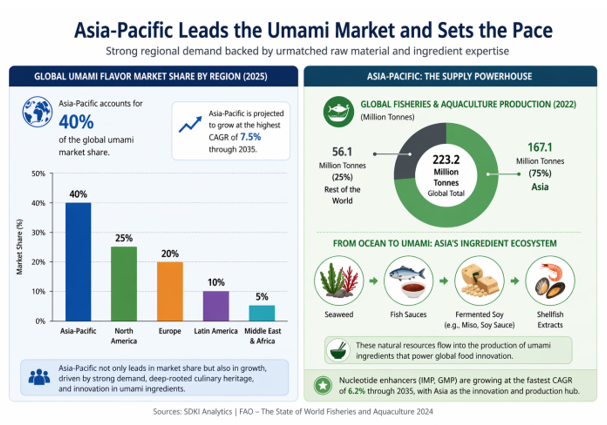
FAO’s 2024 State of World Fisheries and Aquaculture report recorded a total global fisheries and aquaculture production at 223.2 million tonnes in 2022, with Asia responsible for 167.1 million tons, accounting for 75% of the world total. Seaweed, fish sauces, fermented soy, and shellfish extracts all flow from that supply chain into umami ingredient production.
Japan, South Korea, China, and Indonesia are not just consuming umami at high volume but they are the origin points for many of the ingredient categories now being scaled globally, such as dashi concentrates, miso-based flavor systems, nucleotide enhancers like IMP and GMP.
The 6.2% CAGR projected for nucleotide enhancers through 2035 is the fastest of any sub-segment in the market (SDKI Analytics), and it is Asian food technology companies that hold most of the production expertise.

Japan’s Aging Population Is a Major Driver for the Umami Market
Japan presents a specific and durable demand case. According to Japan’s Ministry of Internal Affairs and Communications, as of October 2024, 36.24 million people, i.e., 29.3% of the total population were aged 65 or older. That figure is the highest proportion of any country with a population exceeding 100,000. The demand implication for umami is not trivial, as older populations tend to experience declining taste sensitivity, particularly for salt. Foods need to deliver perceived satisfaction without relying on sodium to do the heavy lifting.
The Japanese umami segment is forecast at a 5.8% CAGR through 2035 as per SDKI Analytics, supported by health policies targeting sodium reduction among an aging demographic. The product categories gaining traction include fermentation-based flavor systems, such as miso concentrates, dashi stocks as well as specialized umami blends designed for elderly nutrition applications.
Within Japan’s domestic market, Tokyo’s CAGR is projected at 6.1% and thus reflects both premium retail penetration and the outsized concentration of foodservice innovation in the capital.

Plant-Based Protein’s Flavor Problem Is Umami’s Revenue Opportunity
Plant-based meat and dairy alternatives face a persistent palatability gap. Reproducing the savory depth of animal protein without animal-sourced ingredients is, at core, an umami problem.
Hydrolyzed vegetable protein, yeast extracts, and mushroom concentrates are the primary tools that manufacturers use to close that gap and these are all umami-dense ingredient categories. The HVP segment is projected to grow at 5.9% CAGR through 2035, with North America as the lead region, driven by the concentration of plant-protein startups and large CPG reformulation programs there as per SDKI Analytics.
Umami-forward packaged foods, such as premium sauces, ramen kits, seasoning blends, etc., are among the categories benefiting most from the shift to online food purchasing. The **legumes market** is gaining relevance here as well, i.e., legume-derived fermentation substrates are increasingly used to produce clean-label umami ingredients outside traditional soy and wheat-based processes.
The Competitive Landscape Is Not Uniform: Ingredients vs. Formulation
The umami market has two distinct competitive layers. The first is the global flavor house tier dominated by Givaudan, Kerry Group, Symrise, IFF, Sensient Technologies, etc., which sells umami components and full flavor systems to food manufacturers. These companies are competing primarily on formulation capability and regulatory expertise, which is the ability to design an umami profile that is clean-label compliant, performs across a range of pH and temperature conditions, and meets the labeling requirements of multiple jurisdictions simultaneously.
The second layer is the Japan-origin specialist tier, anchored by Ajinomoto, Yamaki, Mitsubishi Corporation Life Sciences, and Kikkoman, each with deep process heritage in MSG, nucleotide production, as well as in fermented flavor systems.
But the bottleneck of clean-label tension is evident. FDA and EFSA maintain regulatory frameworks around synthetic flavor additives that affect market positioning, particularly in premium retail channels. Meanwhile, synthetic umami sources are projected to hold 38% of the source segment by 2035, and will maintain dominance through cost efficiency and formulaic consistency, but the fastest premium growth is in natural extracts, i.e., mushroom, seaweed, fermented soy. Thus, the brands that can deliver proven natural provenance while matching synthetic cost parity at scale will define the next competitive cycle.
Market Intelligence for Investors and Ingredient Buyers in the Umami Market
A few dynamics narrow the window for positioning. The regulatory timelines around sodium labeling and reformulation mandates are tightening across the EU and in key Asia-Pacific markets. Companies that have not yet built umami-based reformulation capability into their product pipelines will face procurement urgency as front-of-pack compliance becomes mandatory rather than voluntary.
Supply chain consolidation in key natural ingredient categories, such as seaweed extraction, mushroom concentrate, fermentation-derived enhancers, etc., is already underway. The early movers in sourcing agreements gain both cost and supply security advantages.
The fermentation-based segment, including miso and dashi concentrates, is forecast at 6.0% CAGR through 2035, with Japan and broader Asia-Pacific as the primary production base. For ingredient buyers outside the region looking to work with natural umami systems, the sourcing relationship needs to be built before the demand surge fully materializes. The data in the SDKI report maps regional supply concentration against demand forecasts by application and this is precisely where procurement and investment decisions should be anchored.
Umami has moved well past the stage where it needs to be explained to food executives and the burning question now is execution. For instance, which ingredient categories to prioritize, which regional demand curves to front-run, and how to position against a regulatory environment that is actively creating a reformulation mandate. The companies that treat umami as a serious structural input, not a trend addendum, are the ones building durable competitive positions in food manufacturing over the next decade.

메타데이터
- post_id
- d3c4ba827b46
- slug
- the-rise-of-umami-and-the-fifth-taste-reshaping-food-d3c4ba827b46
- url
- https://medium.com/@sdki-analytics/the-rise-of-umami-and-the-fifth-taste-reshaping-food-d3c4ba827b46
- canonical_url
- https://medium.com/@sdki-analytics/the-rise-of-umami-and-the-fifth-taste-reshaping-food-d3c4ba827b46
- author_url
- https://medium.com/@sdki-analytics
- status
- ok
- fetched_at
- 2026-07-10 22:23:26