The Golden Age of the Russian Nobility — part 2
A day in the life of a typical nobleman - the salon and the ball
The Golden Age of the Russian Nobility — part 2
The salon and the ball
The carriage was already waiting for Konstantin at the grand entrance of the mansion. The footman opened the carriage door, inviting our hero inside. Another second — and the carriage was already racing along the capital’s avenues. Ahead lay a night of social conversations and receptions, and the first stop — the salon!
The Salon of Princess Y.
Salons in the 18th–19th centuries were something like modern social networks, only in person… and with far stricter rules. Salons were typically hosted by the highest circles of the elite, who invited the noble and the famous, the talented and the successful. There one could meet generals, officials, ministers, princes and princesses (including imperial ones), and above all poets, scientists, and artists. It was a closed social network of the capital’s elite.
Salons were not hosted by men, but by women. They could be “anyone” — a countess or a princess, a renowned literary lady, or the wife of a minister. One could enter only by invitation.
By seven o’clock in the evening, Konstantin Danilovich’s carriage arrived at the luxurious grand entrance of a Baroque mansion — a perfect example of the architecture of Catherine the Great’s era. Lavishly decorated with statues and stucco, the pale pink house looked like a confection — wealth and elegance itself.
At the front door, he was greeted by a footman. Our hero introduced himself, and the footman immediately understood who he was and that he had indeed been personally invited by the hostess. Konstantin carefully handed his sword to the valet in the cloakroom area, and then proceeded deeper into the vast palace, guided by the footman.
On the second floor of the house, in a grand salon glittering with countless candles, crystal, and mirrors, the name of our hero was announced to all those present. Then followed the obligatory ritual, much like today: one must greet the hostess of the salon first. The greeting was measured to perfection — first a bow of the head, then, stepping slightly back, Konstantin took the hostess’s hand and kissed it. She was, of course, flattered by the young officer’s gallantry. She smiled broadly and welcomed the guest.
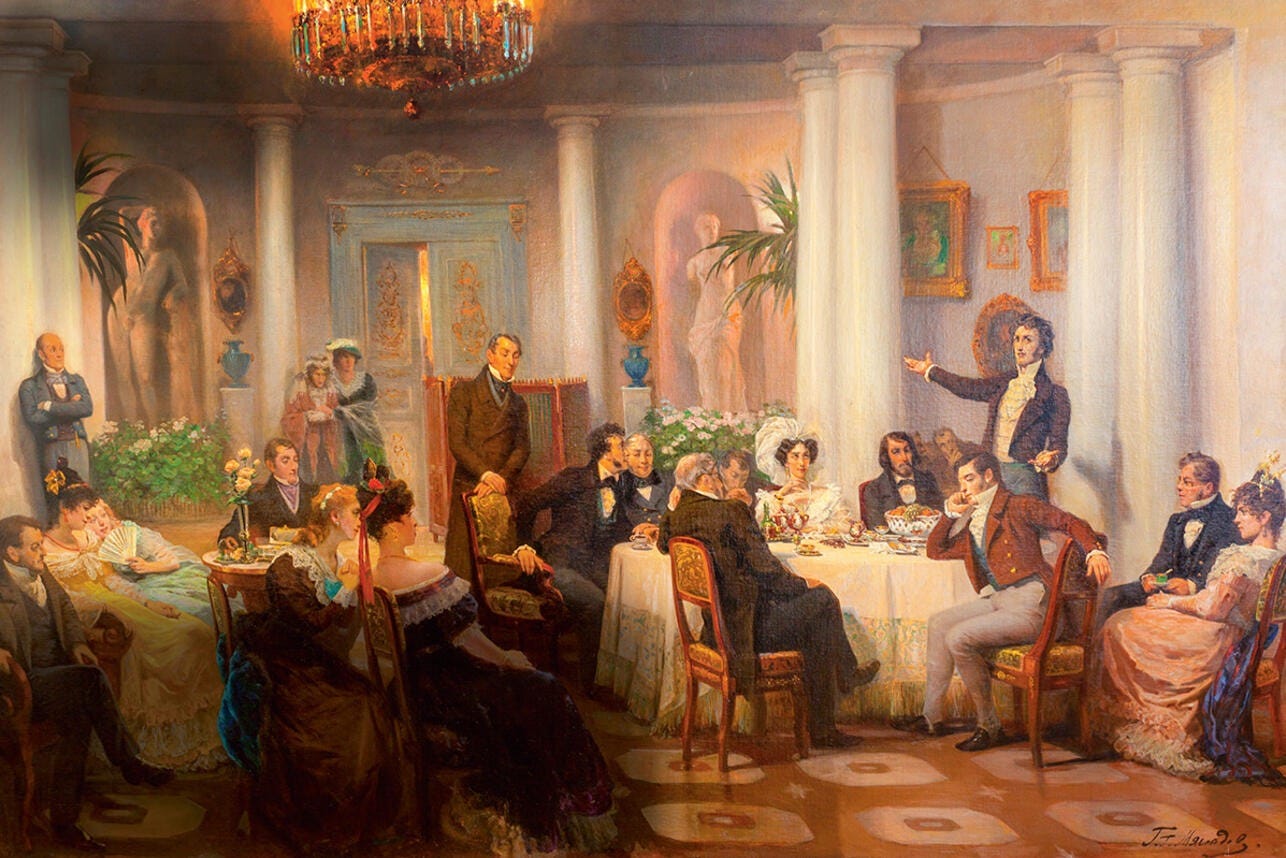
Grigory Myasoedov, Pushkin and His Friends Listening to Mickiewicz’s Recitation at Princess Zinaida Volkonskaya’s Salon (1899–1907) — This is approximately what the salon visited by Konstantin Danilovich would have looked like.
After the ceremony, Princess Y. led Konstantin Danilovich through the groups of guests, introducing him to the right people — here were generals who had most likely known his father and therefore greeted our hero almost like a cousin; and there — the Minister of Education surrounded by representatives of the artistic elite (writers and painters). At a table with drinks, several countesses discussed the upcoming ball. Nearby, comfortably seated on sofas and armchairs, young ladies conversed with the wife of the Minister of Education, speaking about the recent theatrical premiere. Elsewhere, a lady-in-waiting of the Empress spoke of a recent imperial hunt… and so on.
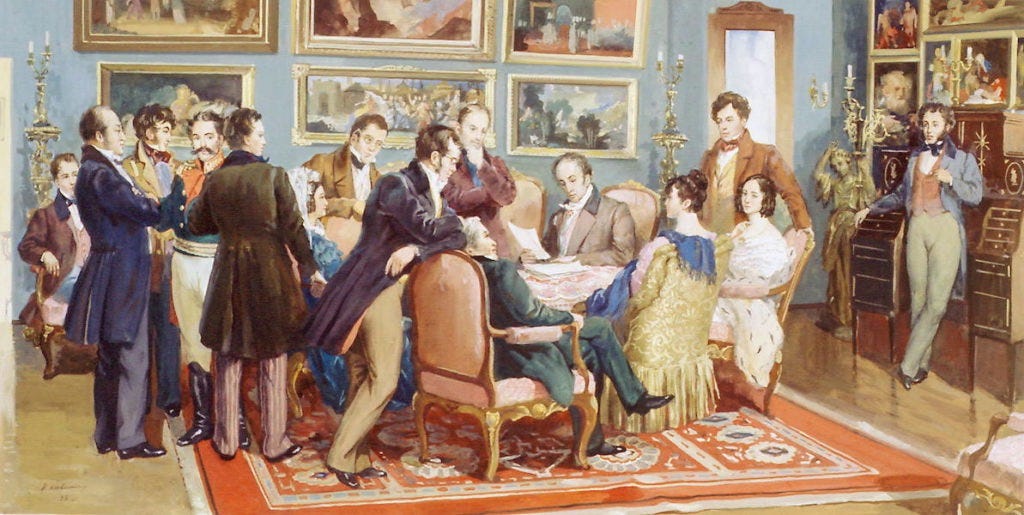
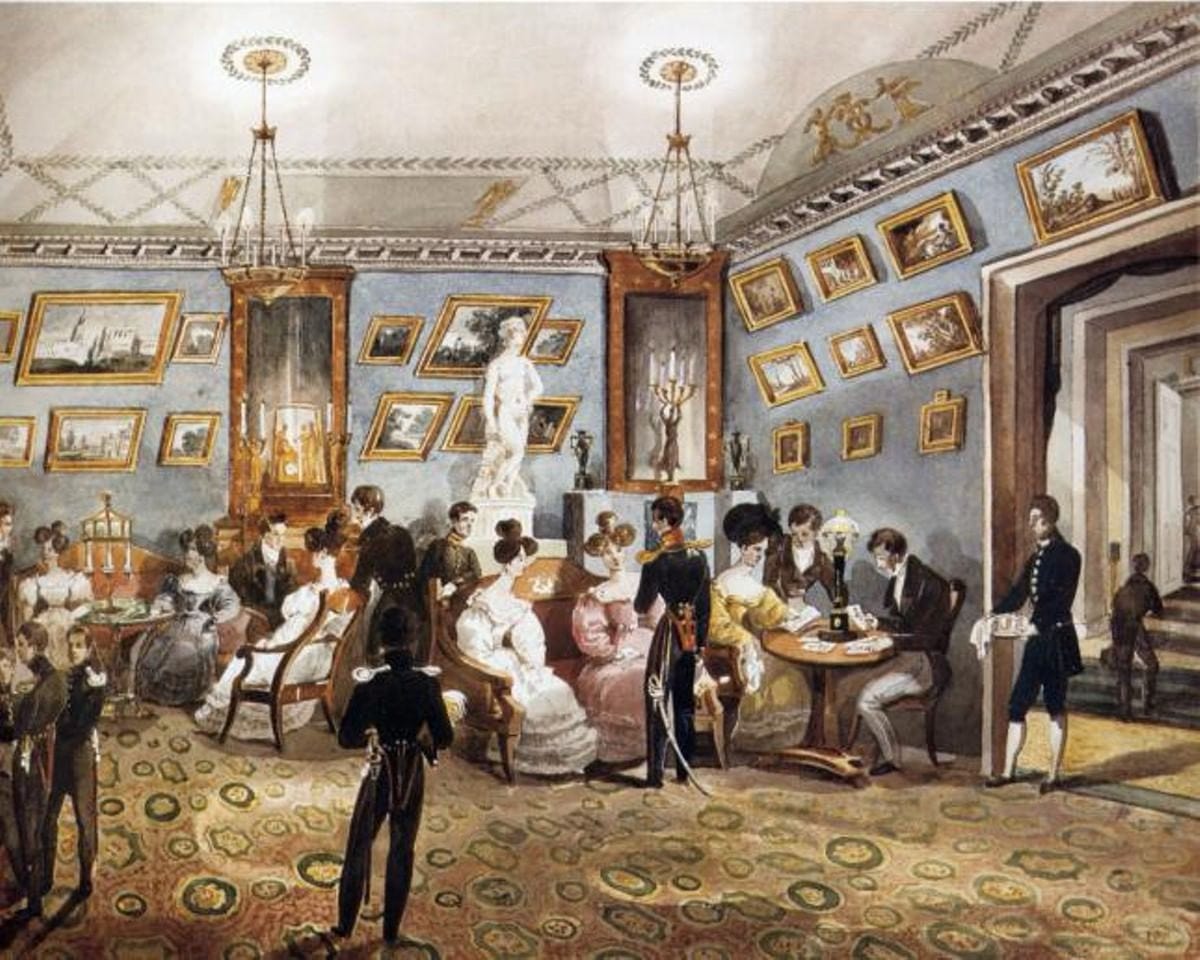
Salons in the beginning of the 19’s century
The etiquette of early 19th-century salons did not allow loud music or heated debates. The purpose of the gathering was conversation and the exchange of gossip, meetings with important acquaintances, and the formation of new alliances. They spoke of theatre and music, art, painting, and literature. They might also discuss governmental reforms — but not internal politics, rather foreign affairs. Most of the times the hostess would invite some one famous to the salon — a poet or a painter, a proclaimer or a sculpture. Everyone would gather around this guest of honour to vitness what they would say or show. This salon, on the other hand, was somehow different- something of a gathering and chat.
Gossip, of course, was highly valued: what was being worn at the English court? What palaces and castles existed in Denmark? How many dogs did the Queen of Sweden keep? How had Princess K.’s palace expanded? And much, much more.
In the adjoining rooms — no less elegant and richly decorated — other guests entertained themselves with card games (whist), smoked, or simply strolled through the open enfilades, admiring the owners’ treasures: paintings, antiques, and exotic curiosities from the East.
Konstantin Danilovich, accompanied by his noble patroness-hostess, moved fluidly from one group to another. His main task was to meet the right people. A company of generals was especially interested in him: they asked about his mother, recalled his father, reminisced about his mother’s receptions and joint hunting trips many years ago. One of them promised to inquire about new military appointments and to put in a good word for the son of an old friend.
Naturally, such attention did not go unnoticed. A nearby group of mothers quickly observed Konstantin’s success. On their shoulders rested the same daughters who needed to be married off — and here was a fortunate opportunity: a young guards officer with connections to the empire’s high command.
Princess Y. led our hero to meet them as well, presenting him as a promising young man — the future of the empire. They exchanged bows and visiting cards, and he was introduced to their daughters. Several of them pleased Konstantin — young, beautiful, intelligent, noble, and wealthy.
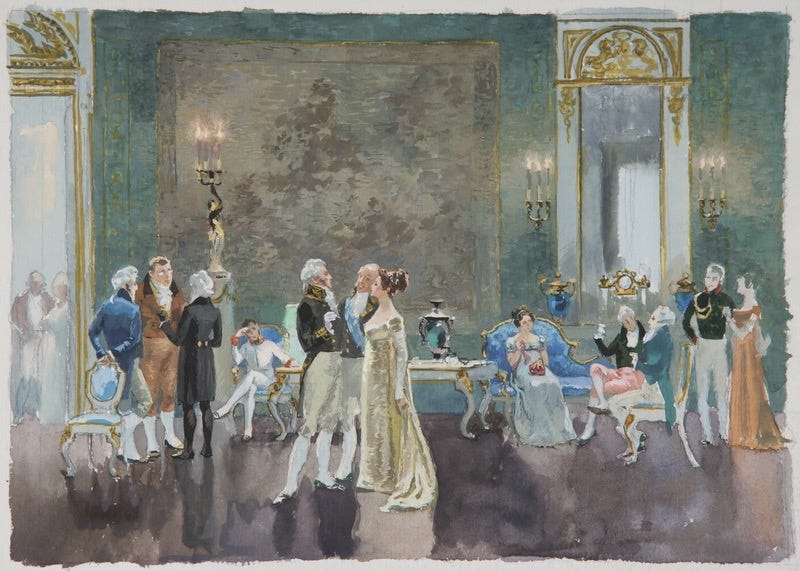
Anna Pavlovna Scherer’s Salon. Painting by A. Nikolaev. The events of War and Peace take place in the early nineteenth century, the same period in which Konstantin Danilovich’s story unfolds.
In those days, although one’s position was important, the primary focus in choosing a future spouse lay in lineage and, above all, prospects. And it must be said that Konstantin was in a favorable position.
After several hours of conversation, introductions, and social exchange, it was time to move on. By eleven o’clock in the evening the salon came to an end, but the guests had no intention of returning home. One after another, they entered their carriages and moved on — to the ball!
The Ball
To an even more lavish, and even larger mansion (though it was more like a palace), Konstantin Danilovich arrived at twenty minutes to midnight — just in time for the beginning of the ball. This event was no longer as intimate and cozy as the salon, where candles softly flickered in mirror reflections and guests drifted through rooms engaged in relaxed conversation. Here, everything was serious.
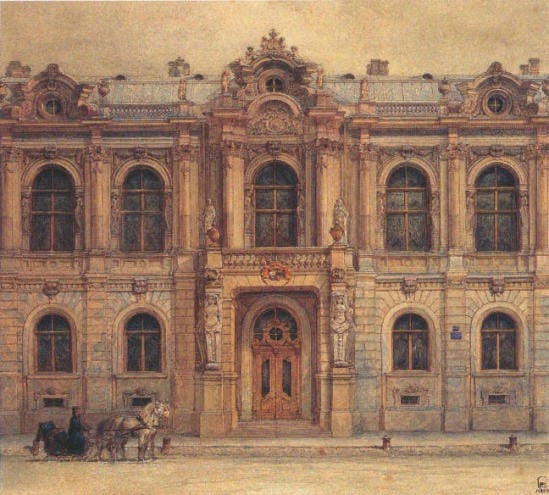
The Mansion of Countess Zinaida Ivanovna Yusupova. Illustration by Vasily Sadovnikov, 1866. — An approximate depiction of the mansion where the ball in Konstantin Danilovich’s story is set.
Guests arrived from half past eleven until midnight. Being late was considered bad manners. Footmen and valets greeted them, helping remove their outer garments. The guests were then escorted into the ballroom, where the hosts of the ball received them — one had to bow or formally introduce oneself, depending on rank. Music was already playing — not yet for dancing, but soft and graceful melodies.
Konstantin Danilovich flawlessly followed all rules of etiquette. In the ballroom, after greetings, he met his friends — Count and Countess O. , at whose home he had dined earlier that same day. The friends exchanged greetings and, sipping lemonade, conversed.
The hall filled more and more with each passing minute. It is impossible to convey the festive atmosphere: gallant gentlemen slowly paced the room in search of suitable dance partners. Young ladies, using the language of the fan, chose their partners, while their mothers — stern and watchful — ensured that the suitors were noble, wealthy, and handsome… though the last quality was not always essential.
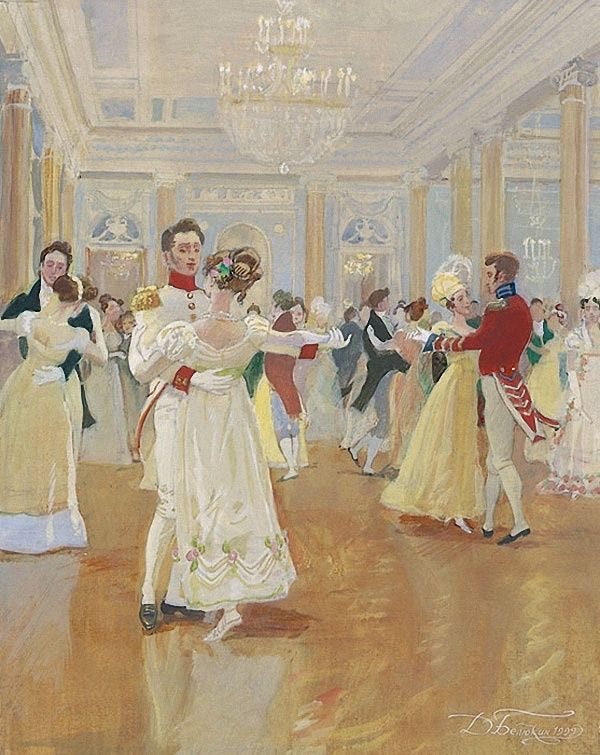
Dmitry Belyukin, The Ball (1999)
Konstantin was no exception. He found the young ladies he had met earlier in the salon and, with the confident stride of a guards officer, approached… their mothers first. One had to greet them before requesting permission from the young lady to be honored with a quadrille or mazurka. A refusal was possible — the gentleman might not be to one’s liking, or there might simply be no space left on the dance card. Konstantin was fortunate — almost all the ladies he had taken an interest in at the salon had available dances, and their mothers were entirely favorable to such a match.
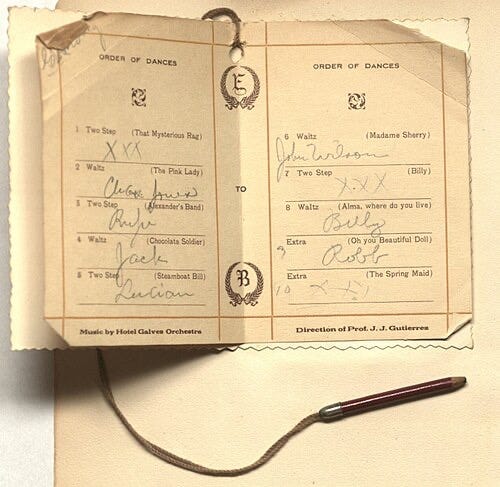
Dance card — 1912
It was not customary to dance too often — more than twice in a row with the same lady was considered improper, especially at a first meeting. Three consecutive dances were regarded as a public declaration of affection. One danced with several ladies over the course of the evening. Both the gentleman and the lady, and especially her parents, observed one another carefully, learning about lineage, fortune, family, and income (this, of course, came later, after the ball).
Konstantin chose according to his mother’s guidance. Some families she knew personally and advised him to observe; others matched his social standing. Several potential brides were intelligent and well-educated, and, to his own delight, personally pleasing to him.
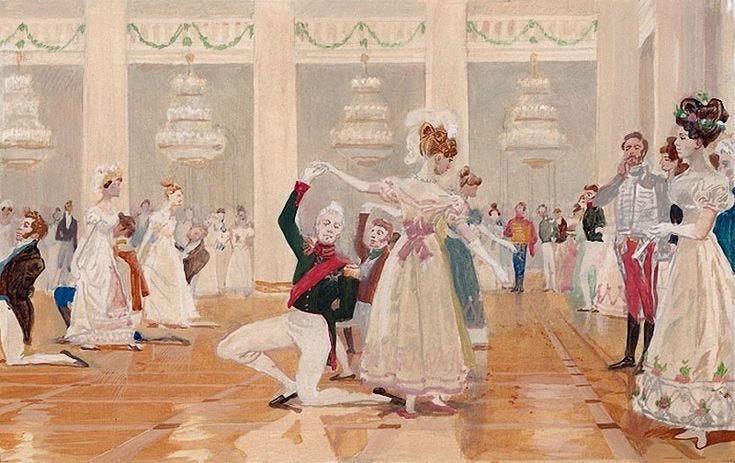
Dmitry Belyukin, Ball at the Moscow Noble Assembly
And so at last he was engaged for the entire night — dance after dance. But when will it truly begin?
Fanfares sounded. In the center of the ballroom appeared the hostess of the evening and the guest of honor — this time, Prince Yusupov himself. The host invited Princess Yusupova to the dance — a mutual exchange of invitations that was an essential ritual of etiquette. Such honor confirmed the status of the house, the family, and the evening itself. The dance would be a quadrille — light, graceful, and joyful.
All dances followed a strict order known to the guests in advance. The titles were announced by the master of ceremonies so that the orchestra would play the correct piece.
In the first part of the ball, dances followed one after another with only brief pauses. Guests danced, changing partners. Then came a short intermission. The hostess invited everyone to walk through the grand halls and galleries, to rest and breathe. In the dining room, a buffet was laid out — fruits, sweets, cold tea, and lemonade. Wine and coffee could also be requested from the servants, though heavy drinking was not customary among the young — wine was mostly enjoyed by the older guests. Why were the young not allowed to drink? Because they still had many dances ahead!
Konstantin, it seemed, had made his choice… He was drawn to one of his dance partners — a young lady, the daughter of Countess Natalya. He approached her and her family again, bowed to all of them, and asked permission to escort the young lady to the dining room to offer her dessert. Her mother agreed, giving her silent blessing. Our hero took Natalya’s arm. Her parents followed at a slight distance, giving them the opportunity to speak briefly and assess Konstantin.
The dining room was cool and already crowded. Konstantin briefly left Natalya by the window so she could breathe fresh air, while he went to fetch cold tea and sugared fruits for her. Nearby, elderly ladies rested on long sofas, while young girls, newly introduced to society, chirped around them — this was their debut in high society. They were not yet seeking suitors — this was their “training” in the social world.
While guests rested, windows were opened in the ballroom to air the space. The large number of people, the energetic dancing, the candles… one can only imagine how difficult it was to breathe (not forgetting the entirely different standards of hygiene of the time).
As they spoke, Konstantin learned much about Natalya’s family (as if he had not known already) and about her herself — her interests, her passions. Everything mattered greatly. And here he was fortunate: they turned out to be very similar — both loved country life, the same dishes, horses, flowers, and much more. Gathering courage, Konstantin asked Natalya for one more dance… and she agreed.
When they danced together for the second time, everyone present took it as a sign of mutual affection. Some were disappointed, others saw it as a challenge. The dancing continued until dawn — sometimes until four or even five in the morning. After that, guests returned home, and by noon only began to wake.
Konstantin returned home, floating on clouds of thoughts about Natalya. As he rode through the empty streets of Saint Petersburg, his consciousness slowly drifted into sleep, where he saw her smile and felt the gentle scent of her rose perfume.
The next day, Konstantin would remain at home — thinking about how to prepare his house for the arrival of his mother, who was soon to come to the city. And, of course, when he should visit Natalya — immediately, or perhaps only the next day.
메타데이터
- post_id
- d3d4e98543ce
- slug
- the-golden-age-of-the-russian-nobility-part-1-d3d4e98543ce
- url
- https://medium.com/@v.gomann/the-golden-age-of-the-russian-nobility-part-1-d3d4e98543ce
- canonical_url
- https://medium.com/@v.gomann/the-golden-age-of-the-russian-nobility-part-1-d3d4e98543ce
- author_url
- https://medium.com/@v.gomann
- status
- ok
- fetched_at
- 2026-07-09 13:13:48