From Passion to Practice: How the High’s Docents Enrich Visitor Experiences
Sophia Sobrino introduces two of our docents who make a difference at the High with each visitor they encounter.
From Passion to Practice: How the High’s Docents Enrich Visitor Experiences
Sophia Sobrino introduces two of our docents who make a difference at the High with each visitor they encounter.
By Sophia Sobrino, Coordinator, Gallery Learning

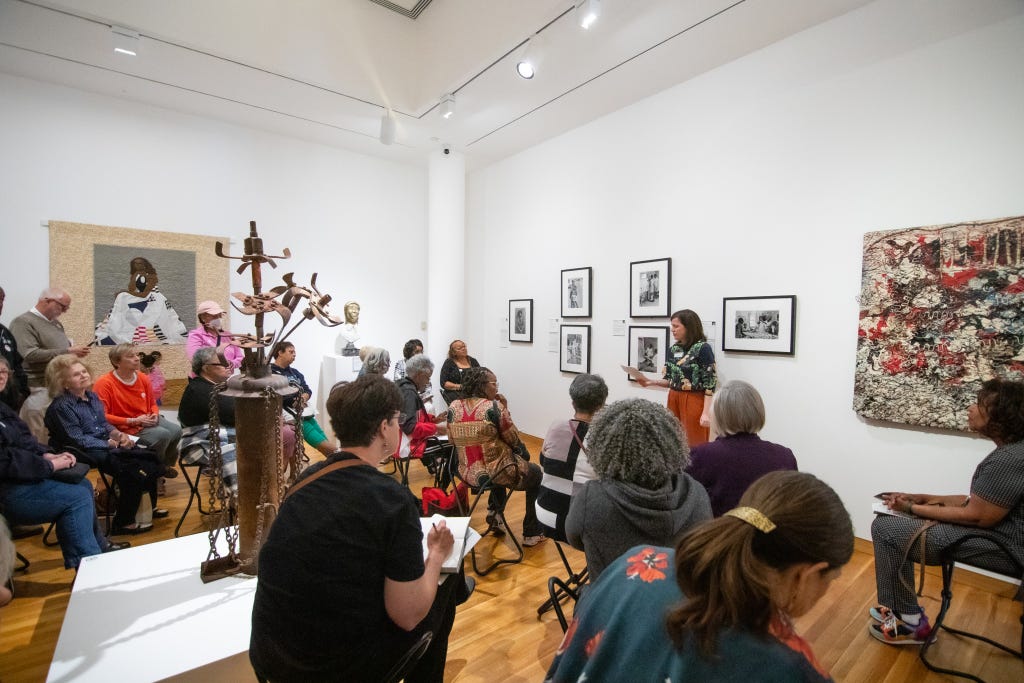
The High Museum of Art depends on its docent volunteers to be the museum’s “face” to visitors, as our curators can’t be everywhere at once! Enter our docents, who create memorable experiences for visitors ranging from toddlers to older adults.
Dedicated to art and education, volunteer docents are the first people many of our visitors see and are essential in creating a meaningful and memorable museum experience. Currently, the High has more than 130 docents who serve the museum and together conduct thousands of tours each year across family, adult, and student audiences.
The High’s docents are passionate about art education and engaging with the public. They share a strong sense of camaraderie and enjoy the personal enrichment that comes with the academic and practical training they receive, the pleasure of sharing their knowledge with others, and the thrill of learning from our visitors.
To share more about their work, I spoke with two of our docents — read more below!
Meet Arlene Glaser and Mallard W. Benton


Left to right: Arlene Glaser and Mallard W. Benton
Question: What made you want to become a docent at the High, and how long have you been volunteering with us?
Arlene: After my retirement from The Coca-Cola Company, I started to regularly attend and volunteer at the High’s programs, including Conversation Pieces and other Creative Aging and Lifelong Learning sessions. Looking to deepen my relationship with the High and continue to learn more about the collection, I decided to apply to the docent program. I hoped that I could leverage my experience making presentations and facilitating training in a corporate setting into delivering impactful tours to support museum programs. I was very lucky to be admitted into the 2023 docent class.
Mallard: I’ve long been interested in art and have made museums a regular port-of-call wherever I’ve traveled. The opportunity to apply to be a docent at the High coincided with my retirement and a major medical procedure my wife had. I led my first tour, for Holy Innocents’ Episcopal School’s high schoolers, in August 2023.
Q: What’s your favorite aspect of being a docent?
Arlene: I serve as a docent and a volunteer in various programs, helping visitors navigate the museum, participate in Creative Aging and Lifelong Learning classes, and enjoy special events. I believe that being a docent makes me a better volunteer and being a volunteer enables me to be a more effective docent. I have helped visitors find works that delight them and engaged them in rich discussion about the art. I also have helped tour participants learn about the diverse programming offered at the High to identify additional opportunities to connect and be enriched at the museum. The opportunity to make these robust connections with the collection, staff, and visitors has been so fulfilling for me.
Mallard: My favorite aspect of being a docent is sharing my appreciation and enjoyment of the High’s collections and exhibitions with middle and high schoolers who don’t know what to expect. I prepare thoroughly with the hope that students will discover new ways to see, interpret, and enter the works of art on our tour. In the tours that I’ve led with adults, I’ve enjoyed being in conversation with them and the art, listening to their previous experiences in this space and gently nudging them to explore more.
Q: Is there a visitor interaction that stood out to you, or perhaps a work of art that guests seem to gravitate toward during tours?
Arlene: I was assigned to lead a member tour of the recent Tyler Mitchell exhibition. At the end of the tour with a very engaged group, one participant shared that she is Tyler Mitchell’s mother. She went on to validate the information shared on the tour and provided additional context about Tyler’s love of coming to the High as a child and his artistic achievements to date. She even took photos with tour participants. During the run of the exhibition, she returned several times and even organized groups, including Jack and Jill of America, to tour Tyler’s works and *Giants: Art from the Dean Collection of Swizz Beatz and Alicia Keys*. I was very honored that she requested that I facilitate these tours and delighted to connect with her regularly over the course of her son’s show.
Mallard: During a tour stop at *Purissima* on an “Animals and Art” tour, one girl in the class of eight students held her ground in asserting that the halo around the goddess’ head was actually the moon and that the small flowers around the moon were stars. She’d taken looking closely to heart and was so insistent. This type of engagement with her peers, the art, and me made this one of my more memorable tours.
Q: How do you continue learning and evolving as a docent?
Arlene: I love engaging with special exhibitions that come to the High. I frequently attend the great lectures with artists and experts that support these exhibitions to gain additional insights and fun facts that can be shared during tours. For the collection, I periodically select works that are new to me, including recent rotations on view, to research and incorporate into my tours. This allows me to keep learning and keeps my tours fresh.
Mallard: The twice monthly training sessions are vital for me, as is the opportunity to interact with other docents during the training. Prior to tours, I not only walk my planned route, but I also sit in the docent lounge and observe others preparing for their tours and ask how they use certain materials. I’m an avid reader of history and biographies and have added art and artists to the mix.
Q: What advice would you give to someone who would like to become a docent?
Arlene: Don’t worry about being an expert in art history. Success as a docent is more about engaging visitors to look closely and find their own meaning in the art. Passion, energy, and comfort facilitating discussions enable great tours and real connections with visitors.
Mallard: I think a prospect should acquaint themselves with the museum that interests them. Learning a bit about the collections, especially areas that are unfamiliar, is important. Finding out what being a docent in that space means — requirements, techniques, rules, areas of focus, even parking — is also key, and I think a docent should want to know how the museum will support their learning and growth.
Q: In one sentence, what does being a docent mean to you?
Arlene: Being a docent is an amazing privilege that allows me to share inspiring art and programs with visitors, collaborate with great people, and continue my own learning and growth.
Mallard: Being a docent has been an opportunity to continue my own learning and grow and share my enthusiasm for art, art making, and artists with others.
Q: What do you hope visitors take away from their experience at the museum?
Arlene: I hope visitors realize that the High is a special place that they want to keep returning to — I have connected with visitors who have decided to join as members and become frequent participants in programs and walk-in tours. Being a part of the development of those relationships between guests and patrons and the museum has been so satisfying!
Mallard: My routine when I’m wrapping up a tour is to summarize what we’ve seen. Sometimes, I ask whether the visitors had favorites and why. Then I mention that while we just saw five to eight works of art, the museum has more than 20,000 works of art in its collection and that while we were in a couple of galleries on one floor of the museum, the High has three buildings and three to four floors in each. I tell them the art rotates, and I invite them to return with their school, family, or friends. I tell them about our free UPS Second Sunday program that takes place each month and that there are lots of activities at the High. What I want most is that the tour has opened a window for them, that it’s planted a seed that makes them want to see more, to know more, and that they view the museum as an attraction to be further explored.
If you’re interested in becoming a docent, keep an eye on our site for docent opportunities.
Stay connected! Follow us: Medium | Instagram | Facebook | Twitter | YouTube
메타데이터
- post_id
- d3d728e1cff9
- slug
- from-passion-to-practice-how-the-highs-docents-enrich-visitor-experiences-d3d728e1cff9
- url
- https://medium.com/high-museum-of-art/from-passion-to-practice-how-the-highs-docents-enrich-visitor-experiences-d3d728e1cff9
- canonical_url
- https://medium.com/high-museum-of-art/from-passion-to-practice-how-the-highs-docents-enrich-visitor-experiences-d3d728e1cff9
- author_url
- https://medium.com/@highmuseumofart
- status
- ok
- fetched_at
- 2026-07-20 00:49:48