Why Your Loan Keeps Getting Rejected (Even With a Good Salary)
Understand why lenders reject loan applications even with a good salary and how to improve approval chances.
Loan Rejection
Why Your Loan Keeps Getting Rejected (Even With a Good Salary)
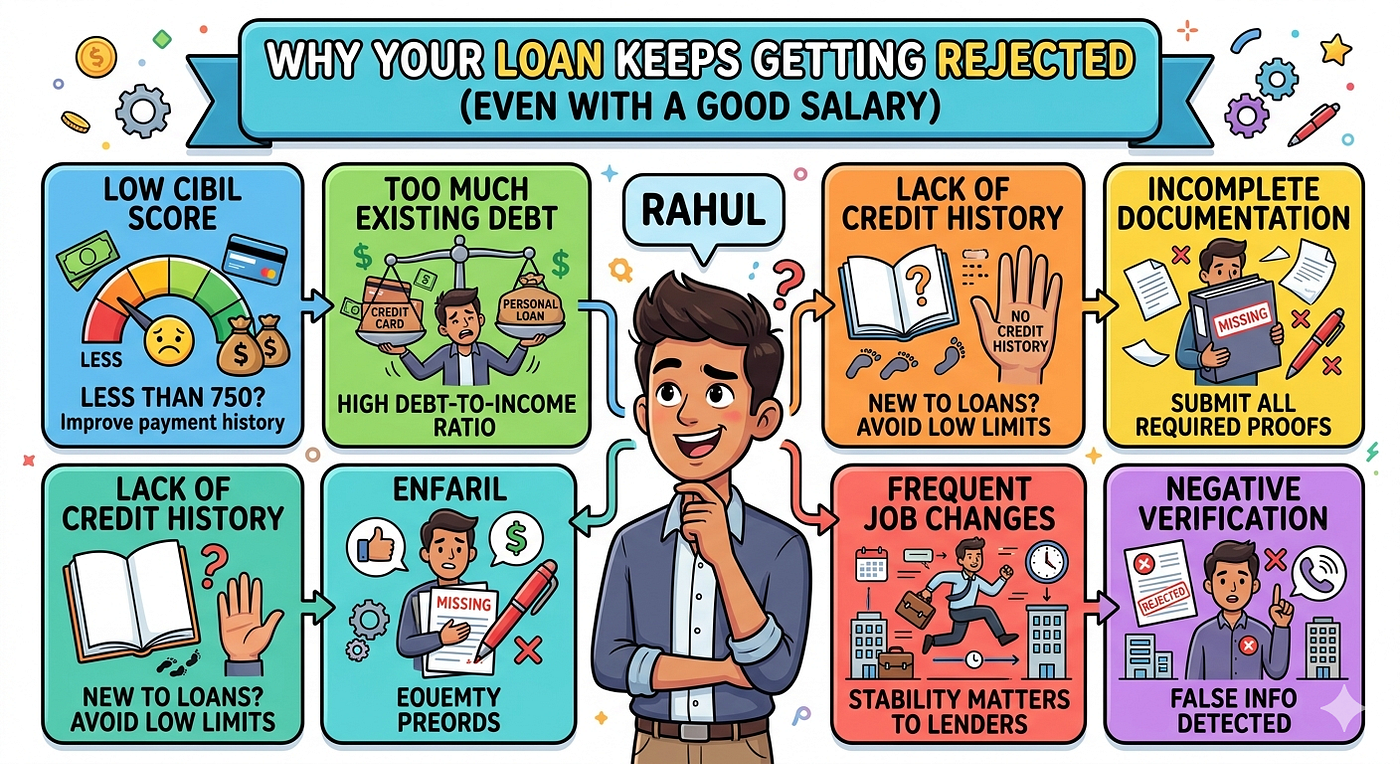
This image is generated through AI
In the financial market, a good salary helps you a lot, but it does not guarantee approval for a Personal Loan. Lenders do not approve a loan just because your monthly income looks healthy on paper. Most major lenders look at your full risk profile: credit score, repayment history, existing EMIs, employer category, job stability, banking behaviour, and even how many times you have applied for credit.
It does not matter if you are earning ₹5,00,000 or ₹55,000, you can easily get rejected if you are not found eligible. In India, lenders have become more selective after stress rose in unsecured retail credit. You just need to understand that rejection is often not about income alone; it is about whether your overall profile fits the lender’s internal model.
Is Your Salary Lower Than Your FOIR?
I know most don’t know what FOIR means, so I will explain to you. In simple words, FOIR means Fixed Obligation to Income Ratio. FOIR refers to the share of your monthly income already committed to EMIs and fixed repayments.
Just imagine your take-home salary is ₹90,000. You already pay ₹18,000 on a car loan, ₹12,000 on a credit card EMI, and ₹8,000 on a consumer durable loan.
This means your fixed obligations are ₹38,000 which is equal to FOIR of 42.2%. Now if the new Personal Loan EMI is estimated at ₹17,000, your total obligation rises to ₹55,000 and your FOIR jumps to 61.1%.
Many lenders prefer this ratio to stay below 45% to 55%, depending on income band and employer profile. So even with a “good salary,” the loan can fail because too much of that salary is already spoken for.
CIBIL Score Hide Credit Problems,
Most of the time, CIBIL score can be the villain in your story. Yes, a 750+ score looks impressive, but lenders do not approve a Personal Loan based only on the score shown on an app.
Most lenders like reading the entire credit report instead of just looking at the numbers. A 30-day delay, a “settled” credit card account, too many unsecured loans, or an old loan still showing as active can trigger rejection too. Let’s understand this with an example:
Imagine someone with a 772 score who had one credit card settled for ₹28,000 instead of fully repaid. That settlement tells the lender that a past lender accepted less than the full dues, and that is a red flag even if the current score still looks decent.
Lenders in India increasingly focus on prime borrowers with a strong repayment track record, not just a decent score. So the score may open the door, but the report decides whether you are allowed in.
Job Profile Matter,
In most of the cases, the job profile of an individual plays an important role in rejection or approval of loan, even more than credit history. Lenders don’t just look at the numbers and accept your salary slip.
Most organisations often ask “Where did you earn that money from?” If you work for a listed company, a government body, a large MNC, or a well-known employer with stable salary credits, your approval odds improve. However, if you work in a very small firm, a new startup, or a company not on the lender’s approved employer list, your application can be rejected despite a solid salary.
People on Reddit mentioned that this process is followed by most major lender institutions and is infact unfair. They also mentioned that this is not acceptable as the lender is trying to assess income continuity.
What To Do Before Applying For A Loan?
The first step a person needs to follow is fixing the basics before sending another application.
Pull your latest credit report, not just the score, and check for errors, active old loans, or “settled” tags. The most important part? Take help from platforms like LoansJagat to help you compare offers across lenders instead of blindly applying to one bank after another.
This is important because the wrong lender can reject a decent borrower, while the right lender may approve the same profile at a more reasonable rate.
Ending Thoughts
At the end of the day, loan rejection does feel personal sometimes. It can be more frustrating than failing in your end semester exams. But most of the time it is really a profile-matching problem, a documentation issue, or a debt-ratio problem in a dramatic costume. Here your salary is only one chapter of the story; lenders read the whole book.
If your Personal Loan was rejected, don’t panic-apply out of frustration. Before you move forward with your application try to clean up the report, reduce obligations, verify your documents, and choose the lender more carefully. Well, don’t think of it like “I failed” and more like “I knocked on the wrong door with the wrong file at the wrong moment.
A Message from InsiderFinance

Thanks for being a part of our community! Before you go:
- 👏 Clap for the story and follow the author 👉
- 📰 View more content in the InsiderFinance Wire
- 📚 Take our FREE Masterclass
- 📈 Discover Powerful Trading Tools
메타데이터
- post_id
- d3ddeaf41a06
- slug
- why-your-loan-keeps-getting-rejected-even-with-a-good-salary-d3ddeaf41a06
- url
- https://wire.insiderfinance.io/why-your-loan-keeps-getting-rejected-even-with-a-good-salary-d3ddeaf41a06
- canonical_url
- https://wire.insiderfinance.io/why-your-loan-keeps-getting-rejected-even-with-a-good-salary-d3ddeaf41a06
- author_url
- https://medium.com/@loansjagat.com
- status
- ok
- fetched_at
- 2026-07-24 00:18:42