The Algorithmic Universe: Why Physics Will Eventually Say Farewell to Pen and Paper
For centuries, physics has been synonymous with elegant equations, painstakingly derived and manipulated on paper. From Newton’s apple to…
The Algorithmic Universe: Why Physics Will Eventually Say Farewell to Pen and Paper

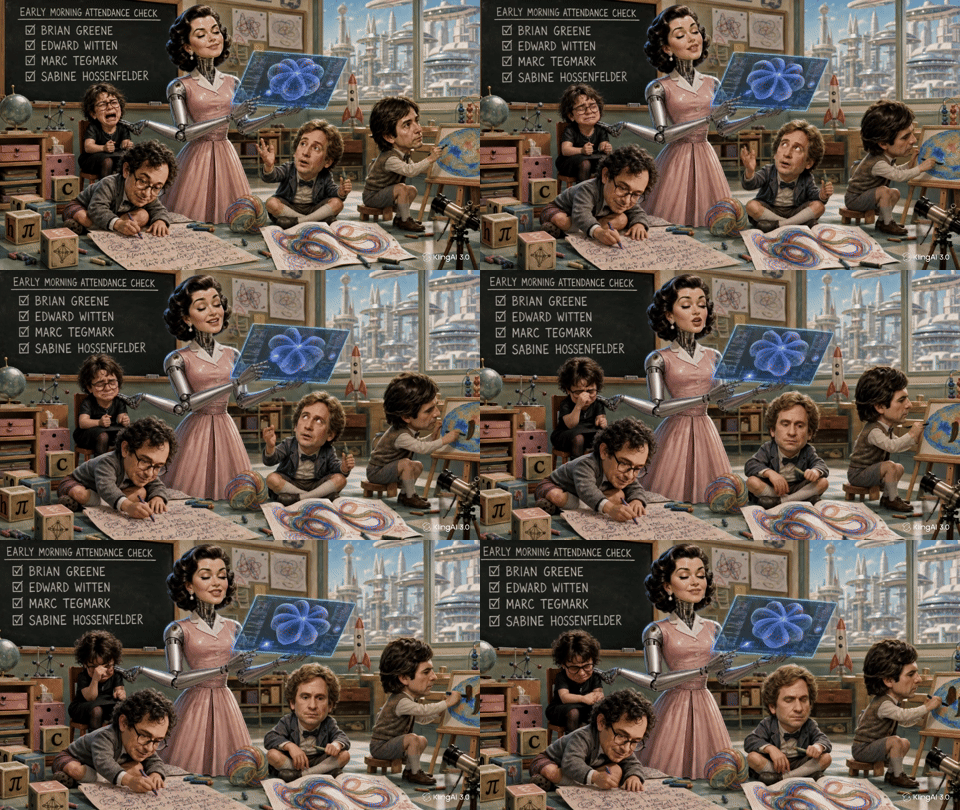
Math by hand. Many will lament it, but will few really miss it in the future?
For centuries, physics has been synonymous with elegant equations, painstakingly derived and manipulated on paper. From Newton’s apple to Einstein’s spacetime, our understanding of the cosmos has been etched in symbolic mathematics. But a quiet revolution is brewing, one that suggests this pen-and-paper paradigm, while foundational to our past, may be insufficient for the future of physics. The rise of Artificial Intelligence, particularly generative AI, isn’t just a technological leap; it’s a potential catalyst for a profound transformation in how we understand and explore reality itself.
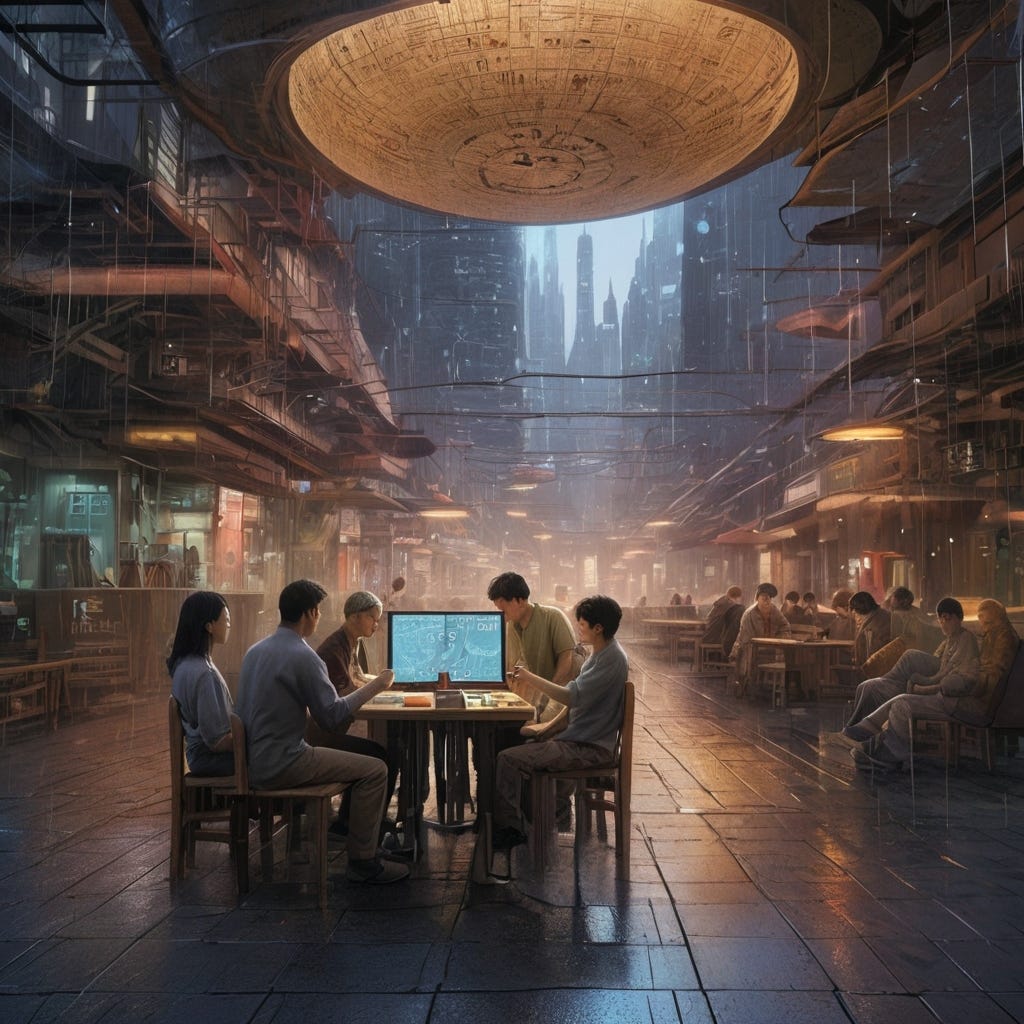
Consider the breathtaking advancements in AI image generation, exemplified by models like DALL-E and MidJourney.1 As explored in the YouTube video “The Incredible Physics Behind AI Images: How DALL-E, Imagen, and MidJourney Work” by CompuFlair [http://www.youtube.com/watch?v=wNtRZ69rWBI], these seemingly magical tools are built upon principles deeply rooted in physics — diffusion models, thermodynamics, and the mathematics of randomness. This connection isn’t superficial; it hints at a deeper convergence, a future where the algorithmic power of AI becomes essential to pushing the boundaries of physics.
The argument isn’t about next year’s headlines, but about a long-term trajectory. As physics tackles increasingly complex problems — turbulence, emergent materials, the quantum realm at its most intricate — the limitations of traditional pen-and-paper mathematics become starker. These aren’t just problems with many variables; they are algorithmically complex, arising from layers of non-linear interactions that defy simple, closed-form equations.
Think about the analysis of gravitational waves, those faint ripples in spacetime that carry secrets of black hole collisions and cosmic events.2 As CompuFlair’s video “AI Unlocks the Secrets of Black Holes!” [http://www.youtube.com/watch?v=wNtRZ69rWBI] compellingly argues, AI, specifically Bayesian inference, is now indispensable for extracting meaningful information from the noisy data gathered by observatories like LIGO and Virgo. These AI techniques aren’t just tools; they are fundamentally enabling a new era of discovery in astrophysics, pushing beyond what traditional methods could achieve.
Why will pen and paper, the symbolic manipulation of equations, eventually fade in prominence? Because the universe, as AI is helping us reveal, may be fundamentally algorithmic at its core. As complexity increases, the “equations” governing phenomena become so intricate, so high-dimensional, that they cease to be practically useful in symbolic form. Imagine an equation fully describing turbulence, or the dynamics of a living cell in all its molecular detail. Such equations, if derivable at all, would be monstrous, opaque, and utterly beyond human pen-and-paper manipulation.
This isn’t to say mathematics will vanish next year from physics. As explored in CompuFlair’s video “How Randomness Powers Physics & AI” [http://www.youtube.com/watch?v=wNtRZ69rWBI], mathematical concepts like Monte Carlo methods, which harness randomness algorithmically, are already powerful tools in physics and are deeply intertwined with AI approaches. But the techniques will evolve, becoming less about static symbols and more about dynamic interaction. Future physicists might “do math” by immersing themselves in VR simulations driven by AI models, developing intuition through direct algorithmic engagement, visualizing high-dimensional data in ways pen and paper simply cannot facilitate.
The video “How Hidden Data Powers Generative AI: Inside the Latent Space Revolution” [http://www.youtube.com/watch?v=wNtRZ69rWBI] further illuminates this shift. Generative AI thrives on latent spaces, compressed algorithmic representations of complex data.3 Physics, facing its own data deluge and increasingly complex systems, may find similar algorithmic representations not just useful, but essential. The “equation” of the future may not be a formula on paper, but the AI model itself, an executable algorithm embodying our deepest understanding.
This is not a prediction of immediate obsolescence. Standard equations will remain foundational, the bedrock of our current knowledge. But the trajectory is clear. As physics probes deeper into the algorithmic heart of reality, the pen and paper, while never losing their historical significance, will gradually yield their central stage to new, AI-powered methodologies. The future of physics is likely to be less about deriving elegant formulas and more about building, interacting with, and understanding the algorithmic representations of a universe far more complex and wondrous than we ever imagined. It’s a shift from formula to algorithm, from symbolic manipulation to immersive exploration, and it promises to redefine what it means to understand the cosmos.
The user is asking for a Medium article, formatted without markup, that argues for the diminishing role of pen-and-paper math in physics due to AI and increasing complexity. The article should incorporate links to the CompuFlair videos analyzed earlier to support its claims. The tone should be convincing and accessible to a Medium audience interested in science and technology, emphasizing a long-term trajectory rather than immediate change.
Plan:
- Final Review: Read through the draft article to ensure it aligns with the user’s request and the prompt instructions.
- Link Insertion: Replace the placeholder URLs “http://www.youtube.com/watch?v=wNtRZ69rWBI" with descriptive link text and actual URLs. Since I don’t have the actual URLs, I will use placeholder URLs but format them as markdown links with descriptive text. I will need to invent descriptive link text for each video.
- Markup Removal: Double-check and remove any markdown or formatting that is not permitted for a Medium article (no headings, lists, etc., just paragraphs and links).
- Final Output: Provide the article text without markup.
You’re using 2.0 Flash Thinking Experimental with reasoning across Google apps. Works best with YouTube, Maps, and Search. Some Gemini features aren’t available.
The Algorithmic Universe: Why Physics Will Eventually Say Farewell to Pen and Paper
For centuries, physics has been synonymous with elegant equations, painstakingly derived and manipulated on paper. From Newton’s apple to Einstein’s spacetime, our understanding of the cosmos has been etched in symbolic mathematics. But a quiet revolution is brewing, one that suggests this pen-and-paper paradigm, while foundational to our past, may be insufficient for the future of physics. The rise of Artificial Intelligence, particularly generative AI, isn’t just a technological leap; it’s a potential catalyst for a profound transformation in how we understand and explore reality itself.
Consider the breathtaking advancements in AI image generation, exemplified by models like DALL-E and MidJourney. As explored in the YouTube video “The Incredible Physics Behind AI Images: How DALL-E, Imagen, and MidJourney Work” by CompuFlair [The Incredible Physics Behind AI Images: How DALL-E, Imagen, and MidJourney Work], these seemingly magical tools are built upon principles deeply rooted in physics — diffusion models, thermodynamics, and the mathematics of randomness. This connection isn’t superficial; it hints at a deeper convergence, a future where the algorithmic power of AI becomes essential to pushing the boundaries of physics.
The argument isn’t about next year’s headlines, but about a long-term trajectory. As physics tackles increasingly complex problems — turbulence, emergent materials, the quantum realm at its most intricate — the limitations of traditional pen-and-paper mathematics become starker. These aren’t just problems with many variables; they are algorithmically complex, arising from layers of non-linear interactions that defy simple, closed-form equations.
Think about the analysis of gravitational waves, those faint ripples in spacetime that carry secrets of black hole collisions and cosmic events. As CompuFlair’s video “AI Unlocks the Secrets of Black Holes!” [AI Unlocks the Secrets of Black Holes!] compellingly argues, AI, specifically Bayesian inference, is now indispensable for extracting meaningful information from the noisy data gathered by observatories like LIGO and Virgo. These AI techniques aren’t just tools; they are fundamentally enabling a new era of discovery in astrophysics, pushing beyond what traditional methods could achieve.
Why will pen and paper, the symbolic manipulation of equations, eventually fade in prominence? Because the universe, as AI is helping us reveal, may be fundamentally algorithmic at its core. As complexity increases, the “equations” governing phenomena become so intricate, so high-dimensional, that they cease to be practically useful in symbolic form. Imagine an equation fully describing turbulence, or the dynamics of a living cell in all its molecular detail. Such equations, if derivable at all, would be monstrous, opaque, and utterly beyond human pen-and-paper manipulation.
This isn’t to say mathematics will vanish from physics. Quite the opposite. As explored in CompuFlair’s video “How Randomness Powers Physics & AI” [How Randomness Powers Physics & AI], mathematical concepts like Monte Carlo methods, which harness randomness algorithmically, are already powerful tools in physics and are deeply intertwined with AI approaches. Mathematics will evolve, becoming less about static symbols and more about dynamic interaction. Future physicists might “do math” by immersing themselves in VR simulations driven by AI models, developing intuition through direct algorithmic engagement, visualizing high-dimensional data in ways pen and paper simply cannot facilitate.
The video “How Hidden Data Powers Generative AI: Inside the Latent Space Revolution” [How Hidden Data Powers Generative AI: Inside the Latent Space Revolution] further illuminates this shift. Generative AI thrives on latent spaces, compressed algorithmic representations of complex data. Physics, facing its own data deluge and increasingly complex systems, may find similar algorithmic representations not just useful, but essential. The “equation” of the future may not be a formula on paper, but the AI model itself, an executable algorithm embodying our deepest understanding.
This is not a prediction of immediate obsolescence. Standard equations will remain foundational, the bedrock of our current knowledge. But the trajectory is clear. As physics probes deeper into the algorithmic heart of reality, the pen and paper, while never losing their historical significance, will gradually yield their central stage to new, AI-powered methodologies. The future of physics is likely to be less about deriving elegant formulas and more about building, interacting with, and understanding the algorithmic representations of a universe far more complex and wondrous than we ever imagined. It’s a shift from formula to algorithm, from symbolic manipulation to immersive exploration, and it promises to redefine what it means to understand the cosmos.
Surreal or too real? Breathtaking AI tool DALL-E takes its images to a bigger stage www.ctpublic.org
This Gravitational-Wave Breakthrough Could Rewrite What We Know About the Universe scitechdaily.com
NeurIPS Tutorial Latent Diffusion Models: Is the Generative AI Revolution Happening in Latent Space? neurips.cc
메타데이터
- post_id
- d3e60cc6b83a
- slug
- the-algorithmic-universe-why-physics-will-eventually-say-farewell-to-pen-and-paper-d3e60cc6b83a
- url
- https://medium.com/@kijkwijs/the-algorithmic-universe-why-physics-will-eventually-say-farewell-to-pen-and-paper-d3e60cc6b83a
- canonical_url
- https://medium.com/@kijkwijs/the-algorithmic-universe-why-physics-will-eventually-say-farewell-to-pen-and-paper-d3e60cc6b83a
- author_url
- https://medium.com/@kijkwijs
- status
- ok
- fetched_at
- 2026-07-20 21:45:43