The Limits of Automation in Hotels and Restaurants: Guests Want Speed, But Not a Soulless…
Automation is entering hospitality from every direction.
The Limits of Automation in Hotels and Restaurants: Guests Want Speed, But Not a Soulless Experience
Automation is entering hospitality from every direction.
QR menus. Self-ordering kiosks. AI chatbots. Voice ordering. Robot waiters. Smart kitchens. Delivery robots. Automated hotel check-in. Even 3D food printers.
The promise sounds attractive: faster service, lower labor pressure, fewer mistakes, and more predictable operations.
But hospitality has one important difference from many other industries:
A hotel or restaurant is not only a transaction. It is a social experience.
Guests do not visit a restaurant only to receive calories. They do not stay in a hotel only to receive a room key. They also expect attention, confidence, help, atmosphere, trust, and sometimes simple human contact.
That means the real question is not:
How much can we automate?
The better question is:
Which parts of hospitality should be automated — and which parts should stay human?
Research on hospitality technology points in this direction. Customer acceptance of automation depends on usefulness, ease of use, trust, perceived risk, service context, and whether the guest still has access to human help when needed. For example, a 2021 hotel self-service technology study found that preferences are shaped by environment, organization, service encounter type, and customer experience — not by technology alone. (ScienceDirect)
The Automation Ladder in Hospitality
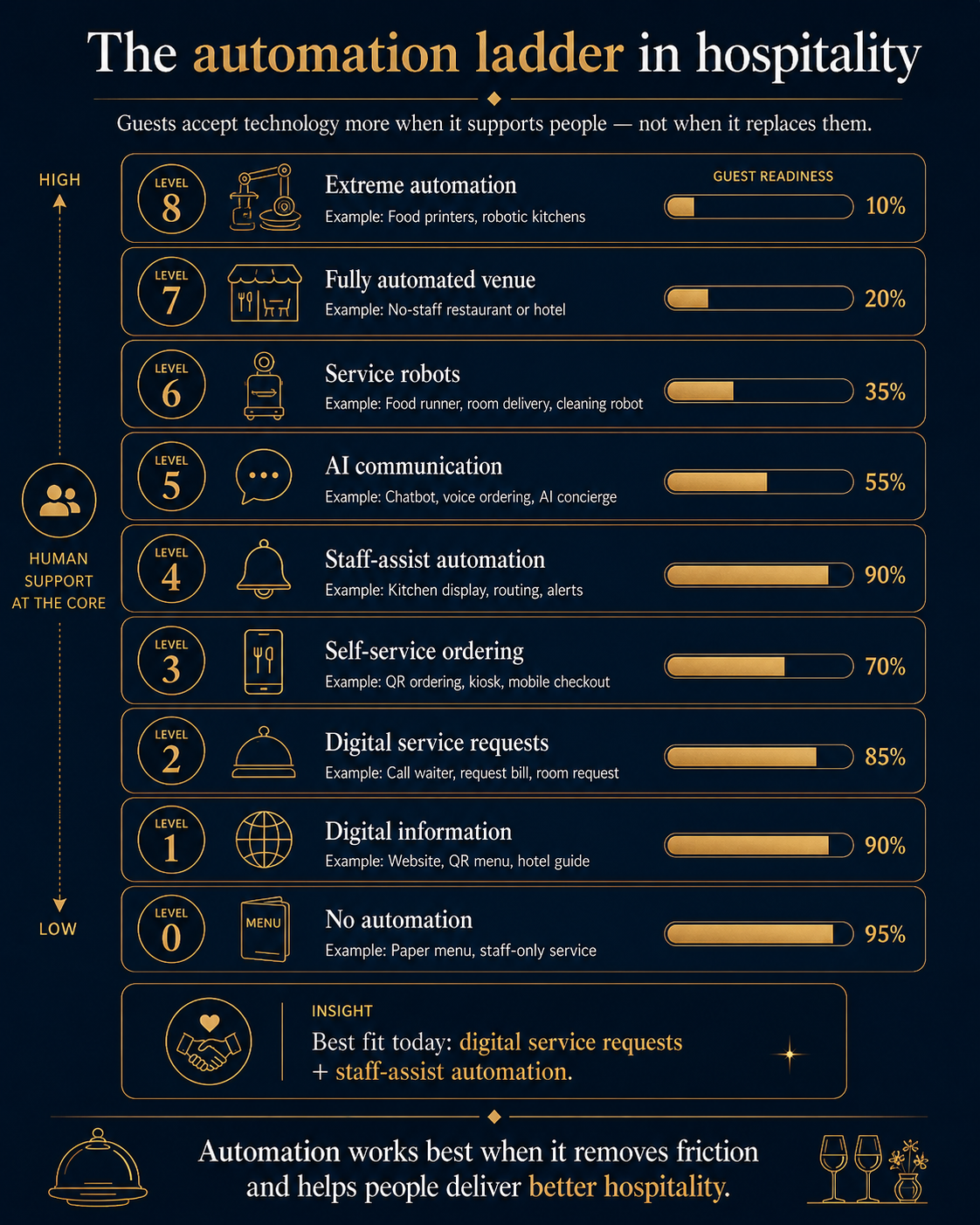
A useful way to think about automation is as a ladder.
Each level adds more technology, but also changes the guest experience.
Level 1 — Digital information Examples: website, QR menu, hotel guide. This is usually the easiest and lowest-risk starting point. Guests get information faster, while staff still control the service experience. Level 2 — Digital service requests Examples: call waiter, request bill, room request. This is often a strong fit because it improves access to staff without removing staff from the process. Level 3 — Self-service ordering Examples: QR ordering, kiosk, mobile checkout. Useful for routine and speed-driven service, especially when guests already know what they want. Level 4 — Staff-assist systems Examples: kitchen display, request queue, alerts. This is often the most valuable layer. It supports people, reduces missed requests, and helps teams coordinate better. Level 5 — AI communication Examples: chatbot, voice ordering, AI concierge. AI can be useful for repetitive questions, menu explanations, and basic guidance. It is weaker when the situation is emotional, unusual, or requires human judgment. Level 6 — Service robots Examples: food runner, room delivery robot, cleaning robot. Robots are usually better as support tools than as full replacements. They can handle repetitive movement, but people still manage exceptions and guest experience. Level 7 — Fully automated venue Examples: no-staff restaurant or hotel format. This is a niche model. It can work in highly standardized contexts, but it is not suitable for every hospitality business. Level 8 — Extreme automation Examples: food printers, robotic kitchens. These are specialized use cases. Interesting, but not yet mainstream for most restaurants, cafés, bars, or hotels.
The pattern is simple:
The more automation supports humans, the easier it is for guests to accept. The more automation replaces humans, the more resistance appears.
Level 0–1: Basic Digitalization Is Already Normal
Most guests are comfortable with basic digital tools.
A restaurant website, online menu, QR menu, booking link, or digital hotel guide does not feel strange anymore. This type of automation does not remove service. It simply makes information easier to access.
At this level, customer readiness is high because the guest remains in control. They can still ask a person if needed.
This is why basic digitalization is a safe starting point for restaurants, cafés, hotels, guest houses, bars, and event venues.
It does not change the meaning of hospitality. It only improves access to information.
Level 2: Digital Service Requests Are the Sweet Spot
Digital service requests are one of the most practical automation layers in hospitality.
They do not replace staff. They help staff see demand.
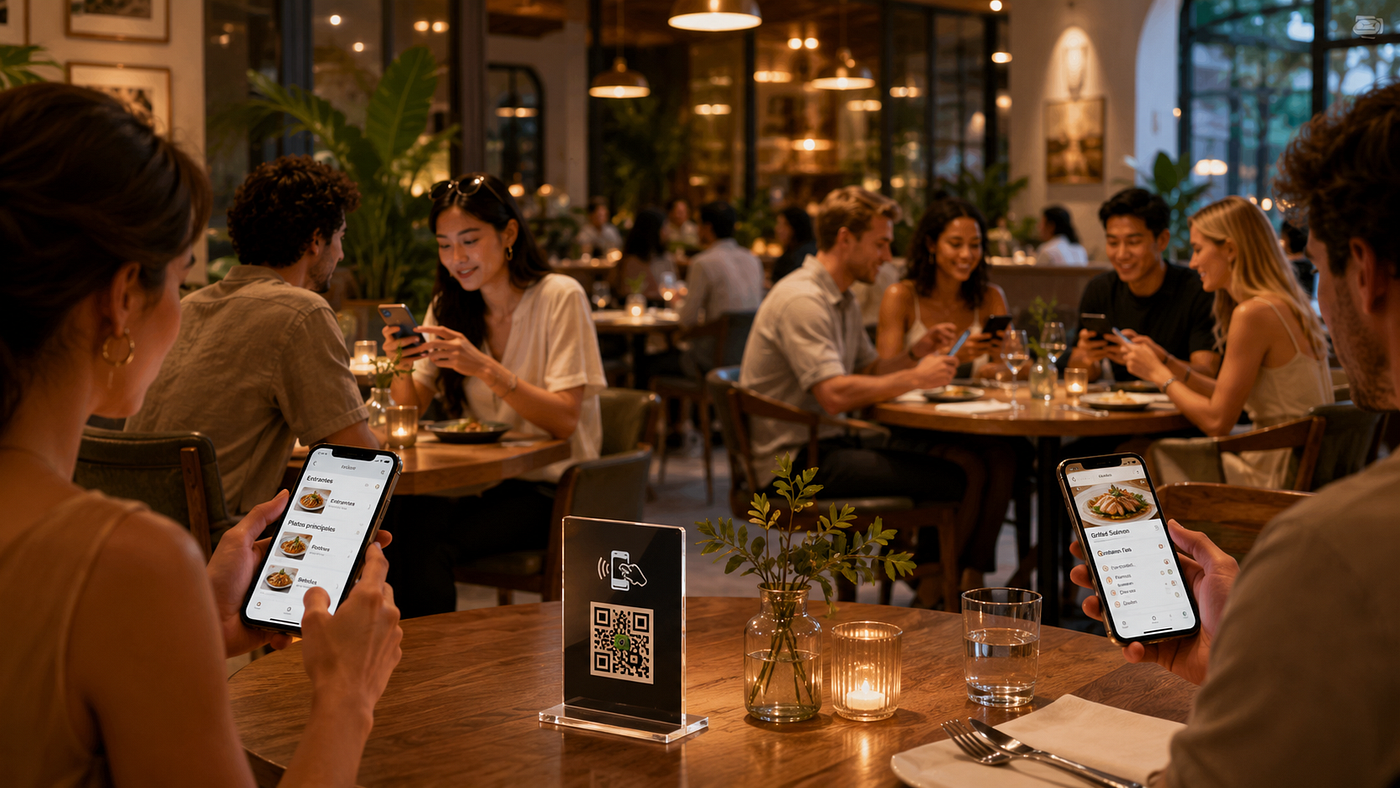
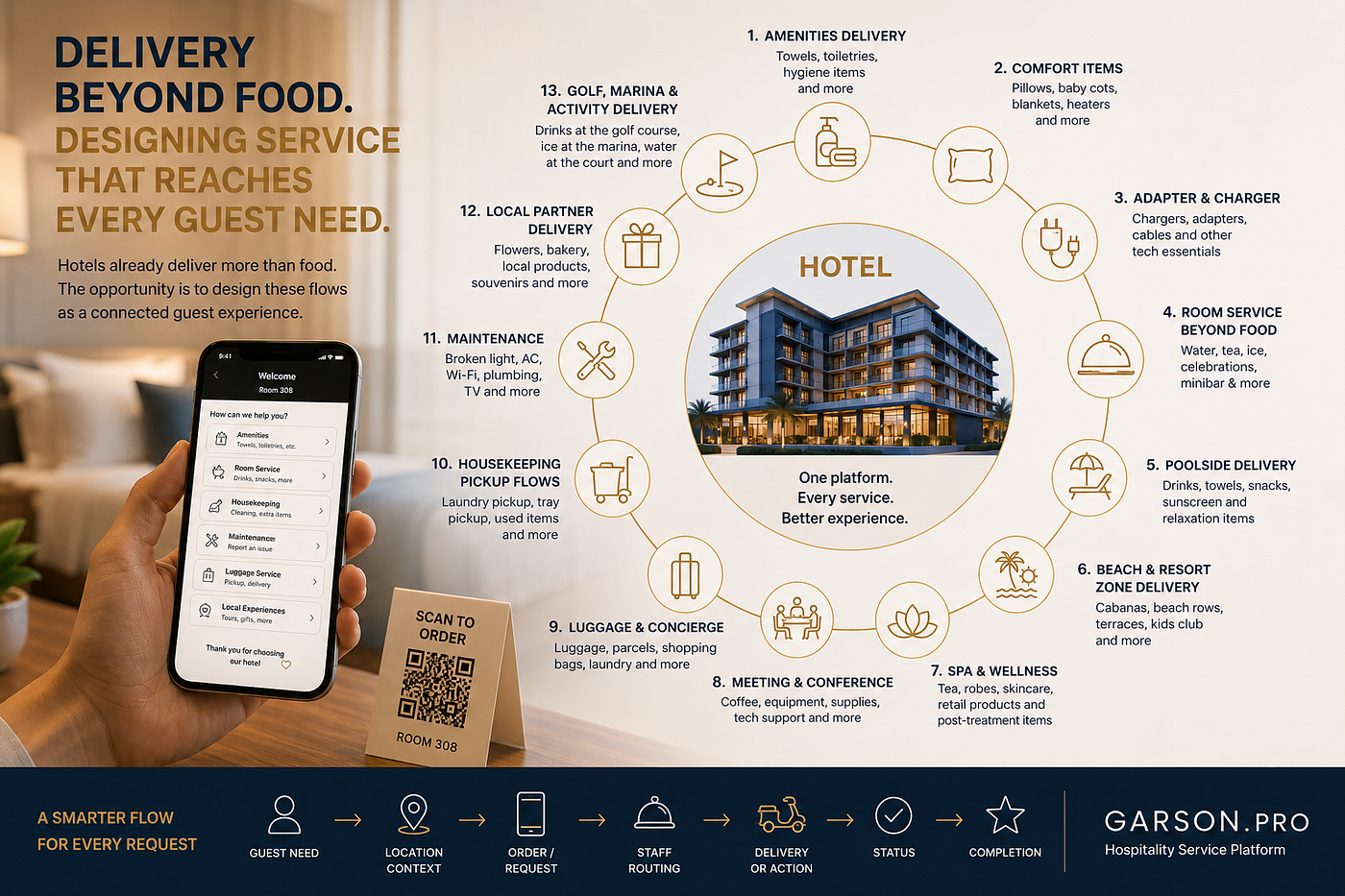
A guest can scan a QR code or tap an NFC token and request:
- call waiter
- request bill
- ask for more drinks
- request room cleaning
- ask for towels
- report an issue
- request help at a table, room, terrace, pool, or conference area
This solves one of the biggest operational problems in hospitality: invisible waiting.
Staff may be working hard, but they do not always know who is waiting, where the guest is, or what the guest needs. A digital request turns hidden demand into a visible queue.
This type of automation is easier to accept because it does not remove the human layer. It improves access to it.
The guest does not think, “I am being served by a machine.”
The guest thinks, “Now they know I need help.”
Level 3: Self-Service Ordering Works — But Not Everywhere
Self-service ordering can work very well in quick-service restaurants, food courts, hotels, delivery-focused restaurants, casual cafés, and high-volume venues.
But it is not equally suitable everywhere.
In a fast lunch café, guests may appreciate speed. In a fine dining restaurant, forcing guests to order everything through a screen can feel like cost-cutting. In a hotel lobby, self-check-in may be convenient for a business traveler arriving late, but frustrating for an elderly guest who needs help.
This is why self-service automation must be matched to the service context.
The research base supports this. Self-service technology adoption is not only about whether the tool exists. It depends on customer experience, service encounter type, environment, and organizational context. (ScienceDirect)
The same guest may love self-ordering at lunch and dislike it during an anniversary dinner.
Automation acceptance is situational.
Level 4: Staff-Assist Automation Is Often the Best Investment
Some of the best automation is almost invisible to guests.
Examples include:
- kitchen display systems
- table status dashboards
- order routing
- preparation timers
- stock alerts
- smart staff notifications
- delivery zone calculation
- automatic bill splitting
- real-time request queues
- AI-assisted staff recommendations
This type of automation improves service without asking guests to change much.
Guests do not need to “accept” a kitchen display system. They simply receive food faster. They do not need to understand a request queue. They simply get help sooner.
This is why staff-assist automation is often the strongest investment for hospitality businesses.
It helps people serve better.
It reduces confusion, missed requests, repeated questions, and operational noise. But it keeps humans in the experience.
This is also where hospitality technology should focus first: not on replacing service, but on making service visible, measurable, and easier to coordinate.
Level 5: AI Communication Is Useful, But Needs an Escape Button
AI chatbots and voice assistants can be useful for repetitive questions:
- What time is breakfast?
- Do you have parking?
- Is the kitchen open?
- Can I book a table?
- Do you have vegan options?
- Can I change my reservation?
- What is the Wi-Fi password?
For these cases, AI can reduce staff interruptions and give guests fast answers.
But AI becomes risky when it blocks access to a person.
A guest may accept AI for simple information. But when there is a complaint, allergy, payment issue, lost item, urgent request, emotional situation, or special occasion, they usually want a human.
Restaurant consumer data supports this caution. PAR Technology’s 2025 consumer preference data reported that 60% of surveyed consumers preferred human staff over AI-managed customer support. The same release reported that 44% favored a balance of human staff and some technology, while 41% preferred no AI use at all in the dining experience. The largest concerns were job loss and loss of human connection or atmosphere. (PAR Technology)
So the practical rule is clear:
Use AI for repetitive questions. Keep a clear path to human help.
AI should not become a locked door between the guest and the staff.
Level 6: Robots Are Interesting, But Not a Universal Solution
Service robots attract attention.
They are visible. They are memorable. They are good for marketing. They can be useful for repetitive transport tasks such as room delivery, carrying items, cleaning, or simple table running.
But robots also create new problems.
They can be slow in complex environments. They may struggle with exceptions. They require maintenance. They need integration with real operations. Staff still need to handle edge cases. Some guests enjoy the novelty; others see it as cold or unnecessary.
Research on service robots in restaurants shows that acceptance depends on perceived usefulness, perceived ease of use, trust, perceived risk, and satisfaction. A study on robot restaurants found that perceived usefulness directly influenced consumers’ revisit intention, while perceived ease of use had an indirect effect. (MDPI)
This matters because it means robots are not accepted just because they are futuristic. They must actually improve the service.
In hotels, robot acceptance also depends on risk perception and information security. A 2024 study specifically investigated how perceived risk and information security affect customers’ intentions to use service robots in hotels. (ScienceDirect)
There is also an important context effect. Research on robot-staffed hotels found that people viewed robot-staffed hotels more positively when COVID-19 risk was made salient. (Scripties)
That tells us something important:
Guests may prefer robots when they want distance, hygiene, or speed.
But they may prefer people when they want care, empathy, trust, or atmosphere.
Level 7: Fully Automated Restaurants and Hotels Are a Niche
The idea of a fully automated venue sounds attractive on a spreadsheet.
No staff shortages. No sick days. No training problems. No emotional conflicts. No scheduling issues.
But real hospitality is full of exceptions.
Guests arrive early. Flights are delayed. Children spill drinks. Allergies need explanation. A card payment fails. A customer is angry. A couple wants a special evening. A business traveler needs urgent help. An elderly guest cannot use the app. A tourist does not understand the local language.
Hospitality is not a clean workflow. It is a constant stream of edge cases.
Fully automated models can work in narrow formats:
- vending-style food
- late-night unmanned stores
- capsule hotels
- budget self-check-in
- airport quick service
- standardized takeaway concepts
- limited-menu robotic kitchens
But they are not a universal model for restaurants and hotels.
The research base does not support a simple “replace people with machines” story. It supports a more careful model: automate routine, low-risk, repetitive tasks, and keep humans available for complex, emotional, trust-based, or exception-heavy situations.
Level 8: Food Printers and Extreme Automation Are Corner Cases
Food printers are fascinating.
They may be useful in space missions, military logistics, medical nutrition, personalized diets, or controlled environments where shelf life, storage, and nutrition constraints are extreme.
NASA-related work has explored 3D food printing for long-duration space missions. NASA Spinoff describes a concept where a 3D printer could deliver starch, protein, and fat, while micronutrients, flavor, and aroma could be added separately. (NASA Spinoff) NASA TechPort also describes a 3D printed food system for long-duration missions beyond low Earth orbit, with goals including hot, quick food and personalized nutrition, flavor, and taste. (NASA TechPort)
A 2024 review on 3D printing for space food applications argues that food 3D printing may help with challenges such as shelf life, variety, personalization, and customized diets in space exploration missions. (ScienceDirect)
But this does not mean normal restaurant guests are waiting for printed dinner.
In most restaurants, food is not only nutrition. It is craft, smell, timing, tradition, presentation, and trust.
A food printer may solve a space mission problem.
It does not automatically solve a hospitality problem.
Extreme automation has a place. But it is a corner case, not the mainstream future of restaurants and hotels.
What Guests Actually Expect
Most guests do not hate technology.
They hate bad service.
They hate waiting without information. They hate repeating the same request. They hate being ignored. They hate downloading unnecessary apps. They hate chatbots that cannot solve the problem. They hate technology that feels like the venue is pushing work onto the customer.
But they usually appreciate technology when it gives them:
- faster help
- easier ordering
- clear status
- fewer mistakes
- better communication
- more control
- access to a human when needed
This is the line hospitality businesses must respect.
Automation should reduce friction, not remove hospitality.
The Best Model Is Not Human vs Automation
The future of hospitality is not a battle between humans and machines.
The best model is:
Automation for repetitive tasks. Humans for care, judgment, trust, and emotion.
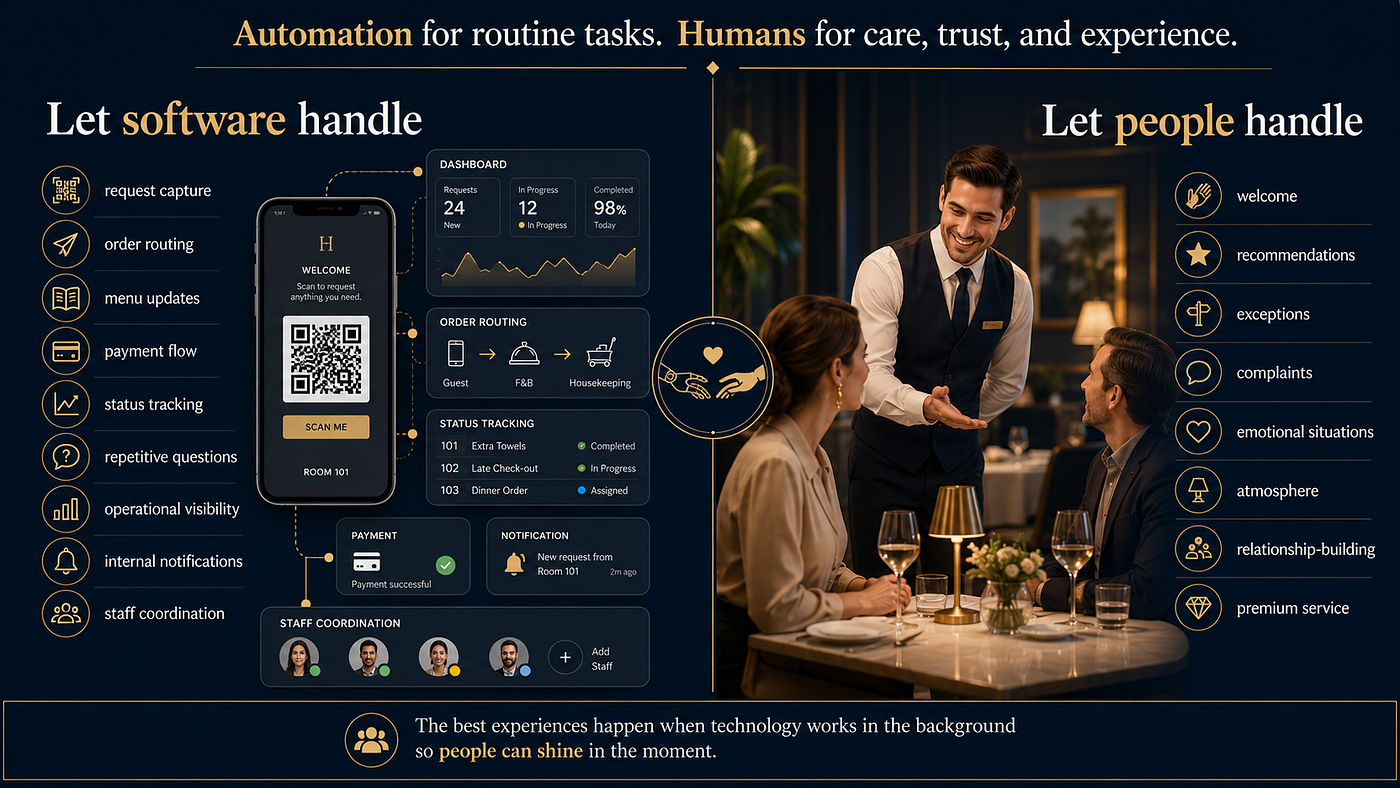
Let software handle:
- request capture
- order routing
- menu updates
- payment flow
- status tracking
- repetitive questions
- operational visibility
- internal notifications
- staff coordination
Let people handle:
- welcome
- recommendations
- exceptions
- complaints
- emotional situations
- atmosphere
- relationship-building
- premium service
This is where automation creates value without damaging the guest experience.
Why Human Service Will Not Disappear
There will always be demand for human service because hospitality covers a basic human need: communication.
A restaurant is not only a food delivery point.
A hotel is not only a sleeping container.
People go out because they want to feel served, seen, welcomed, helped, and sometimes remembered.
This is why extreme automation will remain limited. It may work for airports, space missions, vending formats, low-cost standardized concepts, and very specific operational models. But hotels and restaurants that build loyalty usually need more than efficiency.
They need people.
The strongest hospitality technology will not be the one that replaces staff completely.
It will be the one that helps good staff serve more guests with less stress.
Conclusion
Automation in hotels and restaurants has limits.
Digital menus, service requests, staff dashboards, smart routing, and simple AI helpers can improve operations today. Robots and food printers may have useful niches, but they are not the center of mainstream hospitality.
The research base points to a clear pattern: hospitality automation works best when it removes friction, saves time, and supports staff. It becomes risky when it removes human connection, blocks access to help, or turns hospitality into a cold transaction.
The real opportunity is not to automate everything.
The real opportunity is to automate the right things.
Because guests want speed, clarity, and convenience.
But they still want hospitality to feel human.
References
Liu, C., & Hung, K. “A multilevel study on preferences for self-service technology versus human staff: Insights from hotels in China.” International Journal of Hospitality Management, 2021. (ScienceDirect)
Seo, K. H. “The Emergence of Service Robots at Restaurants.” Sustainability, 2021. (MDPI)
Pizam, A. et al. “The role of perceived risk and information security on customers’ intentions to use service robots in hotels.” International Journal of Hospitality Management, 2024. (ScienceDirect)
PAR Technology. “New Data Reveals the Automation Features Guests Crave Most in Restaurants.” 2025. (PAR Technology)
NASA Spinoff. “Deep-Space Food Science Research Improves 3D-Printing Capabilities.” (NASA Spinoff)
NASA TechPort. “3D Printed Food System for Long Duration Space Missions.” (NASA TechPort)
Santhoshkumar, P. et al. “3D printing for space food applications: Advancements, challenges, and prospects.” Life Sciences in Space Research, 2024. (ScienceDirect)
메타데이터
- post_id
- d3ec3cefc065
- slug
- the-limits-of-automation-in-hotels-and-restaurants-guests-want-speed-but-not-a-soulless-d3ec3cefc065
- url
- https://medium.com/@garsonpro/the-limits-of-automation-in-hotels-and-restaurants-guests-want-speed-but-not-a-soulless-d3ec3cefc065
- canonical_url
- https://medium.com/@garsonpro/the-limits-of-automation-in-hotels-and-restaurants-guests-want-speed-but-not-a-soulless-d3ec3cefc065
- author_url
- https://medium.com/@garsonpro
- status
- ok
- fetched_at
- 2026-06-09 14:34:10