Five Years in Belize: What I Love, What I Regret, and Why I May Leave
Belize gave my family freedom, space, and a life we could never have afforded in Europe. Five years later, the heat, the cost of…
Five Years in Belize: What I Love, What I Regret, and Why I May Leave

Me (Stan Busk) on top, my daughters Gilda and Delia (from left to right), and my wife Yuyi
Belize gave my family freedom, space, and a life we could never have afforded in Europe. Five years later, the heat, the cost of maintaining our dream home, and an uncertain future are making us reconsider everything.
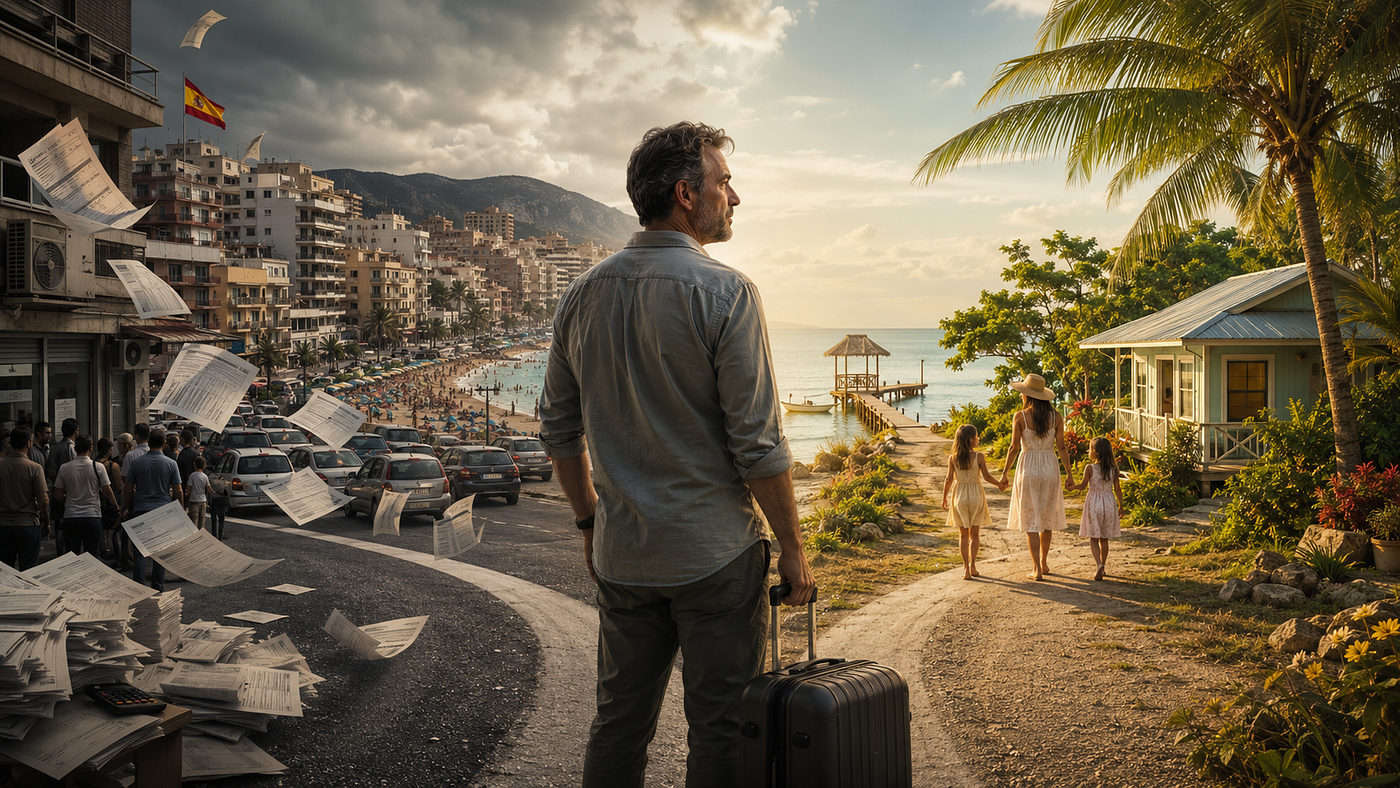
Five years ago, my wife, our two young daughters, and I left Spain and moved to Belize.
We were not escaping poverty, persecution, or an immediate crisis. We were looking for a different kind of life: more freedom, more space, less bureaucracy, and the opportunity for our daughters to grow up speaking English.
In many ways, Belize gave us exactly what we wanted.
We bought a large tropical property with a swimming pool, solar panels, gardens, and a private pier connected to the sea. It is the kind of home we could never have afforded in Spain.
Our daughters adapted quickly. They learned English, made friends, and grew up with a degree of freedom that is increasingly difficult to find in Europe.
And yet, five years later, I am seriously considering selling everything and moving our family to Panama.
Not because Belize failed us.
Perhaps because our needs have changed.
Why we chose Belize
Before moving here, I had lived in Spain for 33 years.
Spain has many qualities. It has excellent food, good infrastructure, beautiful cities, public healthcare, and a level of convenience that is easy to take for granted.
But over time, I became increasingly tired of the bureaucracy, taxation, regulation, and feeling that almost every aspect of life required permission, paperwork, or another payment.
I had been running my own software business for many years. I worked from home and did not need to live near a particular office or city.
That gave us options.
Belize was attractive for several reasons.
English is the official language, which mattered because we wanted our daughters to become genuinely bilingual. The Belize dollar is tied to the US dollar, the tax system is comparatively simple, and the country has a relaxed, informal character.
Belize also offered something that had become almost impossible for us in Europe: space.
We could own a substantial property without becoming millionaires.
We could have a pool, gardens, a pier, solar power, and enough land for our children to play. We could live near the Caribbean Sea without being surrounded by enormous hotels or endless apartment blocks.
We were not looking for luxury in the traditional sense.
We were looking for autonomy.
What I love about living here
There are things about Belize that I still love deeply.
The first is freedom.
Life here often feels less controlled and less standardized than life in Europe. There are fewer layers between you and the decisions you make about your own property, business, or daily routine.
That freedom can sometimes come with disorder, but it is real.
I also love the space.
Our property is around 2,800 square metres. We have trees, tropical plants, a large swimming pool, terraces, a palapa, solar panels, and a pier at the back of the property.
When I look at the house, I still understand why we bought it.
It is exceptional.
Our daughters have had a childhood that would be difficult to reproduce elsewhere. They can play outside, swim, explore, and live without the constant pressure of a large city.
Belize has also given them English.
That alone is enormously valuable. They did not simply study English at school. They began using it as part of their normal lives.
There is also something appealing about living in a small country.
Belize has a population smaller than many European cities. Things can feel personal. Distances are manageable. You can cross the country in a few hours. Mexico is nearby, and we can reach Chetumal relatively easily for shopping or medical appointments.
The winters are pleasant. There are months when the climate is genuinely beautiful, especially when cooler air arrives from the north.
And then there is the house itself.
It has given us many wonderful moments: family meals, visitors, children playing in the pool, afternoons near the water, and a sense that we had created something special.
I do not regret those years.
The dream home became a responsibility
The problem with a dream home is that someone has to maintain it.
When you first see a large tropical property with a pool, gardens, solar panels, pumps, gates, terraces, and a pier, you see the lifestyle.
After a few years, you begin to see the systems.
The pool needs electricity, chemicals, cleaning, filters, pumps, and constant attention.
The garden grows throughout the year. I pay a gardener every month, but there is always more to do.
The well has a pump. The water system has another pump and a pressure tank. The gates have motors. The solar installation has inverters and batteries. The air conditioners need servicing. The pier is exposed to water and weather.
The tropical climate is relentless.
Metal rusts. Paint deteriorates. Plants invade everything. Moisture finds weak points. Pumps fail. Tiles crack. Electronics suffer. Insects appear where you least expect them.
When one problem is solved, another often begins.
None of this is unique to Belize. Large houses are expensive to maintain everywhere.
But a large house in the tropics, near salt water and exposed to storms, requires a particular kind of attention.
I am not a person who enjoys home maintenance.
I do not like spending weekends repairing things. I do not enjoy gardening or construction projects. I do not experience satisfaction from fixing a pump or rebuilding part of a terrace.
Some people do. I admire them.
But I would rather spend my time writing software, working on a project, reading, or being with my family.
Gradually, I have had to accept that I own a property designed for someone who enjoys managing a property.
That person is not me.
The hidden cost of space
A large property does not only cost money.
It costs attention.
There is a permanent mental list of things that should be checked, repaired, cleaned, painted, replaced, or improved.
The pool needs something.
The garden needs something.
The roof needs something.
The solar system needs something.
The pier needs something.
Even when nothing is broken, I know that something eventually will be.
That background anxiety changes how you experience the house.
Instead of looking at the pool and seeing relaxation, you sometimes see the pump, the filter, the chemicals, and the electricity consumption.
Instead of looking at the garden and seeing nature, you see pruning, cutting, insects, fallen branches, and maintenance.
Instead of seeing freedom, you begin to see obligations.
The house is still beautiful.
But beauty and burden can exist at the same time.
The heat is becoming harder to tolerate
The heat was always part of the deal.
Nobody moves to Belize expecting a cool climate.
But knowing that a place is hot and living in that heat every day are different things.
I work from home and spend much of the day under an air conditioner. Without it, concentrating on software development becomes difficult.
My wife is also finding the heat increasingly uncomfortable.
There is a point at which tropical warmth stops feeling like a lifestyle and starts feeling like physical pressure.
You move more slowly. You avoid going outside. You plan your day around the sun. You depend on air conditioning not for luxury, but to function normally.
That dependence also creates another vulnerability.
When the electricity fails, or when an air conditioner breaks, the house becomes uncomfortable very quickly.
Our solar panels and batteries help, and I am grateful to have them. But they are also complex systems that eventually need maintenance and replacement.
For years, I assumed we would simply adapt.
Now I am beginning to wonder whether our bodies are telling us something.
The hurricane question
Living close to the Caribbean Sea is beautiful, but it comes with risk.
Our house is near the coast, with a canal behind it that connects to the sea. The land rises slightly toward the house, and the ground floor is above the normal water level.
Under ordinary conditions, I do not worry.
But hurricanes are not ordinary conditions.
Corozal and nearby Chetumal have been severely damaged by major hurricanes in the past. Storm surge, extreme rainfall, wind, and flooding are not theoretical risks here.
The canal behind the house rises and falls with the water. During unusual tides or rough weather, it can come surprisingly close to overflowing.
I have measured the height difference between the water, the ground near the pier, and the floor of the house. I have studied the slope of the land and considered how water might move across the open fields behind us.
These calculations can be reassuring up to a point.
But they cannot eliminate uncertainty.
The uncomfortable truth is that a major hurricane could cause damage that I would struggle to afford.
I currently do not have home insurance. The available coverage is expensive, and deductibles can be high.
That means the house represents both a major asset and a major concentration of risk.
When you are younger, have growing income, and feel optimistic about the future, that may be acceptable.
As retirement approaches and business income becomes less predictable, it feels different.
My business is no longer what it was
I have been developing and selling software since 2002.
For many years, the business gave me a great deal of independence. It allowed me to work from home, live in different countries, and support my family.
But the software market has changed.
People increasingly expect subscriptions, cloud services, mobile applications, and artificial intelligence. Traditional desktop software has become harder to sell.
Some of my products still have loyal users, but revenue has declined significantly over the years.
That changes the calculation.
A large house with a pool, extensive land, solar equipment, and constant maintenance is much easier to justify when business income is high.
It becomes harder when income falls, and retirement gets closer.
A major repair is not just an inconvenience. It can become a serious financial event.
I have started asking myself an uncomfortable question:
Am I maintaining this property because it still improves our lives, or because I am emotionally attached to the decision we made five years ago?
A house can be too valuable for your lifestyle
This may sound strange, but I sometimes feel that our house is too much for us.
Not too luxurious.
Too demanding.
It requires money, energy, planning, and physical involvement that I increasingly want to direct elsewhere.
The rational decision may be to sell while the property is still in good condition.
The pool works. The solar system is installed. The garden is established. The house has been painted and improved. The property still has the qualities that attracted us in the first place.
Waiting until multiple expensive systems begin to fail would make little sense.
Yet selling is emotionally difficult.
This is not merely a building.
It represents our decision to leave Spain. It represents independence, ambition, and a new life.
Selling it can feel like admitting defeat.
But perhaps the real mistake would be keeping it simply to prove that the original decision was correct.
Why Panama entered the picture
For years, I assumed that our alternatives were limited.
Returning to Spain does not appeal to us at the moment. My wife is Cuban, and we want to remain relatively close to her parents. Our daughters are growing up in an international environment, and we do not necessarily want to abandon that.
Mexico is geographically convenient, but the Yucatán is as hot as Belize.
Costa Rica is attractive, but it can be expensive and heavily regulated.
Then I discovered Boquete, in the highlands of Panama.
Boquete has a much cooler climate than Belize. It is surrounded by mountains, has a significant international community, and offers access to services in the nearby city of David.
It is not perfect.
Panama has bureaucracy. Residency rules can be complex. Property prices in popular areas can be high. It would mean leaving a country we know for one we do not.
Our future home would probably be smaller and less exceptional than the property we have now.
But that may be exactly the point.
A smaller house could mean less maintenance, lower risk, fewer systems, and more time.
A cooler climate could mean spending more time outside instead of moving from one air-conditioned room to another.
Better access to hospitals, shops, schools, and services could become increasingly important as we get older and our daughters grow up.
We would exchange space and freedom for comfort and practicality.
Five years ago, I would probably have rejected that exchange.
Today, I am not so sure.
What I regret
I do not regret moving to Belize.
But there are things I would do differently.
I would think more carefully about how much property we really needed.
I would calculate maintenance not only in money, but in time and mental energy.
I would pay more attention to long-term climate comfort rather than assuming we would adapt permanently.
I would consider how the house would feel when I was approaching 60, not only how impressive it felt when we first saw it.
I would think about how dependent we would become on cars, air conditioning, pumps, batteries, imported parts, and private solutions for problems that public infrastructure solves elsewhere.
Most importantly, I would separate the idea of freedom from the idea of ownership.
Owning more land and more equipment can give you freedom.
It can also create a new form of dependence.
Leaving would not mean Belize was a mistake
People often speak about countries as if one must be the winner.
Spain or Belize.
Belize or Panama.
Europe or Latin America.
But life is not a permanent comparison table.
A place can be right for one stage of your life and wrong for another.
Belize gave our daughters English. It gave us space, adventure, and a remarkable home. It gave us distance from a system in Spain that I no longer wanted to live under.
It gave us five years of experiences that we would never have had if we had stayed where we were.
That has value, even if we eventually leave.
Perhaps success is not staying forever.
Perhaps success is recognizing when your needs have changed before circumstances make the decision for you.
The question I am asking now
I often look around our property and think about what we would be giving up.
The pool.
The garden.
The privacy.
The pier.
The open space.
The freedom to live largely as we choose.
Then I think about what we might gain.
Cooler weather.
A simpler house.
Less maintenance.
Better services.
Lower exposure to hurricanes.
More predictable retirement expenses.
More time to enjoy life instead of managing the infrastructure that supports it.
The decision is not urgent. We may remain in Belize for another two or three years. We may visit Panama and decide it is not for us. We may find another solution entirely.
But the direction of my thinking has changed.
Five years ago, I wanted the largest and freest life we could build.
Today, I find myself wanting something simpler.
That does not mean the dream failed.
It may simply mean that we have outgrown it.

My daughter Delia, 3 years old, when we landed in Belize
Thanks for reading,
메타데이터
- post_id
- d3f27f464f61
- slug
- five-years-in-belize-what-i-love-what-i-regret-and-why-i-may-leave-d3f27f464f61
- url
- https://medium.com/@stanbusk/five-years-in-belize-what-i-love-what-i-regret-and-why-i-may-leave-d3f27f464f61
- canonical_url
- https://medium.com/@stanbusk/five-years-in-belize-what-i-love-what-i-regret-and-why-i-may-leave-d3f27f464f61
- author_url
- https://medium.com/@stanbusk
- status
- ok
- fetched_at
- 2026-08-06 22:18:48