Skyroot Reached Orbit on Its First Try. I Watched It Happen.
I had the livestream open on the 18th, mission control feed and all, counting down alongside a room full of people I’d never met. At T-6…
Skyroot Reached Orbit on Its First Try. I Watched It Happen.
I had the livestream open on the 18th, mission control feed and all, counting down alongside a room full of people I’d never met. At T-6 hours, Vikram-1 was just standing there on the pad, patient, ordinary-looking for a rocket that was about to become the first privately built vehicle in India’s history to reach orbit. Then the clock hit zero, and for about two seconds, all I could see on screen was flame swallowing the frame.
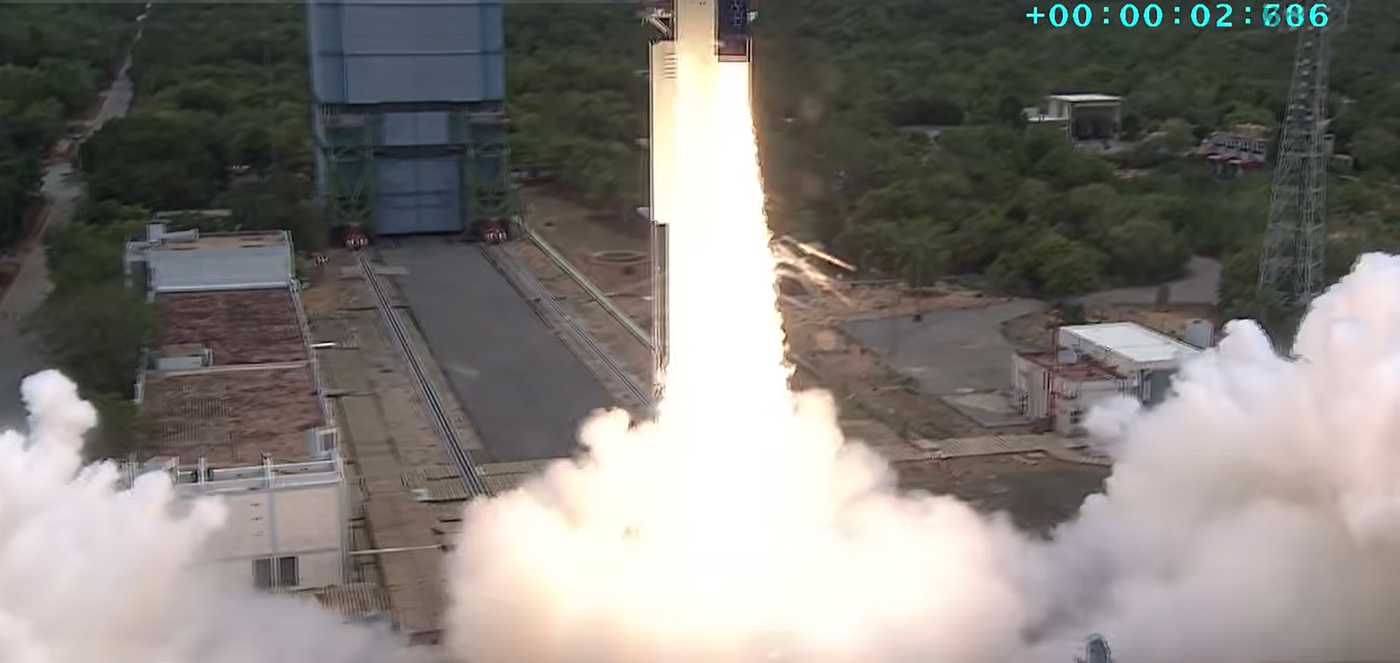
Vikram-1, two seconds after liftoff. First attempt, first success.
Skyroot Aerospace’s Vikram-1 lifted off from Sriharikota that day after a 35-minute hold, climbed through staging, and reached orbit on its first attempt. That’s rare in this industry, rarer than most coverage gave it credit for. Rocket Lab, the closest comparable company anywhere, missed orbit on its first try in 2017 and needed a second attempt in 2018 to get there. Skyroot didn’t need one.
The rocket itself
Vikram-1 stands roughly seven storeys tall, built with an all-carbon-composite structure and a 3D-printed liquid engine, rated to carry up to 350 kilograms to low Earth orbit. This flight carried four working payloads: Skyroot’s own SCOPE satellite, a technology demonstrator from DCUBED, Grahaa Space’s SOLARAS S3 satellite, and a debris-capturing robotic arm from Cosmoserve Space. Alongside them rode two symbolic ones, a floral-shaped artwork called Cosmic Bloom, and an 18-karat gold micro-rocket carrying microscopic sculptures of C.V. Raman, Vikram Sarabhai, and A.P.J. Abdul Kalam, each smaller than a grain of rice.
Watching the feed, what struck me wasn’t the drama of the flame, it was how quiet mission control stayed through it. No cheering until well after the vehicle had cleared the tower. A first-attempt orbital success is a genuinely hard thing to pull off, every subsystem had to perform correctly the first time it flew, with no earlier failure to learn from and correct, and I think that room understood exactly how much was riding on those first few seconds better than I did watching from a screen, though I’ll admit the pride I felt watching it succeed surprised me a little, for a team and a country I only had a screen’s distance from.

Mission control during Vikram-1’s ascent. I was watching from a screen too, just a much smaller one.
What I found myself thinking about instead
What stayed with me afterward wasn’t only the rocket. It was how fast the surrounding ecosystem had to grow to make that moment possible at all.
Six years ago, India’s space sector was almost entirely government-led. Private companies supplied parts and services; ISRO built and flew everything that left the ground. A 2020 regulatory overhaul, and the creation of IN-SPACe, a dedicated agency authorizing private space activity, changed that. The Indian Space Policy 2023 went further still, opening the entire value chain, not just contracting work, to private players for the first time in the country’s history.
There’s a more recent piece too, one that got far less coverage than the launch itself. The government now subsidizes 30 percent of launch costs, up to $3,000 per kilogram, for companies flying on Indian vehicles, and Skyroot is among the primary beneficiaries. In May, two months before this launch, the company raised roughly $60 million in a funding round that pushed its valuation past $1.1 billion, making it India’s first space-technology unicorn.
I found that genuinely remarkable in its own right, watching it unfold from my own screen rather than from inside that control room. Building a regulatory environment from nothing, in six years, good enough that a private company could design, build, and successfully fly an orbital rocket inside it, is a hard problem entirely separate from the engineering one. Plenty of countries spend decades failing to build that kind of enabling environment at all. India’s government built one quickly enough that Skyroot could actually make use of it while the opportunity was still fresh.
Two wins, not one
The instinct with a story like this is to tell it as a single narrative: a determined startup beating the odds. Having watched the whole thing unfold in real time, I’d rather tell it as two separate wins, stacked on top of each other. A team that built something technically excellent enough to succeed on its very first flight, with none of the usual margin for a second attempt. And a government that built the conditions for a team like that to exist at all, and built them fast enough that the timing actually lined up.
Neither win diminishes the other. If anything, each one makes the other look more deliberate than lucky, a company that used its window well, inside a window that was opened on purpose. I don’t know if everyone watching that feed with me understood they were looking at both of those things at once. I don’t think I fully did either, until the flame cleared and the telemetry numbers started climbing.

Vikram-1 on the pad, just over six hours from launch. Six years of policy behind it, six minutes from finding out if it worked.
Smrithi Nair is an astrophysicist and science communicator. This is Light & Void, where she asks uncomfortable questions about the universe and writes honestly about what she finds.
Sources
- SpaceNews, “Skyroot prepares for first orbital launch attempt”
- Reuters/Al Majalla, “India’s First Private Rocket Company Looks to Slash Satellite Costs”
- SpaceDaily, coverage of the July 18, 2026 Vikram-1 launch
- Republic World, “Skyroot Aerospace’s Vikram-1 Showcases India’s Growing Private-Sector Launch Capabilities and Orbital Reach”
메타데이터
- post_id
- d3f487fea833
- slug
- skyroot-reached-orbit-on-its-first-try-i-watched-it-happen-d3f487fea833
- url
- https://medium.com/@lightnvoid/skyroot-reached-orbit-on-its-first-try-i-watched-it-happen-d3f487fea833
- canonical_url
- https://medium.com/@lightnvoid/skyroot-reached-orbit-on-its-first-try-i-watched-it-happen-d3f487fea833
- author_url
- https://medium.com/@lightnvoid
- status
- ok
- fetched_at
- 2026-08-06 11:15:05