Beyond Pods: Why Agent Substrate is the Future of Kubernetes AI Infrastructure
If you are trying to deploy AI agents at scale in a Kubernetes cluster, you have probably run into a frustrating realization: Kubernetes…
Beyond Pods: Why Agent Substrate is the Future of Kubernetes AI Infrastructure
If you are trying to deploy AI agents at scale in a Kubernetes cluster, you have probably run into a frustrating realization: Kubernetes was not built for AI agents.
Standard Kubernetes primitives like Pods and Deployments were designed for long-running microservices (like web servers or databases) or predictable batch jobs. They assume that if a container is running, it should actively consume resources.
AI agents, however, are different. They are bursty: an agent might sit idle for hours waiting for a user message, run intensely for 5 seconds to process a query, and then go back to sleep.
If you run each agent in its own dedicated Pod, your cloud bill will skyrocket. If you scale them to zero to save costs, your users will face 20-second “cold start” latency spikes.
To solve this dilemma, Solo.io developed Agent Substrate (donated to the Linux Foundation) — a Kubernetes-native runtime designed specifically to optimize AI agent execution.
In this post, we’ll dive into what Agent Substrate is, how it works under the hood, and how it can cut your AI infrastructure costs by up to 90% while maintaining sub-second startup times.
The Concept: Actor Multiplexing
The core breakthrough of Agent Substrate is Actor Multiplexing.
Instead of maintaining a 1:1 relationship between an AI agent and a Kubernetes Pod, Agent Substrate separates the Agent (the actor) from the Infrastructure (the pod).
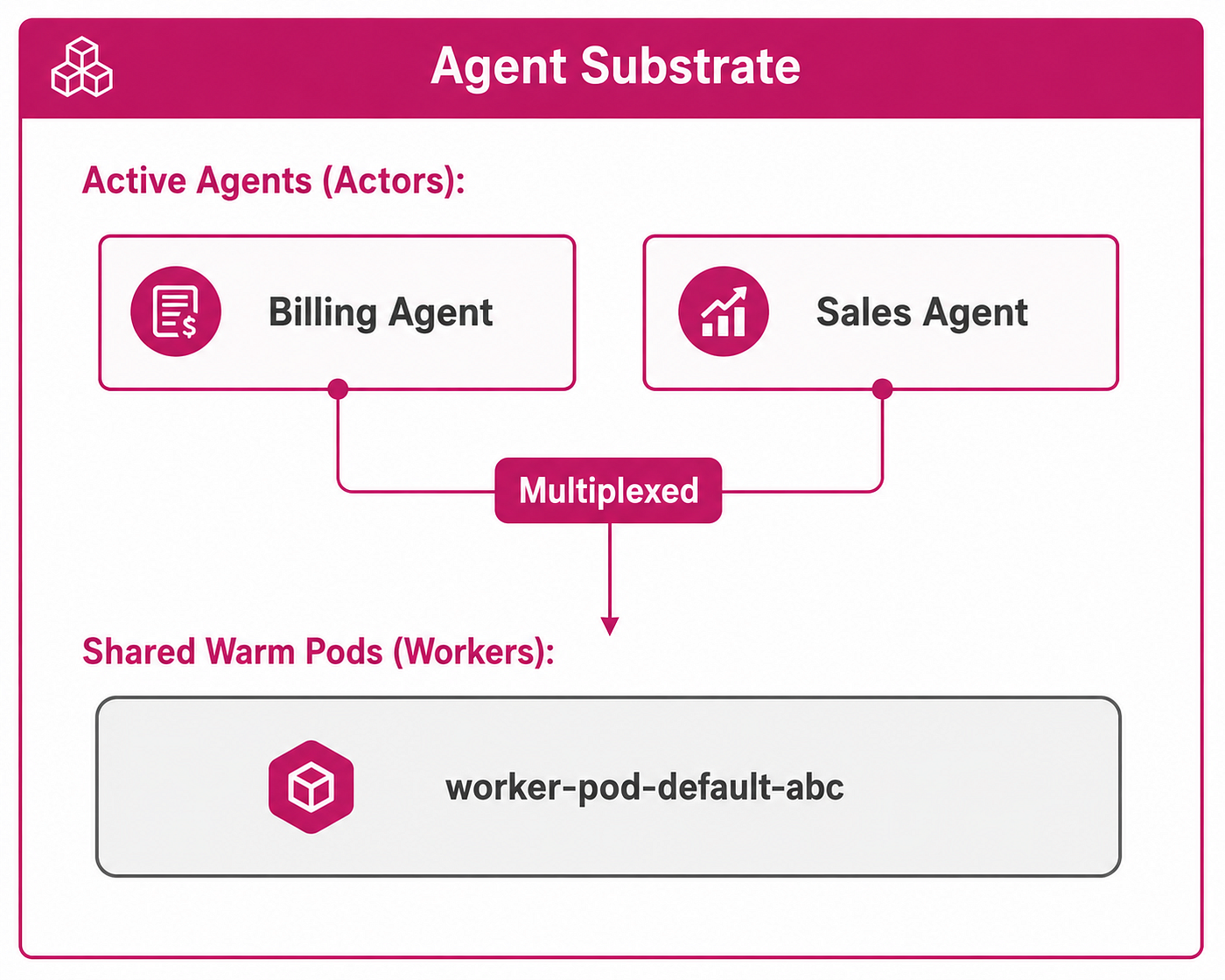
agent substrate- actor multiplexing
- Warm Worker Pool: Substrate pre-provisions a small, fixed pool of generic worker Pods (the data plane) running a secure runtime like gVisor or Firecracker microVMs (backbone of AWS Lambda).
- Stateful Suspension: Inactive agents are “frozen.” Their file systems and RAM allocations are snapshotted and stored in cheap object storage (like S3 or EBS).
- Instant Swapping: When an agent is called, Substrate loads its snapshot into one of the warm worker pods. The agent starts executing in under 100 milliseconds, bypassing the standard Kubernetes scheduling and container-pulling delays.

How to Deploy Agents on Agent Substrate
Agent Substrate introduces declarative Custom Resource Definitions (CRDs) that integrate with your standard GitOps pipelines.
1. Provision the Worker Pool
First, we define the WorkerPool. This CRD creates the warm pods that sit waiting to run our agents.
apiVersion: ate.dev/v1alpha1
kind: WorkerPool
metadata:
  name: support-worker-pool
  namespace: kagent-system
spec:
  ateomImage: ghcr.io/kagent-dev/substrate/ateom-gvisor:v0.0.6
  replicas: 3 # Keeps 3 warm pods running
2. Configure the Agent Harness
Developers define their agents using an AgentHarness. This abstracts the low-level Kubernetes settings and instructs the cluster to run the agent as a Substrate actor.
apiVersion: kagent.dev/v1alpha2
kind: AgentHarness
metadata:
  name: tech-support-agent
  namespace: kagent-system
spec:
  runtime: substrate # Instructs kagent to use Substrate multiplexing
  substrate:
    workerPoolRef:
      name: support-worker-pool
  template:
    spec:
      containers:
      - name: agent
        image: company/support-agent:tech-v2
        resources:
          limits:
            cpu: "1"
            memory: 2Gi
Once applied, the kagent controller registers the agent, compiles the ActorTemplate, and waits. The moment a user queries the tech-support-agent, Substrate schedules it onto one of the 3 warm pods in the support-worker-pool and runs it instantly.
Conclusion
Agent Substrate represents a major step forward for AI platform engineering. By treating AI agents as lightweight, suspendable actors rather than heavy, long-running microservices, it bridges the gap between cost efficiency and performance.
If you are running multi-tenant AI systems, custom customer support bots, or bursty background worker agents, implementing Agent Substrate will allow you to scale your workloads to thousands of agents while keeping your cloud billing under control.
메타데이터
- post_id
- d3fb5aa81de9
- slug
- beyond-pods-why-agent-substrate-is-the-future-of-kubernetes-ai-infrastructure-d3fb5aa81de9
- url
- https://medium.com/@ravishkhullar/beyond-pods-why-agent-substrate-is-the-future-of-kubernetes-ai-infrastructure-d3fb5aa81de9
- canonical_url
- https://medium.com/@ravishkhullar/beyond-pods-why-agent-substrate-is-the-future-of-kubernetes-ai-infrastructure-d3fb5aa81de9
- author_url
- https://medium.com/@ravishkhullar
- status
- ok
- fetched_at
- 2026-07-10 16:32:07




