Saikat: Spotted and Spoken With
Saikat: Spotted and Spoken With

Saikat Chakrabarti speaks at a rally during his campaign for the US House representative position in California’s 11th district. (Photo courtesy of Mariana Garcia and missionalocal.org)
My San Francisco shoulder brushing continues.
This past weekend, my ferry ride to Treasure Island for an afternoon of pickleball was made particularly noteworthy by the presence of a fellow passenger. Congressional candidate Saikat (pronounced Shuy-kaut) Chakrabarti — who is seeking to assume Nancy Pelosi’s long-time position as the US House representative for California’s 11th district — made his way across the San Francisco Bay to knock on some doors on the developing isle. The timing of this chance encounter felt particularly serendipitous. Just days earlier, I received a flyer of his in the mail which outlines his ambitious AI policy proposals.
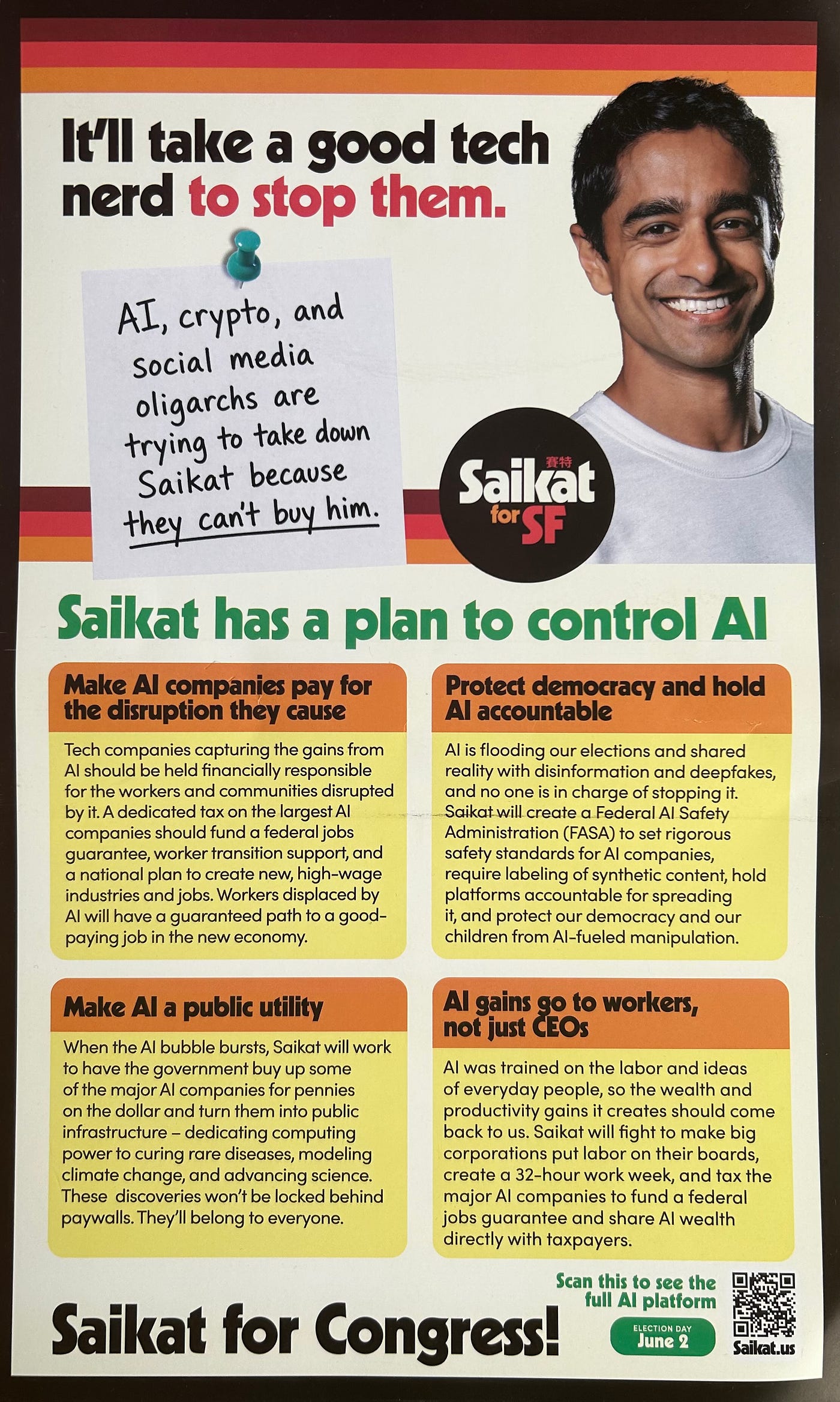
I received Chakrabarti’s flyer in the mail on April 30th, 2026.
On the flyer, Chakrabarti hones in on four methods in which he plans to “control” the US AI industry that calls San Francisco home. The feasibility and efficacy of these methods are subject to necessary scrutiny, but they demonstrate a clear stance: AI should be regulated by the government, and its rewards distributed amongst the public rather than hoarded by C-suite executives in control of the technology. Additionally, a somewhat adversarial relationship between Chakrabarti and Big Tech emerges in the rhetoric he employs on the flyer. In bold red lettering, Chakrabarti establishes his intent to “stop them.” Labeling those in the industry as “oligarchs,” the flyer proudly tells of his inability to be bought or manipulated by said oligarchs as a candidate or elected official. Considering the employment of large swathes of his electorate by the AI and social media companies he refers to, I found the distribution of this flyer incredibly bold. I was, to say the least, intrigued by his candidacy.
My investigation of Chakrabarti’s AI policy stances was simplified the moment I had the chance to ask him questions directly. Chakrabarti boarded the boat with just a photographer in tow. When I approached him, he greeted me with a smile and a handshake. I explained my background and my interest in his flyer, then asked my first question: why is he concerned about unregulated AI? Chakrabarti immediately touched on an issue I find particularly frightening: the concentration and consolidation of power that AI provides. At present, a small group of “oligarchs” control the largest, most ubiquitous AI companies that own the tools used by corporations, the military, and the public. Chakrabarti explained that these oligarchic individuals have the capability to take up entire industries and their workforces by way of the technology that they own. In turn, their share of wealth production and the economy could grow to unprecedented levels, which furthers the power imbalance I outlined in my last article.
Guided by the same question regarding unregulated AI, Chakrabarti pointed out the self-regulation that currently serves as the principal structure for AI companies like OpenAI and Anthropic. Interestingly, Chakrabarti was keen to point out the incongruencies in these self-regulatory policies across AI firms. This landscape makes for a lack of set standards, which exposes users of tools provided by these companies to different risks depending on the product they select. Chakrabarti told me of his desire to establish a base regulatory framework across the board simply to eliminate the capability of companies to undercut one another and expose their users to unnecessary risk in the name of financial gain.
Earlier this year I met Matt Mahan, mayor of San Jose, who is running for California governor. I mentioned this interaction to Chakrabarti and asked him what he thought of Mahan’s AI policies. Chakrabarti was eager to point out the tech billionaire funding that is driving Mahan’s campaign, which Mahan himself has addressed, albeit vaguely. He expressed his worry about Mahan’s ties to Big tech and AI and his concern that Mahan will prioritize the interests of those AI stakeholders over those of the public if elected. As mentioned in his flyer, he reminded me of his independence from these actors and his refusal to be manipulated by the political and monetary influence they possess. Should both Chakrabarti and Mahan be elected to office in November, the harmony of their stances on AI issues and the degree to which they cooperate with one another on policy implementation will define the contours of AI development in the state.
Overall, I’m impressed with Chakrabarti’s recognition of key AI issues and the creative zeal he brings to his policy proposals. Ultimately, however, Chakrabarti has other challenges to address should he wish to win over enough constituents for a successful congressional push. Chakrabarti has repeatedly leveraged his roles as Alexandria Ocasio-Cortez’s campaign manager and subsequent chief of staff as evidence of his suitability for office. When a reporter recently asked Ocasio-Cortez about her stance on Chakrabarti, she delivered a viral non-answer that cast doubt over her endorsement of him as a candidate. The reasons for Ocasio-Cortez’s response are unclear, but they undoubtedly undermine the credit Chakrabarti has attempted to build through his association with the New York representative.
I’ll be following Saikat Chakrabarti’s campaign closely in the following weeks and months, including attending one of his upcoming town halls on May 13th (more information on this event and others can be found here). He likely has my vote for this election, but I hope to learn more about his other policies on the 13th to fully understand his candidacy.
The primary election for California’s 11th Congressional District takes place on June 2nd, 2026.
메타데이터
- post_id
- d4115994083d
- slug
- saikat-spotted-and-spoken-with-d4115994083d
- url
- https://medium.com/@303RAI/saikat-spotted-and-spoken-with-d4115994083d
- canonical_url
- https://medium.com/@303RAI/saikat-spotted-and-spoken-with-d4115994083d
- author_url
- https://medium.com/@303RAI
- status
- ok
- fetched_at
- 2026-06-10 18:44:10