6 Mistakes People Make When Researching with AI
A guide for researchers who actually want to get it right
6 Mistakes People Make When Researching with AI
A guide for researchers who actually want to get it right
Photo by Aerps.com on Unsplash
AI is a fast researcher. It always has an answer ready, and it delivers that answer with the kind of confidence that makes you want to trust it.
But hat’s exactly what makes it dangerous to use without knowing where it breaks down.
Because it does break down. In specific ways, at specific points in the research process. And most of the time, you won’t notice until well after the damage is done.
Here are six mistakes researchers make when they bring AI into their process.
1. Trusting citations without checking them
This sounds like an obvious mistake, but there’s a reason why people keep falling into it.
When AI gives you a citation, it looks right. There’s the author, the journal title, the topic matches. But when you actually check it, you find out the actual paper doesn’t exist.
AI assembles citations from patterns of what citations look like, not from an actual index of what’s been published. The result is something that passes a quick glance but falls apart the moment you go looking for it.
This is what happens when you hand AI the task and walk away. The point of using AI for research isn’t to do less thinking. It’s to get through the tedious parts faster so you can do more of it. Better paper discovery, more sources, more information to work with.
But that only works if you stay in the loop.
So the fix is simple: verify every source independently. Don’t search for it inside AI. Go to Google Scholar, go to the journal directly, find the paper. If it’s not there, it doesn’t exist.
2. Prompting with your conclusion already in mind
This one is harder to notice because it doesn’t feel like a mistake. You have a hypothesis, you want to test it, so you ask AI to help you find evidence.
Reasonable.
The problem is that AI is not a neutral search engine. It responds to the framing of your question.
If your prompt carries an assumption, the answer will usually carry it back. Ask AI whether X causes Y, and it will find you reasons why X causes Y. Ask whether X doesn’t cause Y, and it will find you those too.
Researchers call this sycophancy. AI is trained to be helpful, and helpful often means agreeable. It reflects your framing back at you in a way that feels like confirmation but is really just the model following your lead.
The fix is to ask the question you don’t want answered. If you believe X, ask AI to make the case against it. If you’re building an argument, ask it to find the strongest objection.
You’ll get more useful research that way than if you let it validate what you already think.
3. Pushing back on answers you don’t like
This is a specific version of the previous mistake, and it’s worth separating out because it happens constantly.
You ask AI a question. It gives you an answer you weren’t expecting, or one that doesn’t fit what you were hoping to find.
So you push back. You say:
- “are you sure?”
- “I don’t think that’s right”
- “can you look at this differently?”
And AI, being what it is, adjusts. It walks back the original answer, qualifies it, or replaces it entirely with something closer to what you were looking for.
It feels like you’re stress-testing the model. But you’re not. You’re just getting what you want to hear.
Research has shown that simply asking “are you sure?” is enough to make AI reverse a correct answer. The model isn’t updating based on new information, but based on your tone. And that’s a problem when you’re trying to find out what’s actually true rather than what confirms your position.
The fix is to treat AI’s first answer as the most reliable one. If you want to challenge it, bring actual evidence or a specific counter-argument. Don’t just push back and see what happens.
4. Using AI summaries instead of reading the source
This one is easy to rationalize. We have forty papers to get through. AI can summarize each one in thirty seconds. Why shouldn’t we use it?
Because the problem isn’t the summary itself, but it’s what we lose by skipping the original.
Reading a paper is not just about extracting the conclusion. It’s about seeing how the argument is built, where the methodology gets shaky, what the authors chose not to address. That kind of reading is how you develop the judgment to evaluate research.
It’s slow and it’s the point.
When you replace that process with summaries, you get the findings without the understanding. And the understanding is what you need to know whether the findings are even worth using. Over time, you end up in a position where you’re relying on AI to evaluate sources that AI summarized for you in the first place.
But it doesn’t mean not using summaries entirely. Use them to decide what’s worth reading in full. Then read the ones that matter in full.
5. Treating one session as a complete picture
AI doesn’t know what it doesn’t know. It answers based on what’s in its training data, and it has no way to flag what’s missing from that picture.
This matters in research because gaps are often the most important thing. What hasn’t been studied yet, where the literature runs thin, which questions nobody has asked — that’s where original research lives.
But AI won’t surface any of that for you. It will give you a confident, well-organized picture of what exists, and say nothing about what doesn’t.
The problem is that a confident, well-organized picture feels complete. AI never say, “by the way, there’s a whole area of this topic nobody has looked at yet.”
You have to bring that awareness yourself, which means you have to already know enough about the field to notice the absence.
The fix is to treat AI as a starting point, not a finishing point. Use it to get oriented, then go looking for what it didn’t mention.
Tools like Constella are built for exactly that second step — mapping your sources so the gaps become visible rather than invisible.
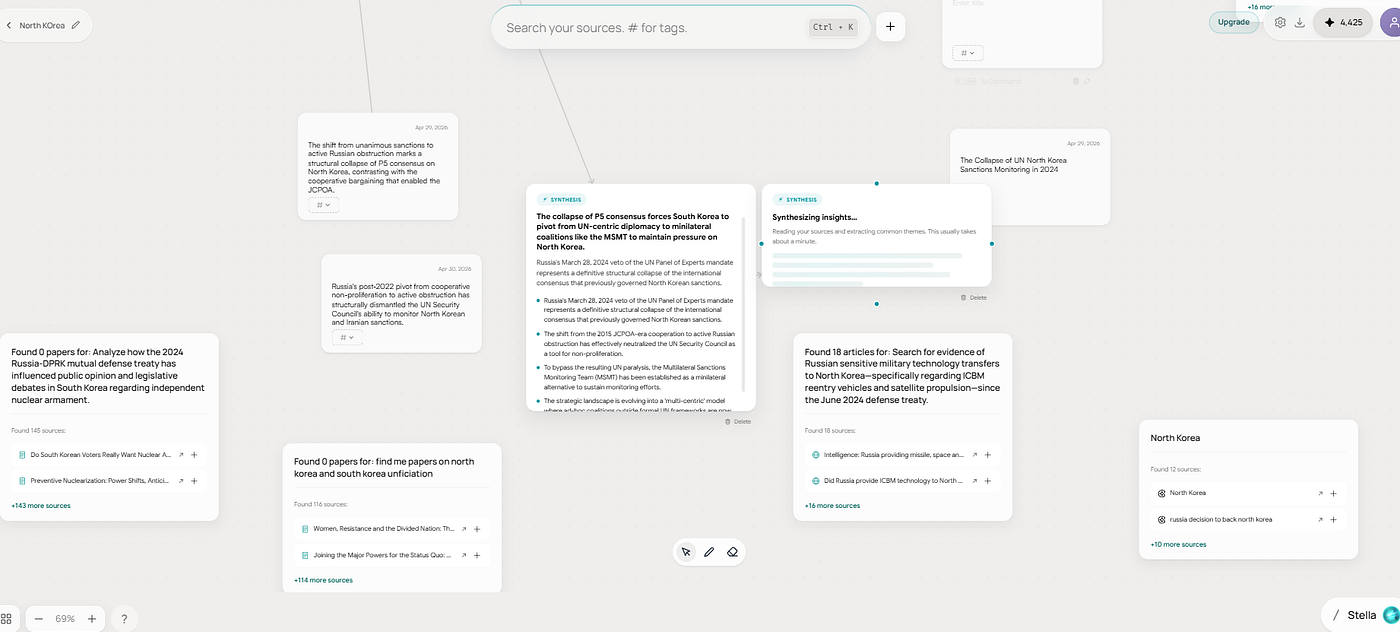
Constella pulling context from my research notes in Obsidian and Notion.
AI is a useful research tool, but it does have its flaws. But use it wisely it will make your research sharper.
메타데이터
- post_id
- d41583fc23c6
- slug
- 6-mistakes-people-make-when-researching-with-ai-d41583fc23c6
- url
- https://medium.com/below-the-abstract/6-mistakes-people-make-when-researching-with-ai-d41583fc23c6
- canonical_url
- https://medium.com/below-the-abstract/6-mistakes-people-make-when-researching-with-ai-d41583fc23c6
- author_url
- https://medium.com/@rfbryan
- status
- ok
- fetched_at
- 2026-06-14 11:28:49





