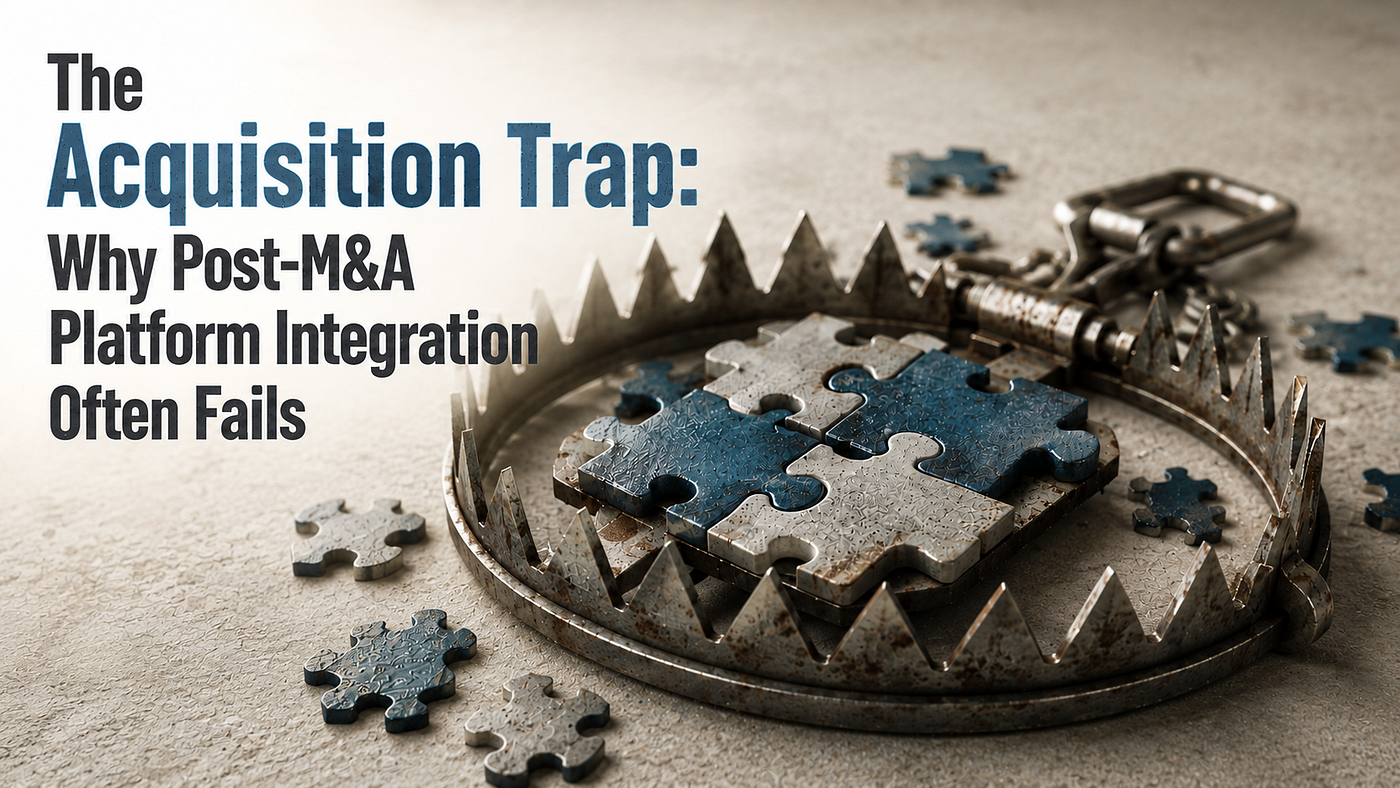
The Acquisition Trap: Why Post-M&A Platform Integration Often Fails
Acquisitions are a capability bet. Integration is a unification bet. Most companies never price both.
The Acquisition Trap: Why Post-M&A Platform Integration Often Fails
Acquisitions are a capability bet. Integration is a unification bet. Most companies never price both.
I have been in that meeting more than once. Different company, same dynamic. The integration initiative has executive sponsorship, a timeline on a slide, and everyone in the room agrees on the goal. The meeting ends. Nothing moves.
I have run platform integration programs at two companies. At one, I led the integration of six acquired products into a unified platform. 6 teams, 6 roadmaps, and 6 definitions of what “integrated” meant. Every team at the table had a different answer to the same question: integrated toward what, and by whose definition?
This is the Acquisition Trap, an organizational failure that presents as a technical one.
The first 3 parts in my series on platform strategy covered the architecture, incentive, and role problems. Each is hard on its own. The acquisition context runs all 3 simultaneously, with less organizational authority and higher timeline pressure than any internal platform initiative.
The Acquisition Trap
Most acquisitions close for legitimate reasons: real capability gaps, genuine product-market fit, strong teams solving problems the acquirer cannot build fast enough. Some close for GTM acceleration, and those companies often integrate only at the GTM layer, selling bundles and portfolios without touching the underlying architecture. The trap catches the companies in the middle, those that acquire for capability but integrate for cost.
The capability thesis drives the deal. Then the CFO models post-close synergies, and the integration roadmap shifts to headcount consolidation and infrastructure overlap, not toward integrating the products. The acquired team feels it. They were told the acquisition was about their product. Six months later, the conversation is about their budget. That shift destroys the capability the acquirer paid for.
One architectural exception exists. When two products share a natural data contract before the deal closes, where the acquired product’s output is already structured to feed the acquirer’s model, the technical drag drops. But the organizational drag doesn’t.
The Survival Gradient
Acquired teams resist integration for rational reasons, not cultural ones.
Every acquired PM knows the pattern: teams that integrate fastest tend to be absorbed. Teams that maintain a distinct value proposition, a separate customer base, and a clear revenue contribution have a reason to exist. Survival and unification pull in opposite directions. Survival wins.
This is the Survival Gradient. The further an acquired team drifts from demonstrating standalone value, the more energy goes toward protecting roadmap, headcount, and customer relationships, not toward platform work. The acquired PM’s incentive is to prove their product works. The acquirer’s is to prove the products work together. Until those align, the Survival Gradient runs against integration.
The Survival Gradient is structural. Treating it as a culture problem produces alignment offsites, not integration.

The Survival Gradient
The Two Clocks
Beneath the Survival Gradient is a second problem, the Two Clocks.
The acquisition timeline runs on investor logic. Close in Q2. Announce synergies by Q3. Show the combined ARR in the next quarterly report.
The integration timeline runs on product logic: unify the data models, integrate the telemetry layers, and migrate customers to a shared workflow. Done well, that work takes 12–24 months. Done under investor timeline pressure, it produces the **Declared Platform from Part 1**: one brand, one login screen, one press release.

Platform Maturity Spectrum: Where M&A Integrations Stall
But the architecture did not change. The diagram below shows why: the investor clock and the product clock run on fundamentally different timelines, and most companies only manage one.

Investor Clock vs. Product Clock
The Integration Illusion
When the two clocks diverge far enough, the result is the Integration Illusion, integration declared before it is architected.
The brand is unified, the website shows one product family, and the sales team has a combined deck. The engineering teams still run separate data pipelines and alert consoles. The acquired PM is still measured on their product’s ARR, not the platform’s NRR. Unified success is defined on a slide, not in a scorecard.

The Integration Illusion: What the press release says vs. what’s true 18 months later
This is the M&A version of the **Declared Platform**. Sophisticated buyers cannot always detect it at the sales stage. They learn it 18 months into the contract, when the integration they were sold is still a roadmap item.
Why This Is Harder Than Internal Platform Work
The **Incentive Trap from Part 2** runs here too, with two more layers. The first is identity. An internal PM who resists platform work is still on the same team. An acquired PM carries a different history and loyalty. Roadmap resistance that looks like misalignment inside a single company is turf protection post-acquisition. The second is the engineering scope. Post-M&A integration means merging two codebases, two data models, two telemetry layers, and two tenancy models. Internal platform alignment never starts that deep.
The Playbook
Change what executives are paid for. Tying executive compensation to platform adoption, not individual product ARR, is the single highest-leverage intervention in post-M&A integration. When the VP who owns an acquired product knows their compensation tracks cross-product NRR and platform attach rate, the Survival Gradient inverts. Protecting standalone metrics no longer serves their career. Contributing to platform strength does.
Anchor on one flagship before asking the rest to follow. The most common mistake in multi-acquisition integration is moving all products toward the platform simultaneously. Cost and risk are distributed across every team, visible progress is thin, and no single integration delivers demonstrable value. Pick the highest-volume acquired product, absorb the integration cost centrally, and get one working integration in front of real customers. Once that integration is live with demonstrated cross-product value, the marginal cost for every subsequent team drops, and the conversation shifts from “why should we integrate” to “what does integration require.”
Build new capabilities on the platform layer first. When features that require cross-product data are built exclusively on the shared data layer, integration stops being a cost and becomes an access condition. An acquired PM whose customers want a capability available only on the platform has a customer-driven reason to integrate. That pressure comes from their own customers, not from the platform team.
Let network effects do what mandates cannot. Every mandate I have seen in post-M&A integration produces compliance without ownership. Teams integrate on paper, declare the milestone, and maintain workflow separation underneath. The companies that escape the trap make integration the rational choice at every level: executive comp, PM incentives, customer demand. When all three align, each team that integrates makes the platform more valuable and lowers the cost for the next team.
What Investors Need to Price
Most acquisition models include integration costs as a line item. They are understated because they model the engineering cost and exclude the organizational one: unifying incentive structures, absorbing the Survival Gradient, and managing two diverging clocks. That cost does not appear in an integration roadmap. It appears in the 18-month renewal conversation, when the promised platform is still a portal.
Before closing a deal, the better question is whether unified success is defined and whether the post-close incentive structure points every team toward it. If not, the integration is already behind before the deal closes.

The Acquisition Trap Diagnostic
Closing the Series
The Acquisition Trap is the hardest version in this series: premature platformization, structural misalignment, and the wrong incentive model, all running simultaneously on a clock shaped by investor timelines rather than product logic.
An acquisition is a bet on unification, not just capability. Most companies close the deal, pricing the capability and underpricing the unification. The Survival Gradient runs until you change what people are paid for. The Two Clocks diverge until you manage both timelines. The Integration Illusion persists until the scorecard reflects the actual goal.
The companies that build real platforms through acquisition align what every team is paid to achieve with what the platform needs. That alignment has to be structured in, not announced.
Key Takeaways
- The Acquisition Trap. Companies acquire for capability and integrate for cost. Cost shapes the roadmap, and the capability the acquirer paid for erodes.
- The Survival Gradient. Acquired teams optimize for survival before unification. Rational, not cultural. Treating it as a culture problem produces alignment sessions, not integration.
- The Two Clocks. Acquisition timelines run on investor logic. Integration timelines run on product logic. Managing only one produces milestones, not integration.
- The Integration Illusion. Integration declared before it is architected. One brand, one login screen, two operating models underneath. The M&A version of the **Declared Platform from Part 1**.
- Change what executives are paid for. Comp tied to platform adoption is the highest-leverage intervention in post-M&A integration. Nothing else changes the Survival Gradient.
- Anchor on one flagship first. Demonstrated cross-product value and reduced marginal cost do what persuasion cannot.
- Feature exclusivity creates pull. Build capabilities requiring cross-product data on the platform layer first. Let customer demand generate the integration signal.
- An acquisition is a bet on unification, not just capability. Price both, or pay for the gap when renewals come around.
This is Part 4 of my 4-part series on platform strategy. Part 1: The Platformization Trap argued that the path to a real platform is a non-skippable maturity spectrum. Part 2: Why Platform Roadmaps Never Get Prioritized covered the incentive problem that stalls even well-architected platforms. Part 3: Platform PM and Product PM Are Not the Same Job addressed the role problem. This piece is the hardest version of all three: post-acquisition integration, where all three problems compound.

I am a product leader with 20+ years of experience in enterprise software and cybersecurity. I have built and scaled cybersecurity platforms at WhiteHat, Tenable, and Qualys, and architected integration platforms at Reynolds American, Thermo Fisher, 3M, and Delta Airlines. These days, I advise and consult with startup founders, product leaders, and investors on AI, cybersecurity, product strategy, and go-to-market.
메타데이터
- post_id
- d41ee2a67e52
- slug
- the-acquisition-trap-why-post-m-a-platform-integration-often-fails-d41ee2a67e52
- url
- https://medium.com/pm-nectar/the-acquisition-trap-why-post-m-a-platform-integration-often-fails-d41ee2a67e52
- canonical_url
- https://medium.com/pm-nectar/the-acquisition-trap-why-post-m-a-platform-integration-often-fails-d41ee2a67e52
- author_url
- https://medium.com/@sandeeppotdar
- status
- ok
- fetched_at
- 2026-06-09 15:37:30