How to Calculate Project Finance Emissions: The PCAF Method (by GreenCalculus.com)
The attribution equation, the data-quality score, and why avoided emissions never net against the financed total.
How to Calculate Project Finance Emissions: The PCAF Method (by GreenCalculus.com)
The attribution equation, the data-quality score, and why avoided emissions never net against the financed total.
Credit: PCAF Project Finance Calculator — Financed & Avoided Emissions | GreenCalculus
If you finance a wind farm, a toll road, or a gas plant, a slice of that project’s emissions lands on your books. PCAF’s Global GHG Accounting and Reporting Standard for the Financial Industry calls this Part A, Project Finance — and it’s the asset class auditors scrutinise hardest, because attribution is where most institutions get it wrong.
The core method
Every PCAF asset class shares one shape: an attribution factor times the project’s own emissions.
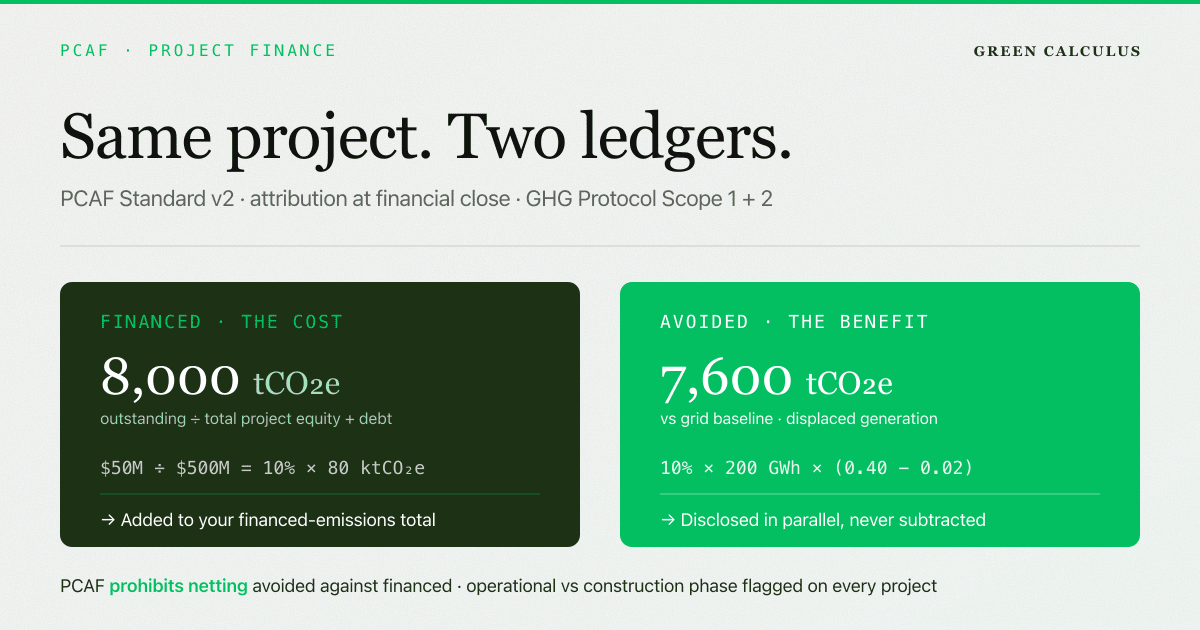
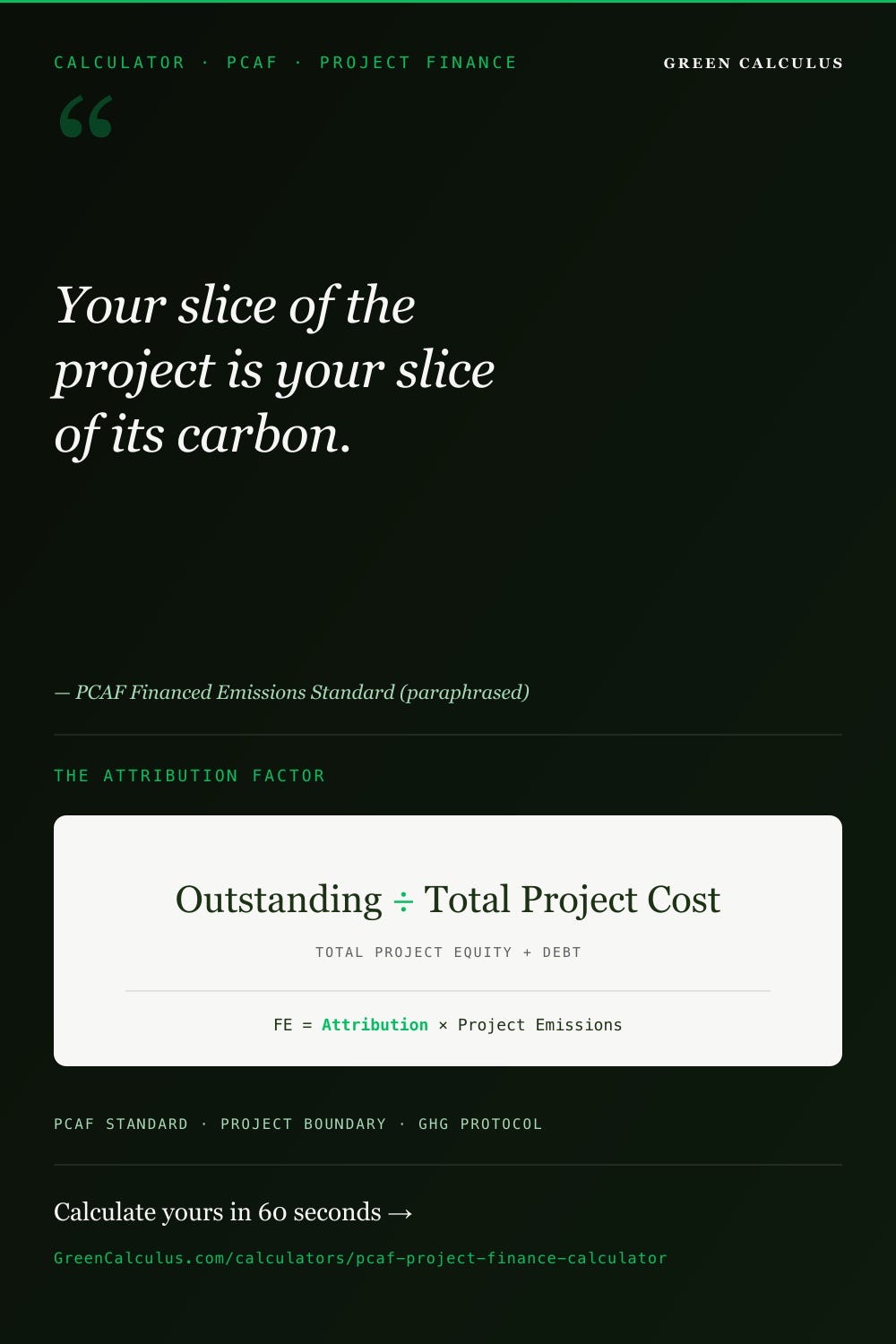
For project finance, the attribution factor is the outstanding amount you’ve provided divided by the total project value (total equity + debt at origination):
Financed emissions = (Outstanding amount ÷ Total project value) × Project emissions (Scope 1 + 2, and 3 where required)
Two things practitioners miss:
- Project value, not total assets. The denominator is the project’s total equity plus debt, fixed at origination — not the balance sheet, not the current valuation.
- Scope 3 is conditional but rising. PCAF requires Scope 1+2 of the project; Scope 3 becomes mandatory for specific sectors (oil & gas, mining, others as the standard tightens). Check the sector trigger before excluding it.
Step by step
- Fix the attribution factor. Outstanding amount ÷ total project value at origination. Lock the denominator date — moving it mid-reporting breaks year-on-year comparability.
- Source the project’s emissions. Best case: reported, verified project-level data. Worst case: economic-activity-based estimates. Where you sit on that range determines your data-quality score (see below).
- Apply scope rules for the sector. Scope 1+2 always; Scope 3 where the sector mandates it. Don’t silently drop Scope 3 to flatter the number — that’s the first thing assurance flags.
- Score the data quality. PCAF scores 1 (verified, measured) to 5 (estimated from economic proxies). This isn’t optional metadata — CSRD and SBTi-aligned disclosures increasingly require the weighted average score alongside the absolute figure.
The hand-off
Rather than reproduce PCAF’s scoring matrix and the sector Scope 3 triggers here, **the project finance calculator on GreenCalculus** applies the current attribution logic and data-quality tiers automatically — you enter the loan, the project value, and what you know about the emissions, and it returns the attributed total with its quality score attached.
A note on avoided emissions
If you’re financing renewables, you may want to report avoided emissions — the grid emissions the project displaces. PCAF lets you, but with a hard rule: avoided emissions are reported separately and never subtracted from your financed total. A solar project’s financed emissions and its avoided emissions are two different numbers in two different boxes. Netting them is a category error assurance providers will reject.
Common mistakes
- Using total assets instead of project value as the denominator — inflates or deflates attribution unpredictably.
- Floating the denominator date — destroys year-on-year comparability.
- Dropping Scope 3 where the sector mandates it — under-reporting that fails assurance.
- Netting avoided against financed — not permitted; report in separate lines.
- Reporting an absolute figure with no data-quality score — increasingly non-compliant under CSRD and SBTi.
- Re-striking the attribution factor at current valuation — origination value is fixed.
Credit: PCAF Project Finance Calculator — Financed & Avoided Emissions | GreenCalculus
메타데이터
- post_id
- d4385442ff0f
- slug
- how-to-calculate-project-finance-emissions-the-pcaf-method-by-greencalculus-com-d4385442ff0f
- url
- https://medium.com/@greencalculus/how-to-calculate-project-finance-emissions-the-pcaf-method-by-greencalculus-com-d4385442ff0f
- canonical_url
- https://medium.com/@greencalculus/how-to-calculate-project-finance-emissions-the-pcaf-method-by-greencalculus-com-d4385442ff0f
- author_url
- https://medium.com/@greencalculus
- status
- ok
- fetched_at
- 2026-06-20 20:29:01