I Lived 270 Days Without Water Infrastructure in Rural Japan
What happened when I moved into one of Japan’s fastest-shrinking regions and tried living with a decentralized water system
I Lived 270 Days Without Water Infrastructure in Rural Japan
What happened when I moved into one of Japan’s fastest-shrinking regions and tried living with a decentralized water system
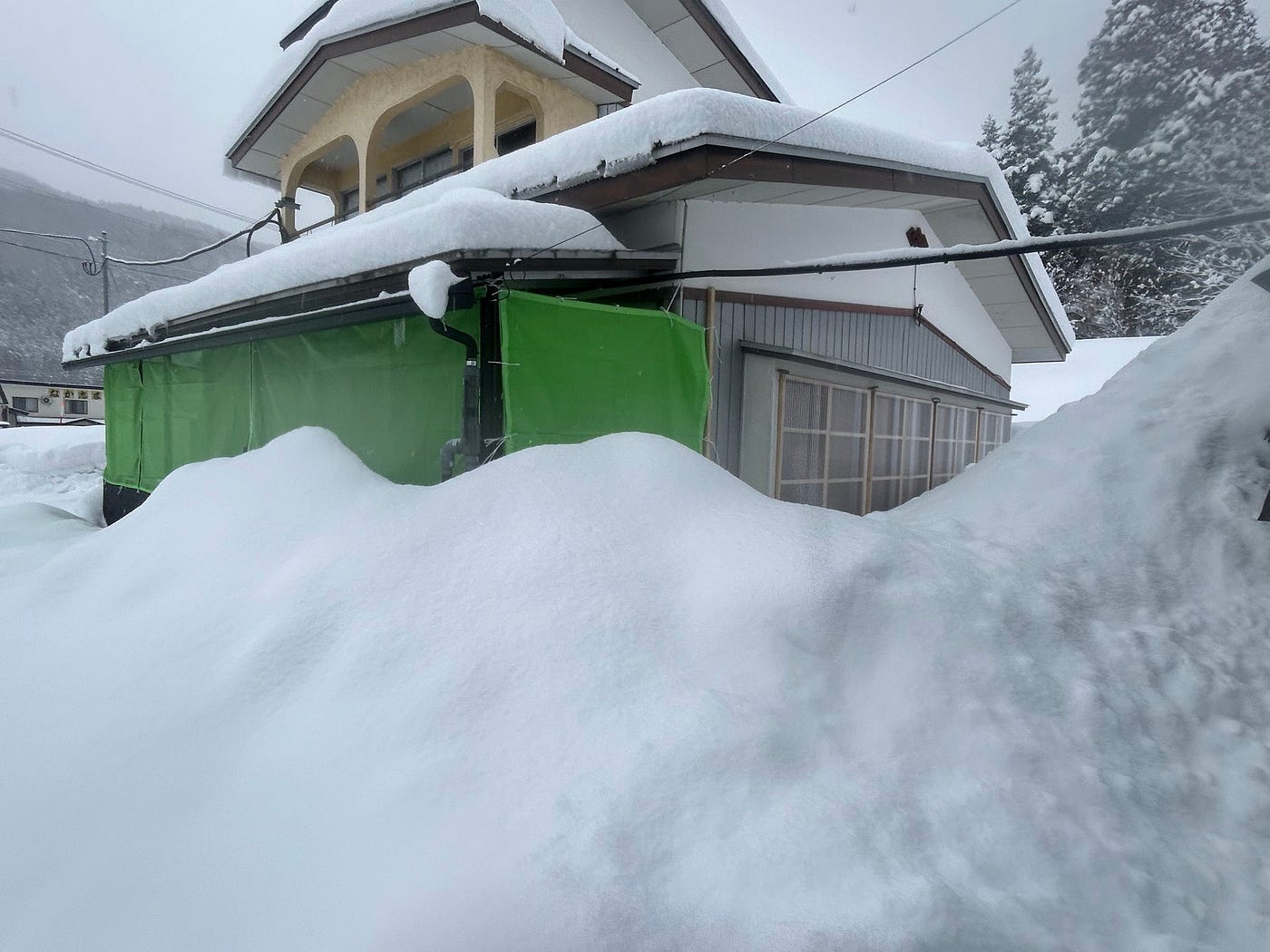


A vacant house in a snowy mountain community. I lived here to explore what infrastructure means in a shrinking society.
When people imagine infrastructure, they usually think of things that are too big to notice.
Power lines. Water pipes. Roads.
Systems that quietly work in the background. You turn on the tap, and water comes out. Most of us rarely ask what happens behind that moment.
I used to think the same way.
Then I moved into a small village in northern Japan and spent 270 days living without a conventional municipal water connection.
Not because of disaster. Not because the system had failed. But because we wanted to ask a difficult question:
What happens when communities become too small to sustain the infrastructure they were built around?
A Country Built for Growth Is Learning How to Shrink
Japan is often described as a country living in the future.
But in many rural regions, that future feels less like advanced technology and more like a simple question:
Who will maintain the systems we already built?
Japan’s population peaked in 2008 and has continued to decline. For decades, population decline was discussed mostly as a labor problem or a social issue.
But standing in rural communities, I began to see something else.
Population decline is becoming an infrastructure issue. Water infrastructure is one of the clearest examples.
During Japan’s period of rapid economic growth, water systems were expanded across nearly every region of the country.
Pipes were laid. Treatment plants were built. Centralized networks became part of everyday life.
But those systems were designed for a society that expected growth.
Today, more than forty years later, many of those facilities and pipelines have reached or exceeded their expected service life.
The water infrastructure built across all regions of Japan during the period of rapid economic growth has now exceeded its 40-year service life, and population decline is making it increasingly difficult to maintain.
Water utilities are facing a difficult reality.
Water pipes do not become shorter when residents leave.
Treatment facilities still need operation. Maintenance still happens. Snow still falls.
But fewer people remain to support the same system.
Maintaining infrastructure designed for growth inside shrinking communities creates a difficult imbalance.
And nowhere did this feel more visible to me than Akita.
Why Akita?
Akita Prefecture is often introduced through numbers.
One of Japan’s fastest population declines.
One of the highest aging rates.
Many municipalities facing depopulation.
But numbers alone do not explain what that means.
You understand it when you walk through a neighborhood and see empty houses.
You understand it when residents talk about children who moved away.
And you understand it when conversations about infrastructure quietly become conversations about whether a community can continue to exist.
That was the reason I moved there.
Not to demonstrate technology.
To understand what infrastructure means when growth is no longer guaranteed.

Moving Into the Experiment
The village was surrounded by mountains.
Winter arrived quickly. Snow accumulated faster than I expected.
And inside the house where I lived, daily life depended on a decentralized water system rather than a traditional municipal connection.
At first, I approached it as a technical experiment.
Could people actually live comfortably?
Would maintenance become difficult?
Would the system survive winter?
Would residents accept it?
Like many people working around infrastructure, I thought performance would decide everything.
I was wrong.
Life Without Conventional Water Was Surprisingly Ordinary
Daily life turned out to be surprisingly normal.
I cooked. I washed dishes. I showered. I cleaned. Most days did not feel experimental at all. And that was exactly what surprised me.
Good infrastructure disappears. Nobody wakes up excited that water arrived correctly. The best infrastructure becomes invisible.
But living there also made me realize something else.
Infrastructure is not only physical. It is social.

Residents visiting my home and discussing infrastructure — not as engineers, but as people thinking about how their community will continue.
The Turning Point Was Not Technical
Residents began visiting.
Some were curious. Some were skeptical. Some asked direct questions.
“Why would we need this?” “We already have water.”
Those reactions made sense. Nobody wants change while the current system still works. People do not adopt infrastructure because technology is interesting. They adopt it when they believe it helps protect daily life.
So conversations gradually changed. Instead of discussing equipment, we discussed the future.
Who will maintain pipes twenty years from now?
What happens when fewer households remain?
What options exist besides simply continuing?
The discussion stopped being about replacing infrastructure. It became about preparing choices.

A roundtable discussion with local residents focused on the future of water infrastructure.
What 270 Days Changed for Me
The biggest lesson was not technical.
It was this: Infrastructure is not pipes. Infrastructure is relationships.
Water systems work because people trust them. Communities work because people participate.
Technology matters. But trust determines whether technology survives.
During those months, I spent time doing things that had little to do with water.
Helping with snow. Joining local activities. Talking with residents. Sharing meals. Listening.
Slowly, I realized that what looked like a demonstration project from outside felt completely different from inside.
It felt like learning how a community functions.
A Different Question About the Future
I did not leave Akita believing centralized water systems should disappear.
That was never the point. Large systems remain essential.
But I left with a new question.
If population decline becomes one of the defining challenges of this century — should infrastructure remain the same size forever?
Or should we begin imagining systems that can become smaller, more local, and more adaptable?
I still do not think there is one universal answer. But I believe we should begin asking.
Because once infrastructure reaches its limit, redesigning it becomes much harder than preparing for change.
And sometimes, understanding that starts not with a spreadsheet —
but by living there.
—
If you have seen communities facing similar challenges in your region, I would love to hear your story.
메타데이터
- post_id
- d46b32f3e1c9
- slug
- i-lived-270-days-without-water-infrastructure-in-rural-japan-d46b32f3e1c9
- url
- https://medium.com/@yumemi.ishii/i-lived-270-days-without-water-infrastructure-in-rural-japan-d46b32f3e1c9
- canonical_url
- https://medium.com/@yumemi.ishii/i-lived-270-days-without-water-infrastructure-in-rural-japan-d46b32f3e1c9
- author_url
- https://medium.com/@yumemi.ishii
- status
- ok
- fetched_at
- 2026-07-26 17:51:35