Spring Boot: Difference Between application.yml vs application.properties
If you’re new to YAML, it might feel weird at first — like riding a bicycle after years of driving a car. But once you get the hang of it…
Spring Boot: Difference Between application.yml vs application.properties
If you’re new to YAML, it might feel weird at first — like riding a bicycle after years of driving a car. But once you get the hang of it, you’ll love how clean and organized it is! 🚴♂️
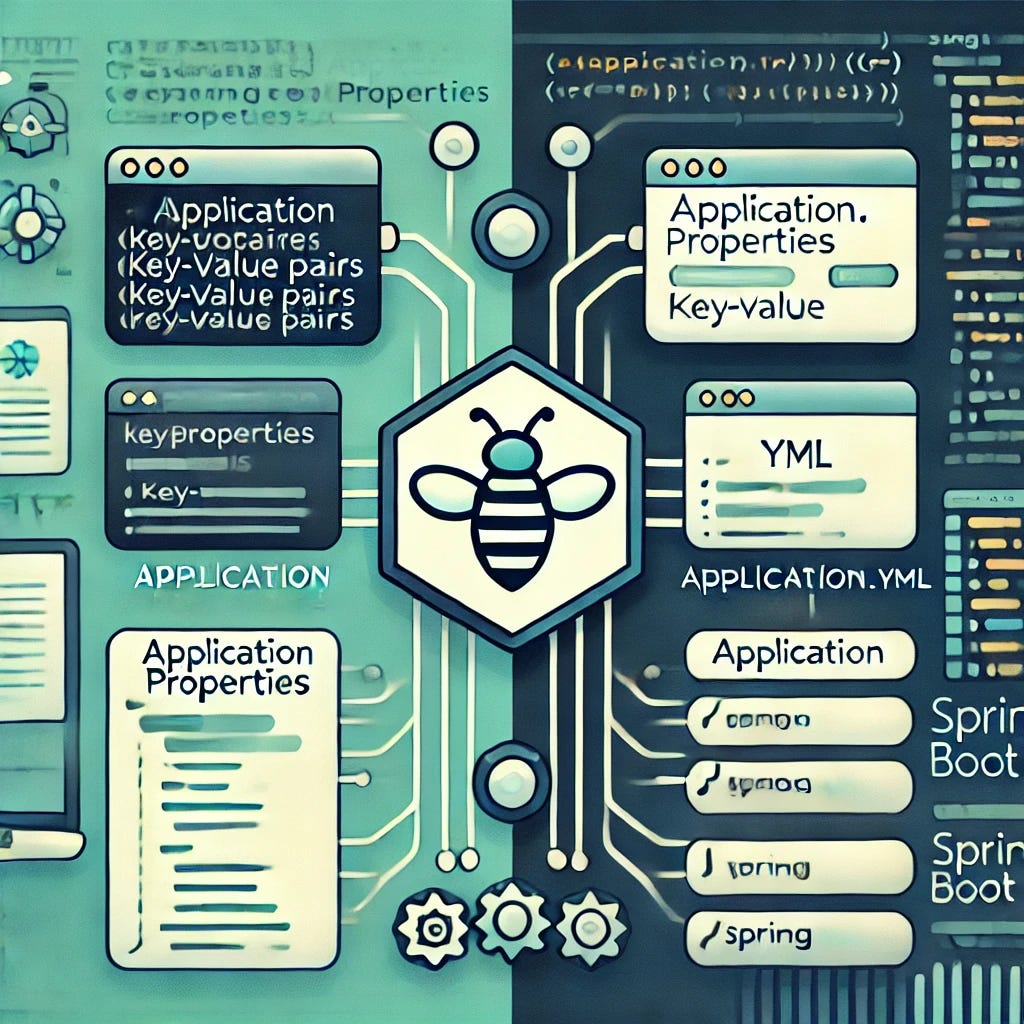
Image generated by DALL-E
When developing a Spring Boot application, one of the essential tasks is configuration. Spring Boot offers two common formats for external configuration: **application.properties and `application.yml`** (YAML). Both serve the same purpose—configuring application settings—but they differ in structure and style.
In this blog, we’ll explore the differences between application.yml and application.properties, their respective strengths and weaknesses, and when to use each. Let’s dive in!
What Are application.properties and application.yml?
application.properties
application.properties is the more traditional and straightforward format. It uses key-value pairs to define configurations.
Example:
server.port=8080
spring.datasource.url=jdbc:mysql://localhost:3306/mydb
spring.datasource.username=root
spring.datasource.password=rootpassword
In this format, each configuration is represented by a single line where the key is followed by the value. Properties files are simple to read and commonly used across many Java projects.
application.yml
application.yml uses YAML (Yet Another Markup Language) format. YAML is hierarchical and more human-readable, especially when dealing with complex configurations.
Example:
server:
  port: 8080

spring:
  datasource:
    url: jdbc:mysql://localhost:3306/mydb
    username: root
    password: rootpassword
YAML files use indentation to represent the relationship between keys and values, making them visually organized.
Key Differences Between application.properties and application.yml
1. Readability and Structure
- Properties:
- Simple and linear.
- Ideal for basic configurations.
- Keys are flattened, which can make hierarchical configurations harder to read.
- YAML:
- More structured and organized.
- Supports nested values and hierarchical data, which improves readability for complex configurations.
Example of hierarchical data in properties:
spring.datasource.url=jdbc:mysql://localhost:3306/mydb
spring.datasource.username=root
spring.datasource.password=rootpassword
Same in YAML:
spring:
  datasource:
    url: jdbc:mysql://localhost:3306/mydb
    username: root
    password: rootpassword
YAML’s structured approach makes it easier to identify groups of related configurations.
2. Syntax
- Properties: Each configuration key-value pair is defined on a single line using
=or:as the delimiter. - YAML: YAML uses indentation to represent nested configurations, and colons
:separate keys from values. This hierarchy is YAML’s strength for more complex setups.
Example of multiple properties:
- In
properties:
logging.level.root=INFO
logging.level.org.springframework=DEBUG
In YAML:
logging:
  level:
    root: INFO
    org.springframework: DEBUG
3. Comments
- Properties: Supports inline comments using the
#character.
# Set the server port
server.port=8080
. YAML: Comments also use the # character.
# Set the server port
server:
  port: 8080
Both formats handle comments similarly.
4. Complex Data Structures
- Properties: Managing lists or complex data types in
.propertiesis difficult and not intuitive. - Example of a list in
properties:
spring.datasource.servers=server1,server2,server3YAML: YAML natively supports lists and complex structures.
Example of a list in YAML:
spring:
  datasource:
    servers:
      - server1
      - server2
      - server3
For more sophisticated configurations, YAML is much more user-friendly.
5. Multiline Values
- Properties: Adding multiline values is awkward and error-prone.
- Example in
properties:
my.message=Hello \
           Spring Boot \
           Developers
YAML: YAML handles multiline strings naturally.
Example in YAML:
my:
  message: |
    Hello
    Spring Boot
    Developers
YAML provides a clean approach to handling multiline strings and other complex data types.
When to Use application.properties
- Simple Configurations: If your configuration is basic with only a few properties, a
propertiesfile is sufficient. - Traditional Approach: For developers who prefer simplicity and have used
.propertiesfor years, the properties format remains familiar and effective. - IDE Autocompletion: Some developers stick with
propertiesbecause many IDEs provide excellent autocompletion and validation support for this format.
When to Use application.yml
- Complex Configurations: If your project requires more complex configurations with nesting or multiple profiles, YAML is far easier to read and manage.
- Structured Data: YAML’s hierarchical structure is better suited for complex data structures like lists, objects, and nested keys.
- Readability: YAML provides a cleaner and more readable format, especially for larger configuration files.
Performance and Other Considerations
- Performance: There is no significant difference in performance between the two formats. Both are handled efficiently by Spring Boot.
- Consistency: Stick with one format throughout the project for consistency, as using both
.propertiesand.ymlcan create confusion. - Environment-specific Configurations: Both formats support environment-specific files (
application-dev.yml,application-prod.properties), making them versatile for any deployment setup.
Conclusion
In Spring Boot, whether you choose application.properties or application.yml largely depends on personal preference and project complexity. For smaller, straightforward applications, properties can be simpler and quicker. However, for larger applications with nested configurations, yml shines with its readability and structured format.
Stackademic 🎓
Thank you for reading until the end. Before you go:
- Please consider clapping and following the writer! 👏
- Follow us **X | [LinkedIn](https://www.linkedin.com/company/stackademic) | [YouTube](https://www.youtube.com/c/stackademic) | [Discord](https://discord.gg/in-plain-english-709094664682340443) | [Newsletter](https://newsletter.plainenglish.io/) | [Podcast](https://open.spotify.com/show/7qxylRWKhvZwMz2WuEoua0)**
- **Create a free AI-powered blog on Differ.**
- More content at **Stackademic.com**
메타데이터
- post_id
- d476b867f5f5
- slug
- spring-boot-difference-between-application-yml-vs-application-properties-d476b867f5f5
- url
- https://blog.stackademic.com/spring-boot-difference-between-application-yml-vs-application-properties-d476b867f5f5
- canonical_url
- https://blog.stackademic.com/spring-boot-difference-between-application-yml-vs-application-properties-d476b867f5f5
- author_url
- https://medium.com/@mbusinesssolutions
- status
- ok
- fetched_at
- 2026-08-05 18:45:48