Amazon FBA Seller Problems and Solutions: 15 Challenges & How to Fix Them
Starting an Amazon FBA business can look simple from the outside: find a product, send inventory to Amazon, create a listing, and start…
Amazon FBA Seller Problems and Solutions: 15 Challenges & How to Fix Them
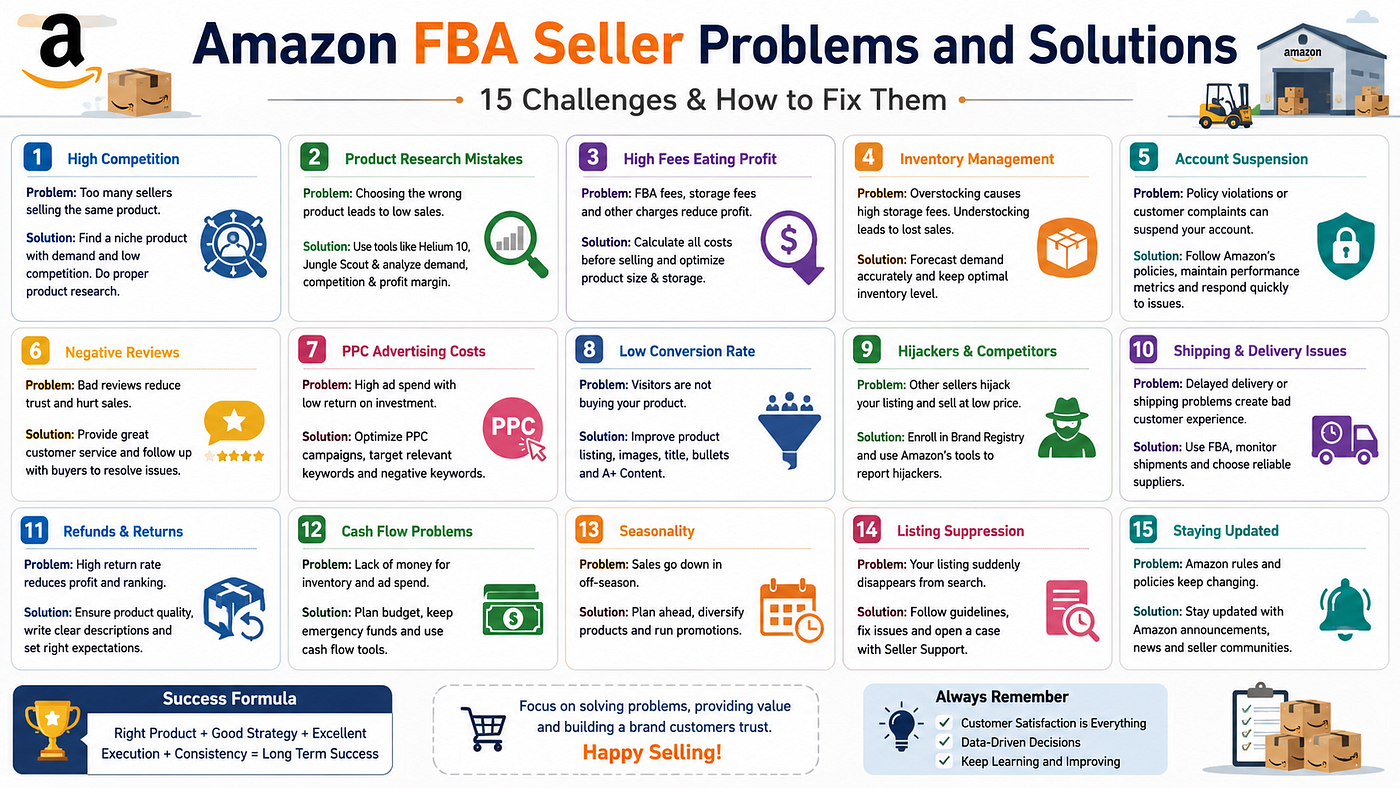
Amazon FBA Seller Problems and Solutions: 15 Challenges & How to Fix Them
Starting an Amazon FBA business can look simple from the outside: find a product, send inventory to Amazon, create a listing, and start selling. In reality, successful sellers deal with product research, competition, inventory, Amazon fees, advertising, returns, account health, and cash-flow challenges.
The good news is that **most Amazon FBA seller problems** can be managed when you understand them early and build systems around them.
This guide covers 15 common Amazon FBA challenges and practical solutions that new and growing sellers should know.
1. Choosing the Wrong Product
One of the biggest Amazon FBA problems is selecting a product based on personal opinion instead of market data.
A product may look profitable but have weak demand, heavy competition, poor margins, or expensive shipping.
Solution: Research demand, competition, reviews, selling price, estimated fees, product size, and potential profit before investing in inventory. Do not order a large quantity until the numbers make sense.
2. High Amazon FBA Fees
FBA is convenient because Amazon handles fulfillment, shipping, customer service, and returns, but these services come with costs. FBA expenses can include fulfillment and storage fees, while aged inventory can create additional costs when products remain stored for extended periods.
Solution: Calculate your complete landed cost before purchasing inventory. Include product cost, freight, customs where applicable, Amazon fees, advertising, returns, and other operating expenses.
A product that looks profitable at $30 may not be profitable after all expenses.
3. Running Out of Inventory
Stockouts can be damaging because your product stops generating sales while competitors continue selling.
New sellers often reorder too late because they only look at current inventory instead of sales velocity and supplier lead time.
Solution: Track your daily sales rate, inventory level, supplier lead time, and reorder point. Keep a reasonable safety stock instead of waiting until inventory reaches zero.
4. Too Much Inventory
The opposite problem can be just as dangerous.
Ordering thousands of units before validating demand can trap your money in unsold inventory. Storage expenses can also increase when inventory remains in Amazon’s fulfillment network.
Solution: Start with controlled inventory quantities, validate demand, monitor sales velocity, and reorder based on actual performance rather than assumptions.
5. Intense Competition
Amazon is highly competitive. A good product can attract multiple sellers, including established brands with larger advertising budgets.
Trying to win only by lowering your price can destroy your profit margin.
Solution: Compete on more than price. Improve your product quality, listing, images, customer experience, packaging, branding, and value proposition.
Ask yourself: Why should a customer choose my product instead of the next listing?
6. Low Product Visibility
Having a good product does not automatically mean customers will find it.
Poor keyword targeting, weak listing content, low conversion rates, and inadequate advertising can limit visibility.
Solution: Optimize your product title, bullet points, description, images, and backend search terms around relevant customer searches. Use advertising strategically to test keywords and generate qualified traffic.
Do not stuff keywords unnaturally. The goal is to help shoppers understand the product while making its relevance clear.
7. Amazon PPC Costs Too Much
Amazon advertising can become one of the biggest expenses for sellers.
A common mistake is increasing ad spending without understanding which campaigns, keywords, and products are actually producing profitable sales.
Solution: Track important PPC metrics such as spend, sales, conversion rate, CPC, ACOS, and TACOS. Separate campaigns by purpose and regularly reduce waste from irrelevant or expensive search terms.
Remember: more sales do not automatically mean more profit.
8. Poor Listing Conversion
You may receive traffic but still struggle to generate orders.
This often happens when customers do not immediately understand the product’s benefits or do not trust the listing.
Solution: Improve the complete customer-facing experience. Use clear product images, benefit-focused copy, accurate specifications, comparison information, and persuasive but truthful messaging.
Your listing should answer the buyer’s main questions before they leave the page.
9. Negative Reviews
Negative reviews can reduce customer trust and hurt conversion.
However, trying to manipulate reviews is not a sustainable solution.
Solution: Find the reason behind the negative feedback. If customers repeatedly complain about packaging, quality, instructions, sizing, or another issue, improve the product or customer experience.
Use legitimate customer feedback as product research.
10. Product Returns
Returns are a normal part of e-commerce, but a high return rate can indicate a deeper problem.
Customers may return products because the product description is unclear, expectations are incorrect, quality is inconsistent, or the item does not match the listing.
Solution: Analyze return reasons and customer feedback. Improve product information, images, instructions, packaging, and quality control where necessary.
The goal should not simply be to reduce returns; it should be to reduce avoidable returns.
11. Supplier Problems
A supplier can affect your entire Amazon business.
Late shipments, inconsistent quality, communication problems, or unexpected price increases can create serious operational issues.
Solution: Do proper supplier due diligence before placing large orders. Request samples, verify product specifications, establish quality-control procedures, and maintain backup supplier relationships when practical.
Never depend entirely on a supplier you have not properly evaluated.
12. Cash-Flow Problems
A profitable Amazon business can still experience cash-flow pressure.
You may have money tied up in inventory while simultaneously needing funds for advertising, reorders, shipping, and operating expenses.
Solution: Maintain a cash-flow forecast. Know how much money is committed to inventory, how quickly products sell, when supplier payments are due, and how much capital you need for the next reorder.
Do not confuse revenue with available cash.
13. Amazon Account Health Issues
Account-related problems can be extremely stressful for sellers.
Policy violations, intellectual-property complaints, listing issues, or other account-health concerns can affect your ability to sell.
Solution: Understand Amazon’s current seller policies and monitor account health regularly. Keep documentation related to products, suppliers, invoices, and compliance.
If Amazon raises an issue, respond carefully with accurate information and address the underlying problem instead of simply trying to write a quick appeal.
14. Trying to Do Everything Yourself
Many new sellers attempt to handle product research, sourcing, listing creation, PPC, customer service, inventory management, bookkeeping, and strategy alone.
This can quickly become overwhelming.
Solution: Build systems before trying to scale. Automate repetitive tasks where appropriate and outsource specialized work when the cost makes business sense.
The goal is not to personally perform every task. The goal is to control the important decisions and build a business that can operate efficiently.
15. Scaling Too Quickly
One of the most overlooked Amazon FBA seller challenges is growing before the business is ready.
A seller may experience a sudden increase in sales and immediately order much more inventory, increase advertising, or launch several new products.
That can create cash-flow problems and operational chaos.
Solution: Scale based on reliable data. Before increasing inventory or advertising significantly, understand your margins, conversion rate, sales velocity, cash position, and operational capacity.
Sustainable growth is generally better than uncontrolled growth.
How to Avoid Amazon FBA Problems Before They Become Expensive
The best Amazon FBA strategy is not waiting for problems to happen.
Create a simple weekly review system covering:
· Sales and profit
· Inventory levels
· Reorder requirements
· Advertising performance
· Product returns
· Customer feedback
· Account health
· Supplier performance
· Cash flow
This gives you an early warning system.
For example, falling sales combined with rising PPC costs may indicate a conversion or competitive problem. Increasing sales combined with declining cash flow may indicate an inventory-financing problem.
The numbers should tell you where the problem is before you spend more money trying to fix it.
Is Amazon FBA Still Worth It?
Amazon FBA can still be a viable business model, but it is not a guaranteed or effortless way to make money.
The sellers most likely to build sustainable businesses understand their numbers, choose products carefully, manage inventory, control advertising costs, protect account health, and continuously improve their customer experience.
The biggest mistake is treating Amazon FBA as a shortcut to passive income.
It is better to think of FBA as an e-commerce operating system: Amazon provides much of the fulfillment infrastructure, but the seller is still responsible for product selection, economics, marketing, inventory decisions, and business strategy.
Final Thoughts
Amazon FBA seller problems are not necessarily signs that the business model does not work. They are often signs that the seller needs better research, systems, financial controls, or operational processes.
Whether you are struggling with Amazon FBA inventory problems, PPC costs, product research, negative reviews, supplier issues, or cash flow, the right approach is to identify the root cause instead of applying a quick fix.
If you’re considering starting or scaling an Amazon FBA business, focus less on chasing the next “winning product” and more on building a repeatable business model.
That shift — from looking for shortcuts to understanding the numbers — is what can separate a short-term Amazon seller from a serious e-commerce business owner.
**Abuv The Par** focuses on helping aspiring and growing Amazon sellers understand the business side of Amazon FBA, from product and business-model decisions to sustainable growth strategies.
메타데이터
- post_id
- d47a5ae0f670
- slug
- amazon-fba-seller-problems-and-solutions-15-challenges-how-to-fix-them-d47a5ae0f670
- url
- https://medium.com/@apluspainting/amazon-fba-seller-problems-and-solutions-15-challenges-how-to-fix-them-d47a5ae0f670
- canonical_url
- https://medium.com/@apluspainting/amazon-fba-seller-problems-and-solutions-15-challenges-how-to-fix-them-d47a5ae0f670
- author_url
- https://medium.com/@apluspainting
- status
- ok
- fetched_at
- 2026-08-18 07:12:45