AI Made Translation Faster. Why Does Localization Feel Harder Than Ever?
Over the last few months, I’ve had conversations with localization leaders from different parts of the world — enterprise teams, LSPs…
AI Made Translation Faster. Why Does Localization Feel Harder Than Ever?
Over the last few months, I’ve had conversations with **localization** leaders from different parts of the world — enterprise teams, LSPs, production managers, language specialists, AI leads, and even founders trying to figure out where this industry is heading next.
And interestingly, most of those conversations begin with the same sentence:
“AI has made translation faster… but somehow our operations feel more chaotic than before.”
At first, it sounds contradictory.
Wasn’t AI supposed to simplify localization?
Wasn’t the promise:
- faster turnaround,
- lower costs,
- scalable multilingual content,
- and fewer operational bottlenecks?
In many ways, yes — that has happened.
But something else happened too.
The nature of the bottleneck changed.
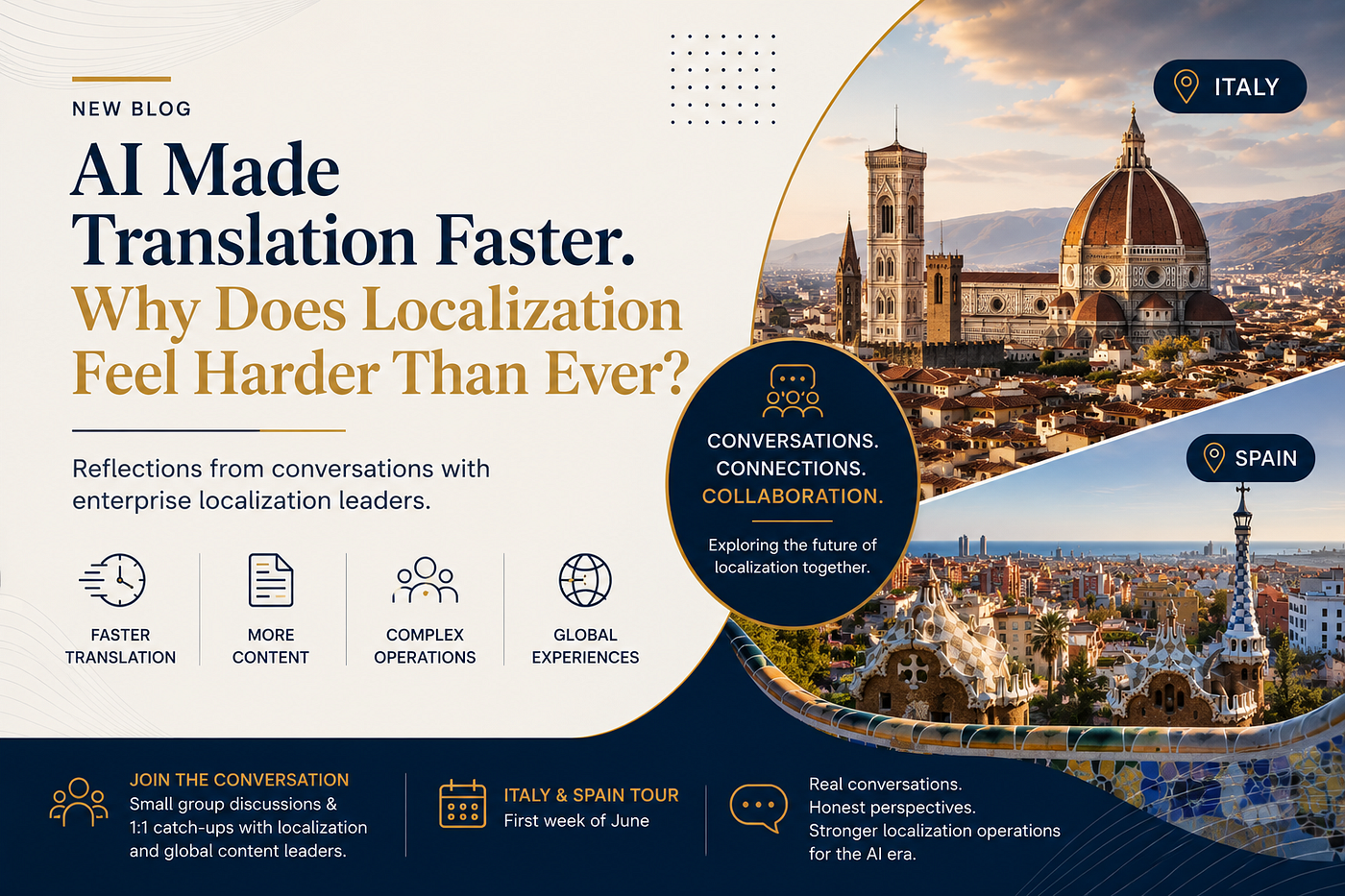
And that is exactly why, over the next few weeks, we’re travelling across Italy and Spain to meet localization professionals, enterprise teams, and partners — not just to talk about AI, but to understand how localization operations themselves are evolving in the AI era.
Because while everyone is discussing translation quality…
…the bigger operational story is quietly unfolding behind the scenes.
The “More Content” Problem Nobody Prepared For
A few years ago, enterprises were selective about what they localized.
A product manual? Yes.
Website pages? Important ones only.
Training videos? Maybe later.
Internal knowledge bases? Not a priority.
Then AI translation arrived.
Suddenly the economics changed.
Content that previously felt “too expensive to localize” became possible overnight.
And enterprises reacted exactly how you would expect them to:
They started localizing everything.
More markets. More languages. More product updates. More learning content. More support articles. More video. More documentation. More UI strings. More revisions.
One localization manager I recently spoke with joked:
“AI didn’t reduce our workload. It multiplied it in 42 languages.”
Funny. Painfully accurate. And increasingly common.
The Hidden Reality: Translation Became Faster Than Operations
This is the part people don’t talk about enough.
Translation is no longer the slowest part of localization.
Operations are.
The downstream chaos begins after the content gets translated:
- formatting breaks,
- multilingual layout inconsistencies,
- subtitle timing issues,
- publishing delays,
- review overload,
- terminology drift,
- regional adaptation gaps,
- file engineering complications,
- QA cycles stretching endlessly.
A European enterprise team recently shared something fascinating.
Before AI, they localized around 20–25% of their internal learning content.
Today?
Nearly 85%.
Sounds like progress.
But here’s the catch: Their review team size barely changed.
Result? Thousands of AI-generated multilingual assets waiting for human validation.
Their words, not mine:
“We solved translation speed and created review paralysis.”
That sentence stayed with me.
Because it perfectly captures where the industry stands today.
The Great Irony of AI Localization
For years, localization teams fought for budget approvals.
Now many of them are fighting for operational breathing room.
In some organizations:
- content creation is exploding,
- marketing teams are publishing faster,
- product teams are shipping updates weekly,
- AI translation is instant,
- but localization operations are still running on workflows designed for 2018.
Imagine upgrading a Formula 1 engine… while keeping the same village roads.
That’s what many localization ecosystems feel like right now.
A Small Story from a Coffee Shop
A few weeks ago, during a conversation with someone leading localization operations for a global SaaS company, we ended up talking less about technology and more about coffee.
Specifically… Italian coffee.
He laughed and said:
“Localization today feels like ordering an espresso in Italy when you expected a giant takeaway cappuccino.”
You think it’ll be simple. Quick. Standardized.
Then you realize:
- every region behaves differently,
- expectations change,
- context matters,
- presentation matters,
- experience matters.
And suddenly localization becomes deeply human again.
Not just linguistic.
Human.
That perspective is becoming more important than ever.
Because AI can generate language.
But operational intelligence? Cultural nuance? Publishing readiness? Workflow resilience?
Those still require people who understand the ecosystem behind the words.
The Shift Nobody Is Measuring Properly
Most AI-localization discussions still focus heavily on:
- BLEU scores,
- translation quality,
- automation percentages,
- cost reduction,
- productivity gains.
Important metrics, absolutely.
But I think we’re entering a phase where another question matters even more:
“Can your localization operations absorb AI-scale content without collapsing?”
That’s a very different challenge.
And honestly, many teams are still figuring it out in real time.
Case Study: When “Faster” Actually Slowed Things Down
One enterprise team expanded AI-assisted multilingual support content across 30+ markets.
Initially, leadership celebrated:
- turnaround time improved,
- translation costs dropped significantly,
- publishing volume increased dramatically.
Three months later, operational cracks appeared:
- inconsistent terminology across regions,
- support screenshots mismatched localized interfaces,
- subtitles failed in regional video formats,
- design overflows broke mobile layouts,
- reviewers became overloaded,
- content updates started piling up faster than approvals.
Ironically, the final publishing delays became longer than before.
Not because translation was slow.
Because operational coordination became harder at scale.
This is where I think the industry is learning an important lesson:
AI does not eliminate complexity.
It redistributes it.
Europe Is Asking Very Interesting Questions
One reason I’m particularly excited about our upcoming Italy and Spain meetings is because European localization conversations often go deeper than just automation.
Many teams are asking:
- How do we maintain quality while scaling?
- What should humans still own?
- How do we redesign workflows for AI-generated volume?
- How do we reduce reviewer fatigue?
- What happens to multilingual brand consistency?
- How do we operationalize multimedia localization better?
- How do we avoid “cheap translation but expensive cleanup”?
And perhaps the most important question:
“What does a sustainable localization operation look like in the AI era?”
That’s the conversation I personally find most valuable.
Not AI vs humans.
But: How humans and AI can create operational systems that actually scale intelligently.
Another Reality Nobody Talks About Enough: Burnout
Localization professionals are among the most adaptive people I’ve met.
This industry has constantly evolved:
- CAT tools,
- MT,
- cloud workflows,
- remote collaboration,
- multimedia localization,
- AI translation,
- generative AI.
And teams keep adapting.
But behind the scenes, many people are exhausted.
Not because they resist innovation.
But because operational expectations are growing faster than support systems.
One manager recently told me:
“We’re expected to move twice as fast with the same team because leadership assumes AI solved everything.”
That sentence deserves attention.
Because the future of localization cannot just be about efficiency.
It also has to be about sustainability.
So Where Does This Leave Us?
Personally, I think we’re entering one of the most interesting phases this industry has ever seen.
Localization is no longer just about language conversion.
It’s becoming:
- operational orchestration,
- multilingual experience management,
- content scalability,
- cultural adaptation,
- multimedia production,
- workflow intelligence.
And perhaps most importantly:
Localization teams are becoming strategic business enablers rather than downstream support functions.
That shift is huge.
Why This Europe Tour Matters to Us
This upcoming visit across Italy and Spain is not simply about meetings.
It’s about listening.
Understanding how different organizations are navigating:
- AI-scale content,
- multilingual publishing complexity,
- operational redesign,
- enterprise localization transformation.
Some conversations may happen in boardrooms. Some over coffee. Some during roundtables. Some probably while debating whether pineapple belongs on pizza. (I’m staying diplomatically neutral.)
But those conversations matter.
Because the industry is changing rapidly. And the best insights rarely come from presentations alone.
They come from honest discussions between people navigating similar realities.
A Final Thought
For years, localization fought to prove its value.
Now the world suddenly wants more localization than ever before.
That’s an opportunity. But it’s also a responsibility.
Because scaling multilingual experiences globally is no longer just about translating faster.
It’s about building systems, workflows, and partnerships that can handle complexity without losing quality, context, or humanity.
And maybe that’s the real conversation the localization industry needs right now.
Not: “How fast can AI translate?”
But:
“How do we build smarter global content operations for the world AI is creating?”
Looking forward to exchanging perspectives with localization leaders and friends across Europe over the coming weeks.
If you’re based in Italy or Spain and would like to connect for a conversation around the future of localization operations, **multilingual publishing**, or AI-era workflow challenges — happy to meet.
메타데이터
- post_id
- d47da00af77a
- slug
- ai-made-translation-faster-why-does-localization-feel-harder-than-ever-d47da00af77a
- url
- https://medium.com/@dtplabs2024/ai-made-translation-faster-why-does-localization-feel-harder-than-ever-d47da00af77a
- canonical_url
- https://medium.com/@dtplabs2024/ai-made-translation-faster-why-does-localization-feel-harder-than-ever-d47da00af77a
- author_url
- https://medium.com/@dtplabs2024
- status
- ok
- fetched_at
- 2026-06-22 00:13:37