NineData Product Update (Jan-Feb 2026) is here!
In the first two months of 2026, NineData focused on strengthening its pre-migration assessment capabilities, enhancing heterogeneous…
NineData Product Update (Jan-Feb 2026) is here!
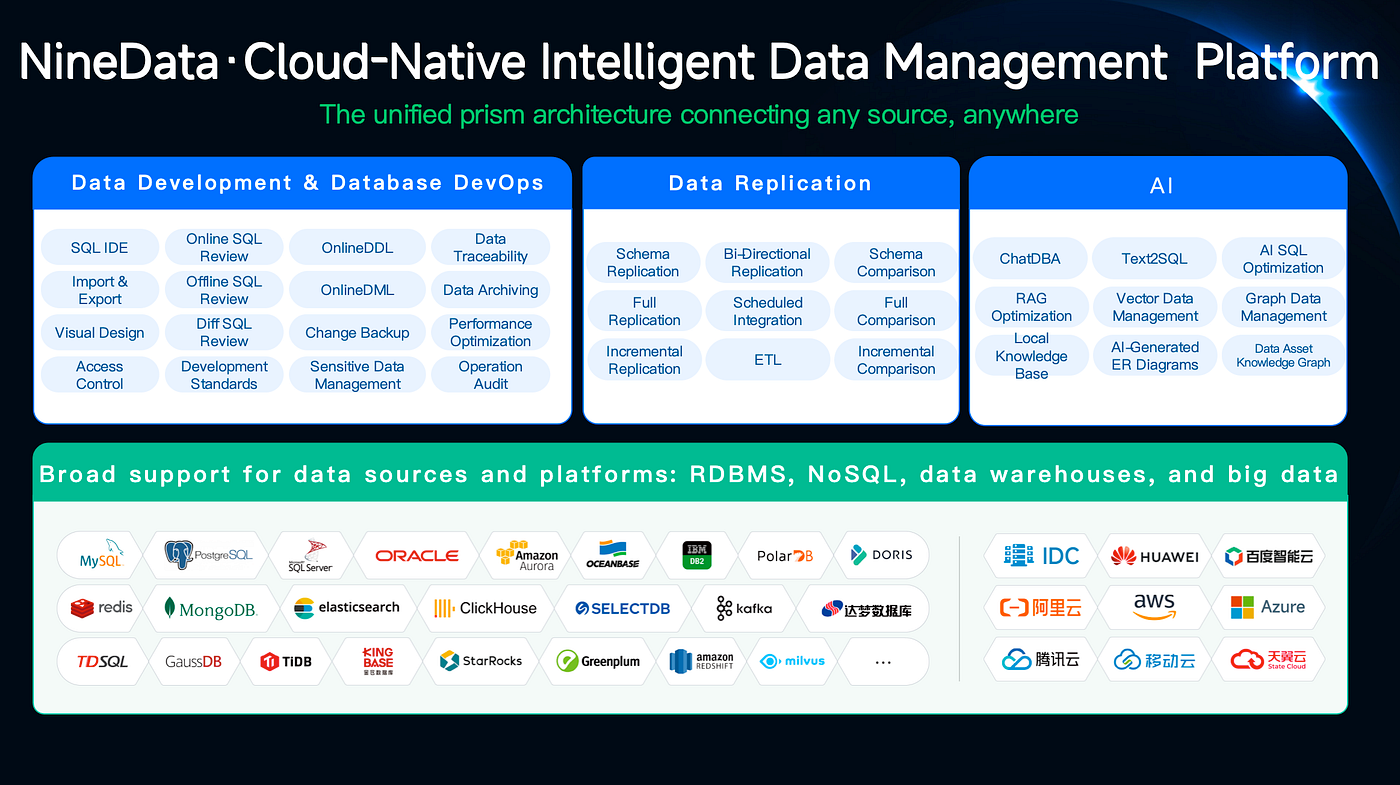
In the first two months of 2026, NineData focused on strengthening its pre-migration assessment capabilities, enhancing heterogeneous database replication, and refining the SQL DevOps experience. Key updates include AI-driven SQL development, extended Slow Query analysis, and streamlined authentication — all designed to accelerate database engineering velocity and simplify cross-cloud platform management.
Major Releases
1. SQL AI Autocomplete: Intelligent Development (Beta)
We have introduced SQL AI Autocomplete within the SQL Console. While traditional rule-based suggestions remain, the new AI engine (indicated by ghost-text previews) leverages semantic context to predict your next action. Simply hit Tab to accept suggestions.
- Semantic Syntax Completion: Goes beyond simple keywords to predict complex clause structures.
- Context-Aware Schema Logic: Intelligently maps tables and fields based on your active query.
- Smart Structural Refactoring: Faster construction of complex JOINs and nested subqueries.
Benefit: Reduces manual typing and syntax errors, significantly boosting developer productivity.
2. Expanded Observability: External Slow Log Ingestion (Elasticsearch)
The Slow Query Analysis module now supports ingesting logs from external sources, starting with Elasticsearch. This is a critical feature for enterprise architectures where:
- Slow logs are centralized in a unified logging platform (ELK stack).
- Direct access to the database slow_log table is restricted for security or performance reasons.
Benefit: Enables cross-system performance auditing and extends the boundaries of database governance without requiring direct DB overhead.
3. Pre-Migration Assessment Framework
To minimize risk in cloud-native transitions, NineData has officially launched its Database Migration Assessment tool. This feature analyzes compatibility and potential risks between source and target engines before a single row of data is moved.
Current Supported Pathways:
- MySQL > PostgreSQL
- MySQL > He3DB PostgreSQL
- Oracle > PostgreSQL
- Oracle > He3DB PostgreSQL
Benefit: Provides a “pre-flight check” to identify syntax incompatibilities or schema mismatches, ensuring predictable migration timelines.
4. Expanded Heterogeneous Replication: HashData Support
We have broadened our support for high-performance analytical warehouses. The following pathways now support full schema, initial load, and incremental CDC (Change Data Capture) replication:
- Oracle → HashData
- GaussDB → HashData
5. Seamless Authentication: Social Login for Developers
To streamline the onboarding experience for our global user base, NineData now supports SSO (Single Sign-On) via:
- Google Account
- GitHub Account
Benefit: Accelerates the “time-to-value” for individual developers and distributed teams by removing registration friction.
Feature Enhancements
SQL DevOps & Performance
- PostgreSQL: Optimized Object Tree rendering performance, ensuring fluid navigation even in schemas with thousands of tables.
- MySQL: Improved SQL parsing logic for INSERT INTO…SELECT statements to enhance execution stability for complex batch operations.
Advanced Data Replication
- Source Decoupling: OpenGauss and DWS are now treated as independent data source types to provide clearer task configuration and specialized capability boundaries.
- Deep Oracle Integration: Enhanced support for Incremental DDL, Sequences, Indexes, Partitioned Tables, Case-Sensitivity, and Grant statements.
- GaussDB Capabilities: Added support for Sequence replication, Indexing, and Schema-based object filtering.
- Transaction Filtering: GaussDB → Oracle now supports filtering specific transactions and user-level SQL during replication.
- Oracle > GaussDB: Added support for replicating SEQUENCE objects.
- GaussDB/DWS as source: Supports filtering objects by SCHEMA.
Connectivity: Kafka NAT Mapping
For hybrid-cloud or cross-network environments, we’ve introduced Kafka Port/NAT Mapping. This allows users to manually map internal Kafka broker addresses to public-facing IPs accessible by NineData, solving “Connection Refused” errors caused by internal Kafka advertisements.
메타데이터
- post_id
- d48b1fb8a2d6
- slug
- ninedata-product-update-jan-feb-2026-is-here-d48b1fb8a2d6
- url
- https://medium.com/@ninedata/ninedata-product-update-jan-feb-2026-is-here-d48b1fb8a2d6
- canonical_url
- https://medium.com/@ninedata/ninedata-product-update-jan-feb-2026-is-here-d48b1fb8a2d6
- author_url
- https://medium.com/@ninedata
- status
- ok
- fetched_at
- 2026-06-24 04:09:36