Clairvoyance: A Complete Guide to Understanding Inner Vision and Intuitive Insight
In a world where uncertainty often shapes our decisions, many people are turning inward to seek clarity. One concept that continues to…
Clairvoyance: A Complete Guide to Understanding Inner Vision and Intuitive Insight
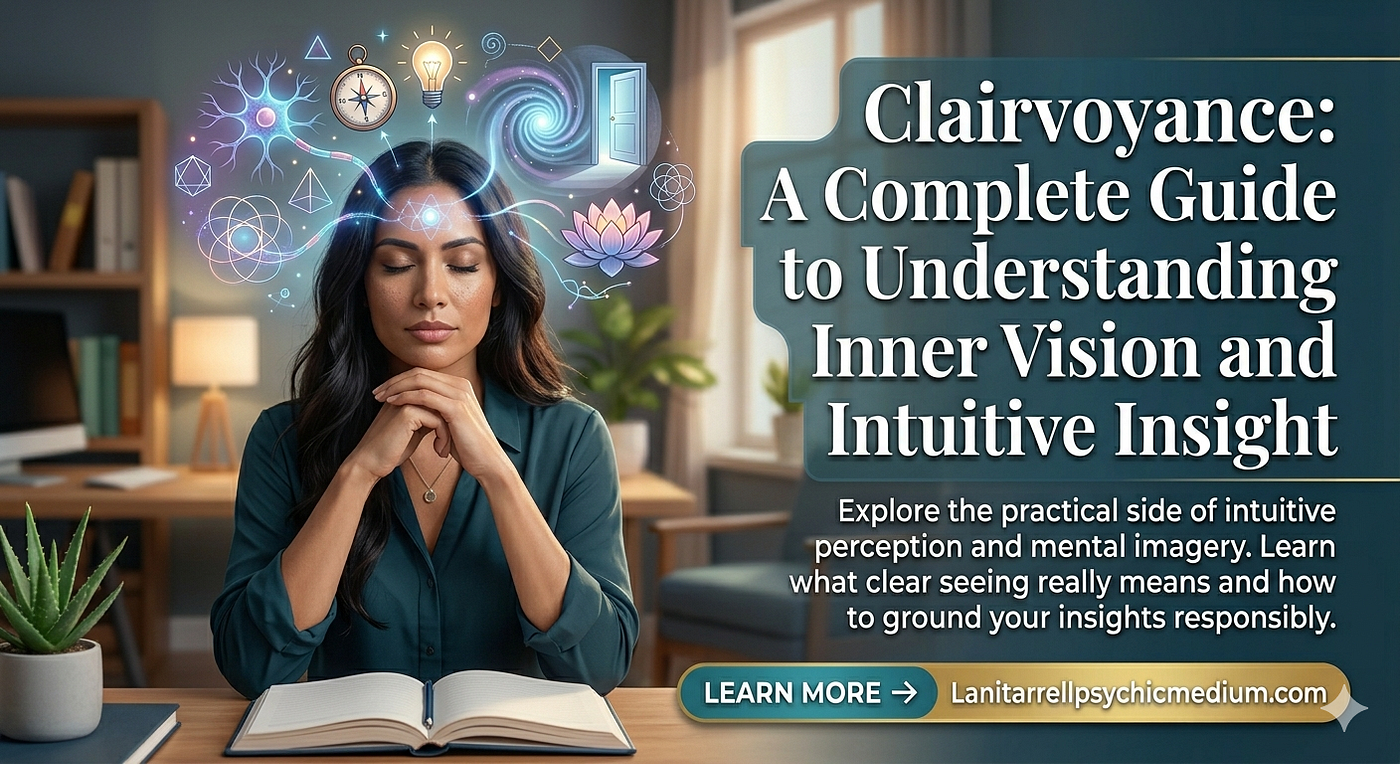
Clairvoyance: A Complete Guide
In a world where uncertainty often shapes our decisions, many people are turning inward to seek clarity. One concept that continues to spark curiosity is clairvoyance. Often misunderstood or oversimplified, clairvoyance is not just about predicting the future. It is about perception, awareness, and intuitive insight.
This guide explores what clairvoyance really means, how it works, and how it can be approached in a grounded and practical way.
What Is Clairvoyance?
Clairvoyance comes from the French words clair (clear) and voyance (vision), meaning “clear seeing.”
At its core, clairvoyance refers to the ability to receive intuitive information through mental imagery rather than through the five physical senses. This can appear as:
- Visual impressions or symbols
- Mental images
- Subtle inner visions
- Imaginative scenes that carry meaning
It is important to understand that clairvoyance is not always dramatic or cinematic. For many people, it is subtle and feels similar to imagination, but with a deeper sense of knowing.
How Clairvoyance Works
Clairvoyance is often described as part of a broader intuitive system. Rather than being separate from the mind, it works through it.
From a practical perspective, it involves:
- Pattern recognition based on subconscious processing
- Emotional and sensory awareness
- Symbolic interpretation
- Focused attention and mindfulness
Many practitioners believe that clairvoyance operates through the brain’s ability to synthesize internal and external cues into meaningful insights.
Clairvoyance vs Intuition
Clairvoyance is often confused with intuition, but they are not exactly the same.
- Intuition is a general sense of knowing without conscious reasoning
- Clairvoyance is a visual form of intuition, where insight appears as images or scenes
Think of intuition as the overall system, and clairvoyance as one specific channel within it.
Common Myths About Clairvoyance
There are several misconceptions that can create confusion:
Myth 1: Clairvoyance means predicting the future with certainty In reality, it is more about gaining perspective, not fixed outcomes.
Myth 2: Only a few people have this ability Many people experience intuitive imagery to some degree, even if they do not label it as clairvoyance.
Myth 3: It is always accurate Like any interpretive process, clarity depends on awareness, emotional state, and context.
Signs of Clairvoyant Tendencies
Some people naturally experience forms of visual intuition without realizing it. Common signs include:
- Strong mental imagery or vivid imagination
- Seeing symbolic images during reflection or meditation
- Visualizing outcomes or scenarios easily
- Noticing patterns through “mental pictures”
- Remembering dreams in visual detail
These experiences do not automatically mean someone is clairvoyant in a formal sense, but they can indicate a strong visual-intuitive style.
Can Clairvoyance Be Developed?
Clairvoyance is often described as a skill that can be refined rather than something entirely innate.
Some ways to strengthen visual intuition include:
-
Mindfulness Practices Quieting mental noise helps you notice subtle internal signals.
-
Visualization Exercises Practicing intentional imagery can improve clarity and focus.
-
Journaling Impressions Writing down images or insights helps track patterns over time.
-
Reducing Overanalysis Clairvoyant impressions are often immediate. Overthinking can distort them.
Development is less about gaining a “new power” and more about becoming aware of what is already present.
Ethical Considerations
As interest in clairvoyance grows, so does the importance of ethical awareness.
Responsible practice includes:
- Avoiding absolute predictions or fear-based messaging
- Encouraging personal agency and decision-making
- Recognizing the limits of interpretation
- Referring individuals to professionals when needed
Clairvoyance should support clarity, not replace critical thinking or professional guidance.
Clairvoyance in Modern Context
Today, clairvoyance is increasingly viewed through a balanced lens. Rather than being positioned as purely mystical, it is often discussed alongside:
- Psychological insight
- Emotional intelligence
- Mindfulness and self-awareness
- Cognitive processing of imagery
This modern perspective allows individuals to explore intuitive experiences without disconnecting from logic and evidence-based thinking.
Final Thoughts
Clairvoyance is best understood not as a supernatural shortcut, but as a form of inner perception. When approached with awareness and responsibility, it can offer a unique way to reflect, interpret, and gain clarity.
In an increasingly complex world, the ability to pause, observe internal signals, and interpret meaning thoughtfully is more valuable than ever.
If you’re exploring your own intuitive abilities or seeking spiritual guidance through life transitions, working with a professional psychic medium can provide clarity and direction. Learn more about online sessions and psychic readings at Lani Terrell’s website.
메타데이터
- post_id
- d4a3d44a5d11
- slug
- clairvoyance-a-complete-guide-to-understanding-inner-vision-and-intuitive-insight-d4a3d44a5d11
- url
- https://medium.com/@aasmakausar786/clairvoyance-a-complete-guide-to-understanding-inner-vision-and-intuitive-insight-d4a3d44a5d11
- canonical_url
- https://medium.com/@aasmakausar786/clairvoyance-a-complete-guide-to-understanding-inner-vision-and-intuitive-insight-d4a3d44a5d11
- author_url
- https://medium.com/@aasmakausar786
- status
- ok
- fetched_at
- 2026-07-14 23:34:00