The Illusion of Choice — Why Autonomy Feels Real
Human Illusion V — Consciousness as a Post-Hoc Narrative, Agency as an Evolutionary Comfort
The Illusion of Choice — Why Autonomy Feels Real
Human Illusion V — Consciousness as a Post-Hoc Narrative, Agency as an Evolutionary Comfort
🌀 This article is part of The Human Illusion, a series exploring the everyday myths and mental shortcuts we mistake for truth — from love to decision-making to the very words we use.
Humanity has always been drawn to grand, philosophical debates. From the existence of God to the ultimate fate of the universe, we fixate on binary dilemmas: fate or freedom, good or bad, black or white. Few of these debates are as enduring — or as personal — as the question of free will.
We frame it as a choice: Are we captains of our destiny, or passengers on a train whose tracks were laid long before we boarded?
Part of the reason we cling to this debate is cognitive efficiency. Our brains evolved to simplify — quick conclusions were a survival advantage when the threat was a predator in the bushes, not a late-night existential spiral. But that same binary reflex bleeds into the moral, philosophical, and political.
Good vs. Bad — The Oldest Internal Loop
We’re constantly judging ourselves. Should I eat this? Skip that? Speak up? Stay quiet? Each decision comes with its own courtroom drama in our heads, complete with prosecution, defense, and sentencing. This compulsion to categorize every action as good or bad is exhausting, but it’s deeply ingrained.
Historically, entire societies have been built around these binaries — religion, law, politics — systems designed to impose order on chaos. Yet despite our technological sophistication, our core hasn’t changed: we breathe, eat, sleep, excrete, and reproduce just like our ancestors. Our negativity bias — the tendency to notice threats more than opportunities — is still here, long after the saber-tooth tiger has gone.
The Constraints We Don’t See
Even when we believe we’re choosing freely, unseen forces are setting the boundaries.
- Fear limits what we’re willing to attempt.
- Social pressure pushes us toward conformity.
- Cognitive biases warp our perception of reality.
- Economic systems determine which options we can afford.
- Biology hardwires habits and impulses we rarely question.
We talk about “free” choice, but most choices are already narrowed by forces outside our awareness.
The Ultimate Constraint: You Didn’t Choose to Be Here
There’s one fact about free will we rarely acknowledge — possibly because it undermines the entire premise: you had no say in starting to exist.
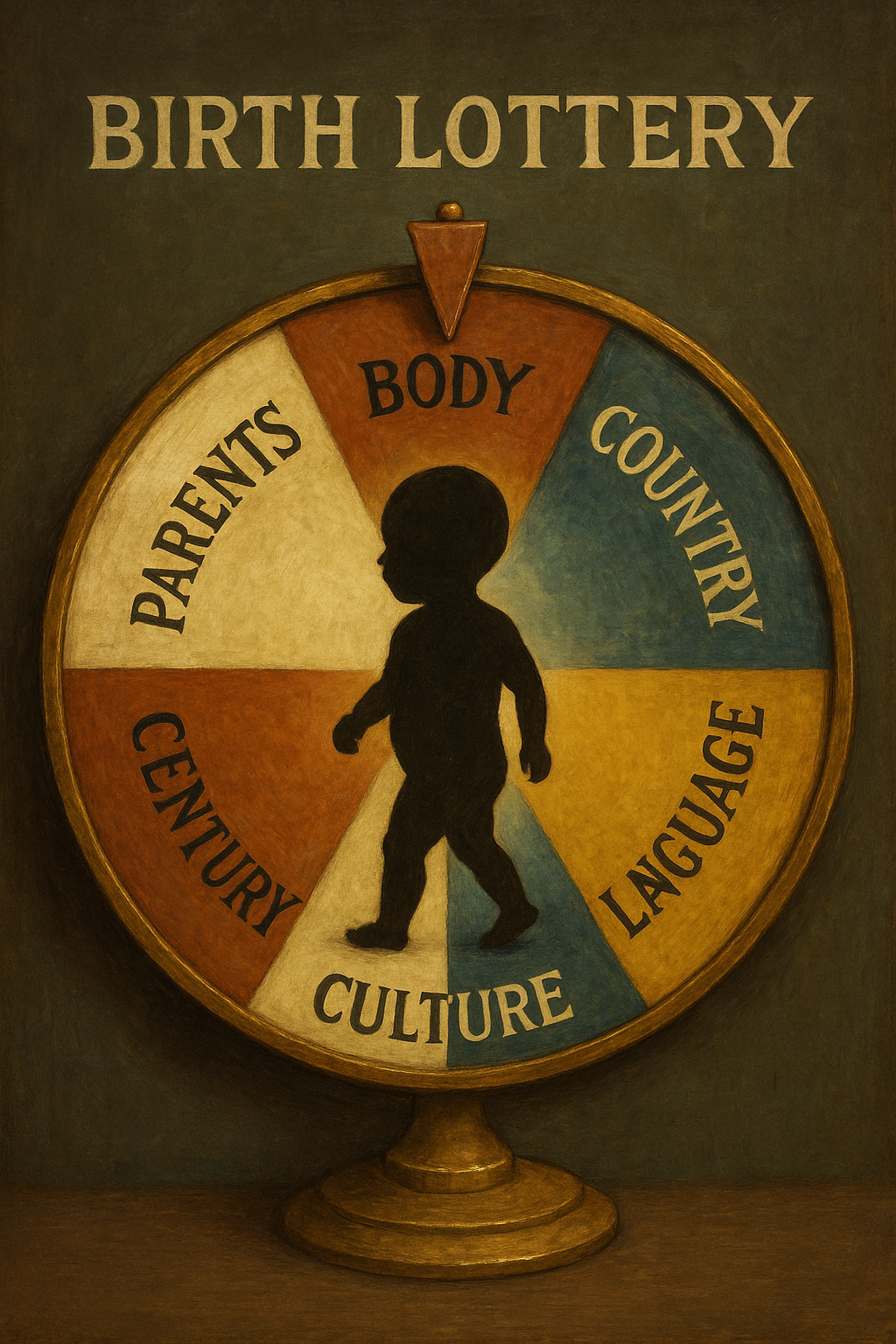
You didn’t choose your birth, your parents, your body, your culture, your century, your genetic lottery, or the first language you heard. You simply appeared, mid-story, in a world already in motion, shaped by forces you didn’t set in motion.
From that starting point, every choice you make is already downstream from conditions you didn’t choose. You might steer the boat, but you didn’t pick the river. And if we never had agency over the first, most fundamental decision — whether to exist at all — then what does “free” really mean in “free will”?
The Time Trick
The most profound limit is also the least visible: our perception of time.
Free will feels real because we experience life sequentially. Cause appears to precede effect. Choices seem to come before consequences. This is only possible because our minds move through events in one direction.
If we could perceive all moments at once — past, present, and future as a single whole — the idea of choice would dissolve. Every “decision” and its outcome would already co-exist. The sensation of standing at a crossroads, weighing options, would be revealed as just another feature of our timeline, not a fork in it.
In that sense, free will might be less a literal truth and more an evolutionary comfort — a narrative that makes life feel navigable. And if that’s the case, maybe the real measure of a life isn’t whether our choices were truly free, but whether we found meaning in making them.
📚 Explore the full **Human Illusion** series here
메타데이터
- post_id
- d4b2278da533
- slug
- the-illusion-of-choice-why-autonomy-feels-real-d4b2278da533
- url
- https://medium.com/@emediazone55/the-illusion-of-choice-why-autonomy-feels-real-d4b2278da533
- canonical_url
- https://medium.com/@emediazone55/the-illusion-of-choice-why-autonomy-feels-real-d4b2278da533
- author_url
- https://medium.com/@emediazone55
- status
- ok
- fetched_at
- 2026-06-20 20:29:01