EV infrastructure scaled. The software behind it didn’t.
Over the past few years, EV charging networks have expanded exactly as expected: more stations, more regions, more partnerships. From the…
EV infrastructure scaled. The software behind it didn’t.
Over the past few years, EV charging networks have expanded exactly as expected: more stations, more regions, more partnerships. From the outside, it looks like steady, confident growth. But inside many of these businesses, the picture is more complex because while infrastructure scaled fast, the software systems behind it often did not. Putting it briefly, growth was physical, but complexity became digital.
🚀 Land Your Dream Tech Job in Weeks
💰 $50–$120/hr | Multiple Roles Open Frontend • Backend • Full Stack • AI/ML • DevOps
At the early stage, most EV platforms were relatively simple: a limited number of chargers, a manageable set of integrations, a smaller user base. It worked. But as networks expanded, every new station, every roaming agreement, every payment provider, every energy partner added another layer of complexity. Not just operationally, but structurally, and today, many EV platforms are no longer single systems. They are ecosystems. And ecosystems are much harder to operate.
You can already see this shift in large networks like ChargePoint and EVgo, both of which operate tens of thousands of charging points across multiple regions and partners. At that scale, the challenge is no longer deployment, it is coordination.
Fragmentation is no longer technical. It’s operational. In many companies, software architecture evolved step by step: one integration at a time, one feature at a time, one urgent fix at a time… Individually, each decision made sense. But together, they created fragmentation. Different parts of the platform behave differently. Data flows are not always consistent. Changes take longer than expected, and this is not theoretical.
In the U.S., Electrify America has repeatedly faced public scrutiny over charger reliability during rapid expansion. Importantly, many reported failures were linked not to hardware, but to software, connectivity, and payment systems. At this stage, the problem is no longer “technical debt” in the classic sense, it becomes operational friction.
Uptime is now a business metric A few years ago, uptime was mostly a technical KPI. Today, it is directly tied to revenue and customer trust. A charger that doesn’t work is more than a technical issue: it is a visible failure.
According to the J.D. Power U.S. Electric Vehicle Experience Public Charging Study, nearly 1 in 5 public charging attempts fails, and a large share of those failures is tied to software, payment, or communication issues rather than hardware. That changes the economics of the entire system. • lost transactions • damaged brand perception • support overhead • partner friction
AI is being added, but ownership is unclear Many EV companies are now introducing AI to the processes of demand forecasting, dynamic pricing, smart routing, predictive maintenance, etc. The intention is certainly right, but in many cases, AI is being added on top of already fragmented systems. Even leading European operators like IONITY and Allego are investing heavily in smarter energy and pricing models all of which depend on clean, consistent data across the platform. Without clear ownership, this creates new questions: • Who is responsible for data quality? • Who ensures consistency across systems? • Who manages long-term behavior? As everybody can see now, AI does not simplify operations by default, it amplifies whatever structure already exists.
The real bottleneck is not talent When systems become harder to manage, the first instinct is to hire more people. But most EV companies already have strong teams. The issue is rarely capability, it is structure: this is increasingly acknowledged at the leadership level.
As Pasquale Romano noted in discussions about network scaling, EV charging has gone far beyond deploying hardware, it involved operating a highly distributed, software-driven energy and mobility platform. And that shift is not trivial.
At the same time, industry data shows the pressure clearly: According to the International Energy Agency, the global public charging network grew by over 40% year-over-year, while utilization, reliability expectations, and integration demands increased even faster. Infrastructure growth is exponential, but system coherence is not.
What changes the situation In practice, the companies that regain control over their platforms shift one thing: They move from fragmented execution to continuous, system-level ownership. Instead of distributing work across disconnected contributors, they create dedicated teams that: • understand the full architecture • stay with the system long-term • own outcomes, not just tasks • evolve the platform as a whole This doesn’t require rebuilding everything from scratch, but it certainly needs a different operating model.
Where this leaves the industry EV infrastructure will continue to grow. That part is clear. What is less visible, but increasingly important is how the software behind it evolves, because the next stage of competition is about who operates better. And that depends less on how systems were built, and more on how well they are owned.
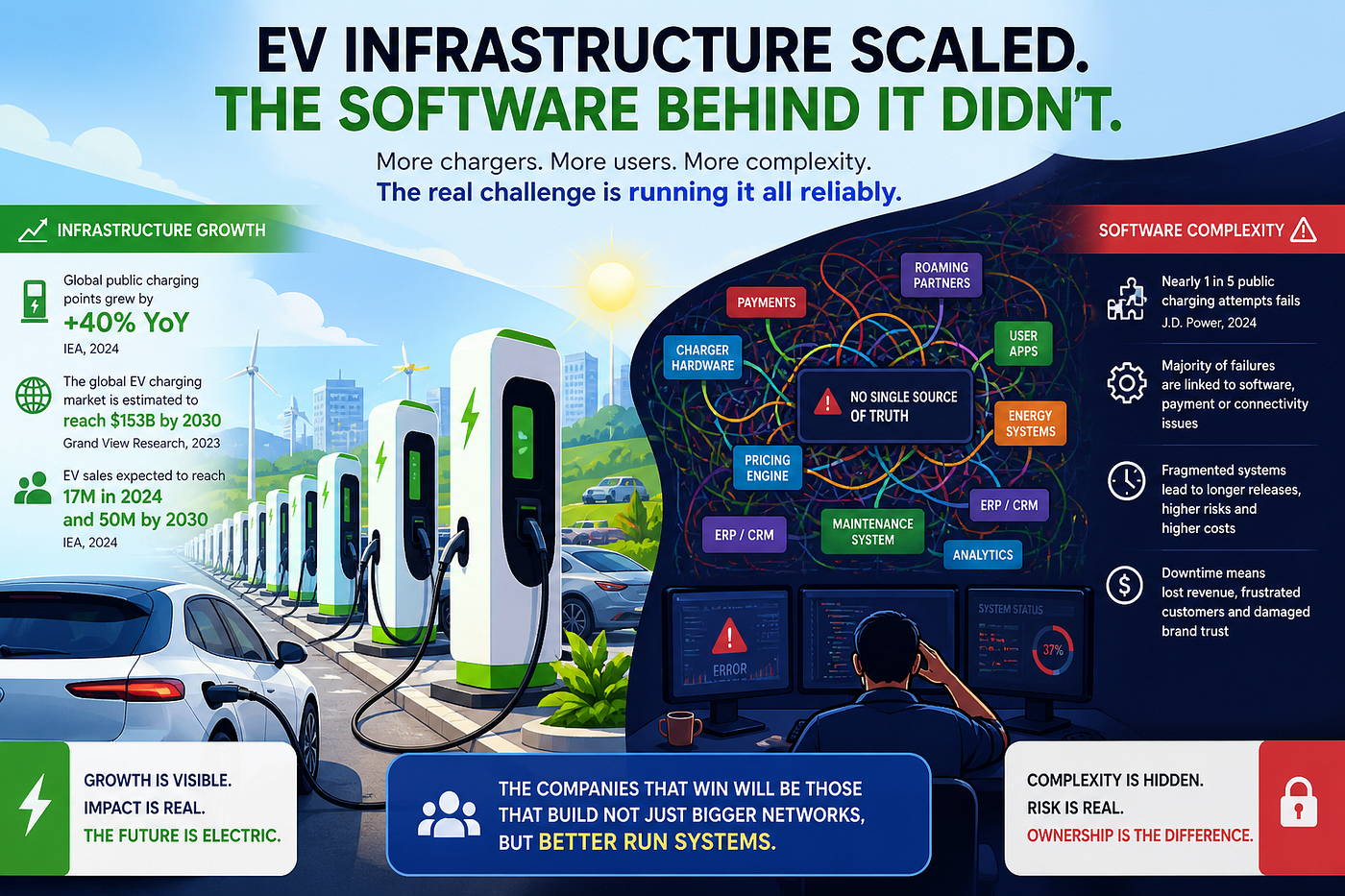
EV infrastructure overcoming challenges which come up while it scales.
Thank you for being a part of the community
Before you go:

👉 Be sure to clap and follow the writer ️👏️️
👉 Follow us: **Linkedin| [Medium](https://medium.com/codetodeploy)**
👉 CodeToDeploy Tech Community is live on Discord — **Join now!**
Disclosure: This post includes affiliate and partnership links.
메타데이터
- post_id
- d4c976a44ad5
- slug
- ev-infrastructure-scaled-the-software-behind-it-didnt-d4c976a44ad5
- url
- https://medium.com/codetodeploy/ev-infrastructure-scaled-the-software-behind-it-didnt-d4c976a44ad5
- canonical_url
- https://medium.com/codetodeploy/ev-infrastructure-scaled-the-software-behind-it-didnt-d4c976a44ad5
- author_url
- https://medium.com/@iryna_90266
- status
- ok
- fetched_at
- 2026-08-11 15:08:43