The 996 Controversy: Why The “GenAI Era” Demands a New Work Ethic
Mention the term “996” (9 am to 9 pm, 6 days a week) in a standard HR meeting, and you will likely be met with horror. It is viewed as the…
The 996 Controversy: Why The “GenAI Era” Demands a New Work Ethic
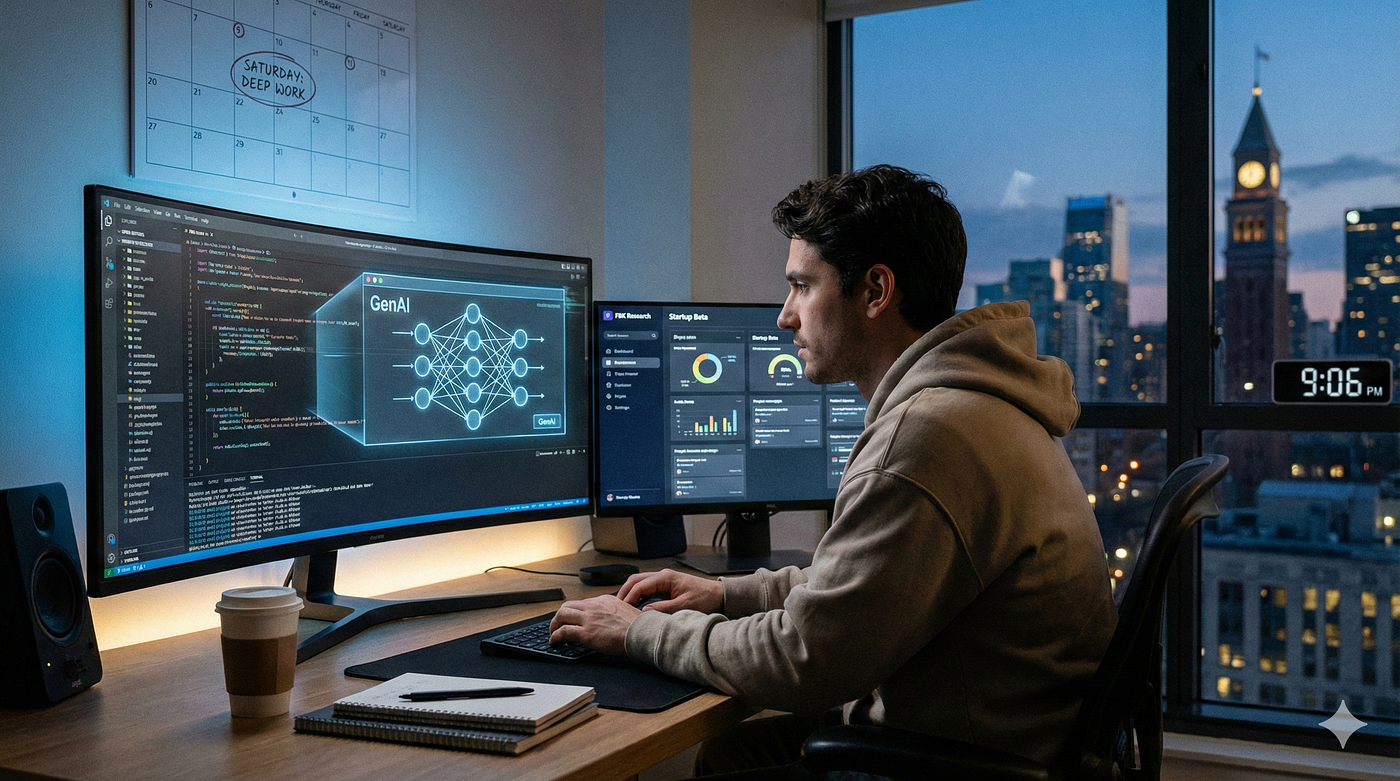
Mention the term “996” (9 am to 9 pm, 6 days a week) in a standard HR meeting, and you will likely be met with horror. It is viewed as the relic of a toxic hustle culture, a symbol of employee exploitation, and a fast track to burnout.
But if you look closely at the bleeding edge of the tech industry right now, something strange is happening. The narrative is shifting.
I am seeing a quiet but massive migration toward a 996 — and in some cases, a 997 — lifestyle. But here is the twist: It isn’t being imposed by bosses. It is being chosen by builders.
We aren’t doing it because we are forced to. We are doing it because we have entered a historical window of opportunity where the cost of not working is simply too high.
We are living in the GenAI Era, and it demands a new work ethic.
The “Super-Individual” Thesis
Why work this hard? Because for the first time in history, the correlation between effort and output is non-linear.
In the past, building a prototype took a team of four and three months of funding. Today, with Generative AI, I can compress that timeline into a weekend.
This has allowed me to test a radical new operational model in my own work: The 1:1 PM-Engineering Ratio.
In the two startups I am currently advising and co-building, I don’t need a massive team to get to a Proof of Concept (PoC). I act as the Product Manager and the Engineer simultaneously. I define the feature, and I use GenAI to accelerate the coding, feature integration, and testing.
The “lag time” between having an idea and seeing it function on a screen has collapsed. When you can move that fast, taking a Saturday off doesn’t feel like “rest.” It feels like leaving money and innovation on the table.
The Evidence: Volume Does Not Kill Quality
The biggest counter-argument to the 996 lifestyle is that “productivity declines after X hours.”
I respectfully disagree. Productivity declines when you are doing busy work. When you are in a flow state facilitated by AI, capacity expands.
I am not speaking from a theoretical standpoint. I currently balance a dual life as a Researcher at Fondazione Bruno Kessler (FBK) and as a startup builder. Here is the hard data on what a “GenAI-fueled 996” looks like in practice in my case:
The Research Reality
Let’s look at the numbers. At Fondazione Bruno Kessler, I am currently managing or actively contributing to over ten simultaneous projects. In a traditional workflow, this volume would result in drowning — missed deadlines and mediocre quality. Yet, the data shows the opposite.
I set myself a strict personal KPI of hitting 95% of project milestones, but I am currently tracking at a 98% on-time delivery rate. Crucially, this speed doesn’t come at the cost of scientific rigor. I consistently publish more than five impactful papers annually, maintaining a positive trend on Google Scholar with at least *75% of those works appearing in top-tier Q1, A, or A venues**. Even with this load, I still carve out space for two major community service commitments every year.
The Startup Reality
But the research is just one half of the equation. On top of this full institutional workload, I am actively advising and contributing to two potential startups.
If you look at this through the lens of a standard 9-to-5 schedule, the math simply doesn’t add up. So, how is this possible?
The GenAI Lever
I don’t work harder at typing code; I work smarter at managing logic. GenAI has fundamentally changed my hourly ROI.
On the Research side: I no longer spend my days hunting for syntax errors. I co-code experiments with AI. This reduces the “time-to-result” drastically. Instead of spending 4 hours debugging, I spend that time developing new ideas. I automate paperwork and repetitive tasks relentlessly.
On the Startup side: The “Idea-to-PoC” cycle is almost instant. I can validate a business hypothesis on a Saturday that would have taken a month in 2020.
Saturday is the New Competitive Advantage
I am currently living the 996 routine. And let me be honest: Saturdays are amazing.
When you choose this life, you aren’t “missing out.” You are trading. Sure, there are fewer parties. There is less aimless scrolling. But there are more opportunities. There is the thrill of seeing a project go from zero to one while the rest of the world is sleeping.
As Sam Altman noted, “Hard work is a compound interest.” In the age of AI, that interest rate just went up.
Conclusion
This is not a prescription for everyone. If you value work-life balance in the traditional sense, that is beautiful, and you should protect it.
But if you are a builder, a researcher, or a founder, realize this: The gatekeepers are gone. The only limit to what you can build right now is your own energy and your ability to wield AI.
Don’t let the stigma of 996 keep you from the most productive period of your life. It’s time to build.
메타데이터
- post_id
- d4ca15af4e35
- slug
- the-996-controversy-why-the-genai-era-demands-a-new-work-ethic-d4ca15af4e35
- url
- https://medium.com/@luca-max/the-996-controversy-why-the-genai-era-demands-a-new-work-ethic-d4ca15af4e35
- canonical_url
- https://medium.com/@luca-max/the-996-controversy-why-the-genai-era-demands-a-new-work-ethic-d4ca15af4e35
- author_url
- https://medium.com/@luca-max
- status
- ok
- fetched_at
- 2026-08-18 06:32:24




