The Use of Advanced AI Models in Finance
CNN, KNN, SVM, GAN, C-GAN, D-GAN, CD-GAN, RAG, LLM
The Use of Advanced AI Models in Finance
CNN, KNN, SVM, GAN, C-GAN, D-GAN, CD-GAN, RAG, LLM
[embed]Most Cited Scholarly Papers on the Application of Advanced AI models In Financemedium.com
Advanced AI models
These advanced AI models offer a range of applications in finance, from predicting market movements and detecting fraud to generating synthetic data and providing personalized financial advice. Leveraging these models can lead to more accurate, efficient, and automated financial processes, ultimately contributing to better decision-making in complex financial environments.DGAN and CDGAN are advanced variants of GANs that build upon the traditional GAN architecture by incorporating deep learning techniques and conditional data generation.
These models are particularly effective in domain-specific applications where high-quality, tailored data generation is required. These GAN variants are used across various domains, including finance, where they contribute to more precise and useful modeling, especially in scenarios requiring synthetic data or personalized data generation.
Photo by randa marzouk on Unsplash
Introduction
Advanced AI models such as Convolutional Neural Networks (CNNs), K-Nearest Neighbors (KNN), Support Vector Machines (SVMs), Generative Adversarial Networks (GANs), Conditional GANs (C-GANs), Retrieval-Augmented Generation (RAG), and Large Language Models (LLMs) have found significant applications in finance. These models are particularly valuable for tasks such as financial forecasting, risk management, fraud detection, and algorithmic trading.
Models and Their Applications
1. Convolutional Neural Networks (CNNs)
1. 1. Overview
CNNs are primarily used for image and pattern recognition tasks. However, in finance, CNNs can be applied to time series data by treating the data as 2D inputs.
1.2. Applications
- Stock Price Prediction: CNNs can be used to capture complex patterns in historical stock price data, improving the accuracy of predictions.
- Financial Sentiment Analysis: By analyzing financial news, reports, and social media, CNNs can detect sentiments that influence market movements.
2. K-Nearest Neighbors (KNN)
2.1 Overview
KNN is a simple, non-parametric algorithm used for classification and regression. In finance, it is used to classify or predict market trends based on historical data.
2.2. Applications
- Credit Scoring: KNN can classify borrowers into different risk categories based on their financial history.
- Portfolio Management: KNN can be used to categorize stocks based on performance metrics and aid in portfolio selection.
3. Support Vector Machines (SVMs)
3.1 Overview
SVMs are supervised learning models used for classification and regression. They are particularly effective in high-dimensional spaces and are robust to overfitting.
3.2. Applications
- Fraud Detection: SVMs can classify transactions as fraudulent or legitimate by analyzing transaction patterns.
- Market Trend Prediction: SVMs are used to predict market trends by classifying stock price movements based on historical data.
Photo by Elena Mozhvilo on Unsplash
4. Generative Adversarial Networks (GANs)
4.1. Overview
GANs consist of two neural networks, the generator and the discriminator, that compete against each other to create realistic data. In finance, GANs are used to generate synthetic data and for risk modeling.
4.2. Applications
- Synthetic Data Generation: GANs can generate realistic financial data, which is useful for testing algorithms when real data is scarce.
- Option Pricing: GANs can model complex financial instruments like options by learning from historical pricing data.
5. Conditional GANs (C-GANs)
5.1. Overview
C-GANs are a variant of GANs that condition the generated output on certain inputs, allowing for more controlled data generation.
5.2. Applications
- Scenario Analysis: C-GANs can generate financial data under specific conditions, such as during a market crash or boom, helping in stress testing.
- Personalized Financial Products: C-GANs can be used to create tailored financial products by generating data based on customer profiles.
Photo by Kier in Sight Archives on Unsplash
6. Retrieval-Augmented Generation (RAG)
6.1. Overview
RAG combines traditional retrieval methods with generative models to produce more accurate and contextually relevant outputs. In finance, it’s useful for tasks requiring both knowledge retrieval and generation.
6.2. Applications
- Financial Reporting: RAG can automate the creation of financial reports by retrieving relevant data and generating insightful commentary.
- Customer Support: RAG models can be used in chatbots to provide personalized financial advice by retrieving and generating responses based on customer queries.
Photo by Dominic Kurniawan Suryaputra on Unsplash
7. Large Language Models (LLMs)
7.1. Overview
LLMs are deep learning models that are trained on vast amounts of text data. They excel in natural language understanding and generation.
7.2. Applications
- Financial News Analysis: LLMs can analyze and summarize financial news, identifying key trends and events that impact markets.
- Algorithmic Trading: LLMs can interpret market signals from unstructured text data, such as news articles, and make trading decisions.
8. DGAN (Deep GAN or Domain-specific GAN)
8.1. Overview
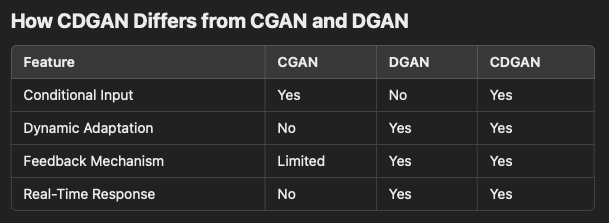
DGAN refers to a variant of Generative Adversarial Networks (GANs) that is designed for deep learning architectures or specific domain applications. DGANs extend the traditional GAN framework by incorporating domain-specific knowledge or by using deep learning techniques that enhance the performance of GANs in particular contexts.
8.2. Applications
- Synthetic Data Generation: DGANs are used to generate high-quality synthetic data that is tailored to specific domains such as healthcare, finance, or autonomous driving. This can be particularly useful when real data is limited or expensive to obtain.
- Domain Adaptation: DGANs help in adapting features learned in one domain to another domain where labeled data might be scarce. This makes them valuable for tasks such as cross-domain image synthesis or transfer learning.
Photo by Deactivated Account on Unsplash
9. CDGAN (Conditional Deep GAN)
9.1. Overview
CDGANs combine the principles of Conditional GANs (C-GANs) with Deep GANs. In CDGANs, the output generation is conditioned on specific input data while leveraging deep learning architectures to improve the quality and applicability of the generated data. This allows for more precise control over the generation process and makes CDGANs particularly powerful in domain-specific applications.
9.2 Applications
- Financial Modeling: CDGANs can generate synthetic financial data that reflects specific market conditions, which can be used for stress testing, scenario analysis, and risk management in finance.
- Personalized Data Generation: CDGANs are capable of generating data that is personalized based on individual characteristics or conditions, such as customer profiles in financial services or personalized medical data in healthcare.
메타데이터
- post_id
- d4d0166e0230
- slug
- the-use-of-advanced-ai-models-in-finance-d4d0166e0230
- url
- https://medium.com/self-study-notes/the-use-of-advanced-ai-models-in-finance-d4d0166e0230
- canonical_url
- https://medium.com/self-study-notes/the-use-of-advanced-ai-models-in-finance-d4d0166e0230
- author_url
- https://medium.com/@cevherd
- status
- ok
- fetched_at
- 2026-06-27 18:20:27