Why Your Cloud Integration Project Is Failing And How to Fix It
What Most Businesses Overlook in Cloud Integration Services
Why Your Cloud Integration Project Is Failing And How to Fix It
What Most Businesses Overlook in Cloud Integration Services
You invested six figures in cloud integration services. Your team spent months planning the migration. You selected an integration platform as a service (iPaaS) solution. Yet here you are six months later, watching data sync failures, missed deadlines, and costs spiraling out of control. Sound familiar?
You’re not alone. According to industry research, 70% of enterprise cloud integration projects underperform expectations. The problem isn’t usually the technology. It’s the approach. Most organizations, from startups to Fortune 500 companies, make the same critical mistakes when implementing cloud integration solutions, and they don’t realize it until significant damage is done.
After implementing 100+ cloud integration architecture projects across healthcare, finance, retail, and technology sectors, we’ve seen what works and what doesn’t. This guide reveals the most common reasons cloud integration services fail and exactly how to avoid them.
Why Cloud Integration Architecture Matters
Cloud integration architecture is an extremely important part of cloud computing that provides a way for different cloud applications and services to interact and share data. For modern businesses when applications becomes too much to handle, this architecture becomes the difference between ease of operation and chaos.
Time and time again, we see this: the organization understands the WHAT(to integrate systems), but completely neglects the HOW and WHY. They choose an integration platform as a service tool, assume that it will make everything work together simultaneously, and keep scratching their heads six months into the project as to why data continues to reside in silos. The fault in this process is that they have not established their actual integration architecturethe core design behind how all the systems should interact with each other.
Without a solid cloud integration architecture you will end up with broken, difficult to maintain solutions. Every connection becomes a unique workaround. Your IT staff will be 80% dedicated to maintain and evolving instead of innovating. Data quality will plummet and expenses will skyrocket.
Common Failure #1: Choosing the Wrong Integration Approach
There are three primary ways to build cloud integration services: API integration services with custom development, pre-built iPaaS solutions, or hybrid approaches combining both. The mistake? Picking one without understanding your actual needs.
The iPaaS-Only Trap: Companies assume an integration platform as a service (iPaaS) tool will handle everything. While iPaaS excels at standard integrations (Salesforce to NetSuite, for example), it struggles with complex scenarios, legacy system connections, custom business logic, and real-time data synchronization with 10+ systems. You end up paying for features you don’t use while hacking together custom code anyway.
The Custom API Trap: Some companies build everything custom, thinking it offers total control. True, but this creates massive technical debt. Every API integration requires ongoing maintenance. One breaking change upstream breaks multiple connections. Your team owns the operational burden forever.
The Right Approach: Hybrid models leverage iPaaS for standard connections while building custom API integration services for complex scenarios. This balances speed, cost, and control. But you need expertise to know which integration method fits which situation, something most organizations lack.
Common Failure #2: Underestimating Hybrid Cloud and Multi-Cloud Complexity
Most enterprises operate in hybrid cloud environments, some systems on-premises, some in AWS, some in Azure, and some in GCP. Add in legacy mainframe systems, and you’ve got a nightmare. Yet many organizations approach this like it’s simple: “Just connect everything.”
Hybrid cloud integration introduces security complications, network latency challenges, and governance questions that multi-cloud integration amplifies further. A solution that works perfectly for two cloud platforms breaks when you add a third. Data that synced in real-time between two systems suddenly lags when filtering through on-premises infrastructure.
The organizations that succeed with hybrid cloud integration and multi-cloud integration do this differently: They architect for specific use cases, not universal connectivity. They implement data governance BEFORE migration, not after. They test extensively in staging environments that mirror production complexity.
Common Failure #3: Ignoring Application Integration Services and Data Integration Realities
Cloud data integration might sound straightforward: just transfer data from System A to System B. In actuality, you will be faced with disparate data formats, unfilled data fields, contradictions in business rules, and transformation guidelines that would probably give you a headache. However, a majority of companies overlook the heavy work of application and software integration services, defining data contracts, establishing governance, and testing edge cases.
They just deploy the platform, switch the power on, and see the bad data spreading throughout the enterprise. One bad customer record now lives in five systems simultaneously. So, reporting becomes useless. Data trust diminishes. And, a few months later, they are still in the middle of their cleanup efforts.
The right way to go is to view data integration services as a discipline capable of producing results rather than something that gets attention only after the fact. Besides clear data quality standards, you probably need automated validation checks and a visible audit trail, which are the things that most organizations consider optional.
What Successful Cloud Integration Solutions Actually Look Like
Based on dozens of successful implementations, here’s what separates winners from those who struggle:
Architecture-First Thinking: They spend time upfront designing cloud integration architecture, not just selecting tools. This includes an API integration strategy, data flow diagrams, security architecture, and governance frameworks. It’s not exciting work, but it prevents expensive mistakes later.
Business Outcome Focus: They define success metrics before implementation. Faster reporting? Lower manual effort? Real-time inventory visibility? Crystal clear. This drives every technical decision and prevents scope creep.
Phased Implementation: They don’t integrate everything at once. Start with high-value, lower-risk integrations. Prove the approach. Build organizational confidence. Then expand. This reduces risk and accelerates learning.
Expert Partnership: They recognize cloud integration solutions require more than platform knowledge. They partner with experienced systems integrators who know both technology and industry challenges. This expertise prevents costly mistakes.
Enterprise Cloud Computing Fundamentals: They treat enterprise cloud computing as foundational; security, scalability, compliance, and performance aren’t afterthoughts. API management solutions ensure secure, auditable data flows. Real-time data synchronization maintains consistency.
The Key Components Your Cloud Integration Platform Actually Needs
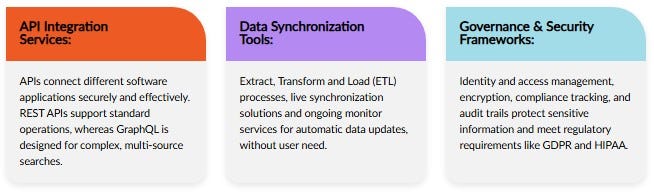
Having a better understanding of the core components of a cloud integration platform will help you to evaluate the right solution to meet your real needs. Key components are:
Three Critical Questions Before You Invest in Cloud Integration Services
Do we know our architecture requirements, or are we just choosing a tool? If you can’t summarize your perfect cloud integration architecture in 3 sentences then you are not ready to implement this.
Are we all set for the governance burden? Cloud data integration without a governance framework is going to make a disaster. Do you have the necessary processes, tools, and accountability built?
Do we have the experts within, or should we seek out an experienced partner? Be honest. Most organizations benefit from experienced guidance. Cloud integration solutions are complex, and trying to figure it out alone often costs more than hiring help.
What Happens Next
If you’re nodding along to this, recognizing your organization in these patterns, it’s time for an honest assessment. The good news: these problems are fixable. Organizations that address these challenges head-on see measurable improvements: faster time to insights, lower manual effort, better data quality, and higher customer satisfaction.
The bad news: every month you delay costs money. Data quality issues compound. Your team gets more frustrated and competing with companies that got cloud integration right becomes increasingly difficult.
Take the Next Step
At Chetu, we’ve spent 26+ years implementing cloud integration services for enterprises across every industry. We’ve learned from both successes and failures. If you’d like an honest assessment of where your organization stands and a concrete roadmap for the next 90 days, we’re here to help.
Request a free cloud integration assessment today. Let’s talk through your specific challenges and see if there’s a path forward.
Disclaimer:
This content has been made available for information purposes only. Views and opinions expressed in this content are those of the individual author only and do not necessarily represent the opinions and views of Chetu. Chetu, and its representatives, make no representation or warranty of any kind, express or implied, regarding the accuracy, adequacy, validity, reliability, availability, or completeness of any information of this content. Under no circumstances shall Chetu, or its representatives, have any liability to you or any loss or damage of any kind incurred as a result of the use of this content or reliance on any information provided in this content. Your use of this website and your reliance on any information on this content is solely at your own risk.
About Chetu:
Founded in 2000, Chetu empowers businesses with AI and digital transformation solutions, supporting startups, SMBs, and Fortune 5000 companies. We deliver end-to-end software solutions backed by global digital intelligence and industry expertise. Our customized software delivery model and one-stop-shop approach span the full technology spectrum. Headquartered in Sunrise, Florida, Chetu operates 13 locations across the U.S., Europe, and Asia.
Originally published at https://www.chetu.com.
메타데이터
- post_id
- d4d0c027ff5d
- slug
- why-your-cloud-integration-project-is-failing-and-how-to-fix-it-d4d0c027ff5d
- url
- https://medium.com/@chetuservice/why-your-cloud-integration-project-is-failing-and-how-to-fix-it-d4d0c027ff5d
- canonical_url
- https://medium.com/@chetuservice/why-your-cloud-integration-project-is-failing-and-how-to-fix-it-d4d0c027ff5d
- author_url
- https://medium.com/@chetuservice
- status
- ok
- fetched_at
- 2026-07-21 18:21:00