When the Sun Whispers to the Sky: The Hidden Space Weather Signals Shaping Earth’s Atmosphere
The Big Idea: Not Control, But Influence: Solar activity does not “cause” storms, droughts, or heatwaves in the way greenhouse gases or…
When the Sun Whispers to the Sky: The Hidden Space Weather Signals Shaping Earth’s Atmosphere
[embed]Youtube.com | Youtu.be | Channel | Select the BELL to Subscribe How coronal mass ejections and geomagnetic storms interact with Earth’s magnetosphere, triggering atmospheric changes that may influence droughts, heatwaves, and flooding events.
The Big Idea: Not Control, But Influence: Solar activity does not “cause” storms, droughts, or heatwaves in the way greenhouse gases or ocean currents do. Instead, researchers describe the Sun’s role as a modulator. When intense solar events disturb Earth’s magnetic environment, they can slightly alter atmospheric circulation, pressure patterns, and energy flows already in motion.
Think of Earth’s climate system as a massive orchestra. Solar storms are not the conductor, but they can tap the music stand, subtly shifting timing or emphasis. Over short periods this effect is tiny. Over years or decades, those nudges may matter more than once assumed.
- Solar activity varies in roughly 11-year cycles.
- Earth receives about 1,361 watts per square meter of solar energy at the top of the atmosphere.
- Only a fraction of that energy changes during storms, but it is where and how it enters the system that counts.
What Exactly Is a Solar Storm?
A solar storm is a broad term for intense bursts of energy and matter released by the Sun. These events are driven by the Sun’s magnetic field, which is constantly twisting, snapping, and reconnecting.
Key Types of Solar Storms
- Solar Flares — Sudden flashes of radiation that travel at the speed of light.
- Coronal Mass Ejections (CMEs) — Massive clouds of magnetized plasma hurled into space, sometimes containing billions of tons of material.
- High-Speed Solar Wind Streams — Faster-than-average flows of charged particles from coronal holes.
When a CME is aimed at Earth, it can reach us in as little as 15–18 hours. Upon arrival, it compresses Earth’s magnetic field and injects energy into near-Earth space.
Earth’s Magnetic Shield: The Magnetosphere
Earth is wrapped in a magnetic bubble called the magnetosphere. It deflects most solar particles, preventing them from stripping away our atmosphere. During geomagnetic storms, this shield is shaken, stretched, and sometimes violently compressed.
Measurements show that strong geomagnetic storms can dump 100–1,000 gigawatts of power into the upper atmosphere for hours at a time. That energy does not disappear; it cascades downward.
What Changes During a Geomagnetic Storm?
- Electric currents intensify in the upper atmosphere.
- Charged particles increase heating in polar regions.
- Magnetic field lines reconfigure, altering energy pathways.
The Ionosphere: Where Space Weather Meets Air
Beneath the magnetosphere lies the ionosphere, a region of Earth’s atmosphere extending roughly from 60 to 1,000 kilometers above the surface. Here, solar radiation strips electrons from atoms, creating an electrically charged environment.
During solar storms, ionospheric density and temperature can change dramatically. Satellite data show temperature increases of up to several hundred degrees Celsius in the upper thermosphere during major events.
These changes alter wind patterns at high altitudes. Like ripples in a pond, altered winds can propagate downward, influencing the stratosphere and even the troposphere where our weather forms.
From Space to Surface: Shifting Pressure Systems
One of the most intriguing links between solar storms and weather lies in atmospheric pressure. Studies have observed correlations between geomagnetic activity and changes in surface pressure patterns, particularly at high and mid-latitudes.
For example, following intense geomagnetic storms:
- Polar surface pressure has been observed to rise slightly.
- Mid-latitude pressure belts can weaken or shift position.
- Storm tracks may migrate north or south by several hundred kilometers.
These shifts are small — often less than 1–2 hectopascals — but they can alter the steering currents that guide weather systems.
Jet Streams Under Solar Influence
Jet streams are fast-moving rivers of air that shape weather across continents. Their position determines where storms intensify, where cold air plunges south, and where heat domes linger.
Research suggests geomagnetic storms can influence jet stream behavior by modifying temperature gradients in the upper atmosphere. Even a 0.1–0.3°C change in upper-level temperature can affect jet strength.
Potential Jet Stream Responses
- Increased waviness, leading to stalled weather patterns.
- Temporary strengthening or weakening of zonal flow.
- Greater persistence of blocking highs linked to heatwaves or cold spells.
Droughts, Heatwaves, and Floods: The Subtle Links
Extreme weather events rarely have a single cause. Solar-driven atmospheric nudges may act as a background factor, amplifying conditions already favorable for extremes.
Observational studies have noted:
- Increased likelihood of prolonged heatwaves during periods of low solar activity.
- Shifts in monsoon timing correlated with solar cycle phases.
- Enhanced precipitation extremes following major geomagnetic disturbances in some regions.
During certain historic solar minima, drought frequency increased in parts of Europe and Asia, while flood risk rose elsewhere due to altered circulation patterns.
Key Statistics at a Glance
- Solar wind speeds during storms can exceed 800 km/s.
- Major geomagnetic storms occur a few times per solar cycle.
- Upper-atmosphere density can increase by 50–100% during strong events.
- Weather impacts are indirect and typically lag solar events by days to weeks.
What the Science Community Agrees On
Scientists broadly agree on several points:
- Solar storms strongly affect space weather and upper-atmosphere dynamics.
- There are measurable pathways connecting the ionosphere, stratosphere, and troposphere.
- Solar influences are secondary compared to greenhouse forcing and ocean cycles.
Where debate remains is in quantifying how large these effects are at the surface and under what conditions they become meteorologically meaningful.
Why This Matters in a Changing Climate
As climate change alters baseline conditions, even small external nudges may have outsized effects. A slightly shifted jet stream or pressure system can determine whether a region experiences beneficial rain or catastrophic flooding.
Understanding solar-atmospheric coupling could improve long-range forecasting and help distinguish natural variability from human-driven change.
Conclusion: Invisible Hands, Gentle Pushes
Solar storms are not secret puppet masters of Earth’s weather. They are more like invisible hands, gently pushing a system already in motion. Through geomagnetic storms, coronal mass ejections, and their interactions with the magnetosphere and ionosphere, the Sun can nudge atmospheric pressure systems, jet streams, and the distribution of extremes.
As research advances, these subtle connections remind us that Earth’s weather is not just a product of oceans and air, but also of our dynamic star.
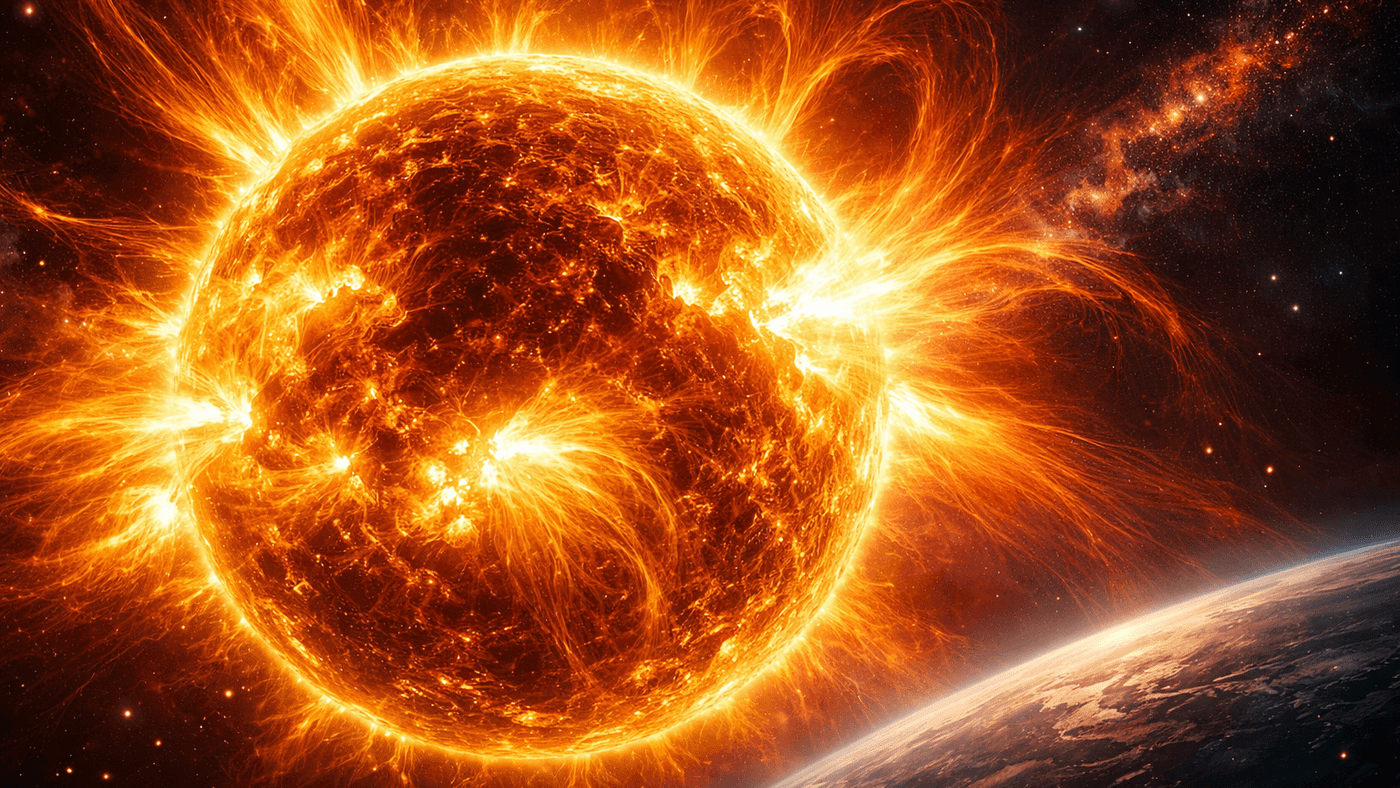
Understanding the relationship between solar storms and Earth’s weather offers a broader perspective on how interconnected our planet truly is with its cosmic environment. While greenhouse gases, oceans, and land systems remain the dominant drivers of climate and weather variability, space weather adds an often-overlooked layer of complexity. Geomagnetic storms and coronal mass ejections inject energy into the upper atmosphere, subtly altering pressure gradients, wind patterns, and jet stream behavior. As climate change amplifies extremes, these small solar nudges may play an increasingly important role in determining the timing, persistence, and regional expression of droughts, heatwaves, and extreme rainfall. Continued research into Sun–Earth interactions not only improves space weather forecasting but also deepens our understanding of the delicate balance governing Earth’s atmosphere.
메타데이터
- post_id
- d4e31c60487d
- slug
- when-the-sun-whispers-to-the-sky-the-hidden-space-weather-signals-shaping-earths-atmosphere-d4e31c60487d
- url
- https://medium.com/@statuslink/when-the-sun-whispers-to-the-sky-the-hidden-space-weather-signals-shaping-earths-atmosphere-d4e31c60487d
- canonical_url
- https://medium.com/@statuslink/when-the-sun-whispers-to-the-sky-the-hidden-space-weather-signals-shaping-earths-atmosphere-d4e31c60487d
- author_url
- https://medium.com/@statuslink
- status
- ok
- fetched_at
- 2026-06-09 15:37:30