Are “Let’s Plays” More Personal than VR?
In the blink of an eye, or rather the blink of a cursor, everything that you know can melt away instantaneously, isolating you in an…
Are “Let’s Plays” More Personal than VR?

In the blink of an eye, or rather the blink of a cursor, everything that you know can melt away instantaneously, isolating you in an uninterrupted world of unfamiliar sights and sounds in which the only thing you can do is move your head and reach your hand out to illusions in the distance. Virtual reality presents players with completely private and immersive experiences unlike any other form of media on the market; however what if I were to say that watching someone else play a VR game through a “Let’s Play” style video is actually more personal than the sense-captivating experience of VR?
While mainstream use of VR is relatively new, the concept of “Let’s Play” videos on platforms like YouTube have been around for many years. When the two are combined, the personalization of the viewing experience, interactivity stemming from the community aspect, and the simultaneous emotional connect and disconnect from the medium make viewing the narrative of a game catered to the individual in a way that VR can’t compete with.
In order to evaluate these phenomenons in their specificities, we will take a look at the YouTube video “FNAF VR — The End of FNAF | Five Nights At Freddy’s VR: Help Wanted (Ending),” from the channel GTLive, an offshoot channel of the highly successful channel The Game Theorists run by internet personality MatPat. This video is the final installation of a live streamed play-through of, as the title suggests, Five Nights at Freddy’s VR: Help Wanted (which will be referred to as FNAF VR from this point forward), the sixth game in a franchise about killer animatronics in a Chuck E. Cheese-esque pizzeria. This game was chosen specifically in this analysis because a key part of its narrative is that the physical VR player is the main character of the game, becoming a “beta tester” for an “unreleased” VR game; as a result, MatPat becomes the main character of both the video and the game, the narrative of both revolving around his success. Additionally, as this is a VR game, the video is formatted so that the majority of the screen is filled with the footage from MatPat’s headset, and a small square sits off to the side showing MatPat in his actual physical environment, allowing the audience to see his reactions and movements in real time.
With the media artifact defined, we will begin dissecting the most obvious way that the “Let’s Play” format influences the personalization of the story: how the audience consumes the game. The everyday individual likely doesn’t have the time to comb through a game that takes well over 12 hours to complete, nor do they likely have the paycheck to afford VR equipment, a compatible computer, or the $30 game itself. YouTube, however, being the largest free video sharing platform is able to combat these issues. For instance, to view the storytelling elements of the game in a more succinct fashion, a viewer can skip through, say an hour of MatPat attempting to beat the FNAF 1- Night 5 Minigame, by clicking ahead, checking timestamps in the comments, or using the new “most replayed” function on YouTube’s desktop site in order to find the run where MatPat proves victorious. What’s more, the audience can play the video at 2x speed, as long as they’re alright with a little motion sickness, effectively cutting the gameplay down from a whopping three hours to a more manageable hour and a half. In viewing the plot points in a more succinct way, their memory isn’t bogged down by replaying the same elements in attempt after attempt to progress their position, making them more apt to interpret the material in a level-headed fashion. Additionally, they are able to easily start and stop the viewing experience at anytime and from anywhere, allowing each viewer to consume the story in the way that best fits their lifestyle.
While this video format does constrict viewers’ interactivity with the game, transforming the infinitely unique experience to one that is shared with 6.3 million people, the form of interactivity that comes with taking part in the formed community creates a personal connection much bigger than what the game alone can offer. There’s something inherently special about sharing a moment with people who have the same interests as you. Through interacting with the comments and the top chat replay, the audience is able to react to the story, ask and answer questions, and work together as a community, bouncing ideas off of each other like friends trying to solve a puzzle.

This provides some form of interactivity that is lost through the separation of mediums. Additionally, these interactive elements cannot be experienced within the VR environment itself as FNAF VR is a single player game not built for a shared experience. It is only through a second alternate medium that this enhanced collaboration can be possible, allowing viewers to help each other gain a better understanding of the game’s plot as well as form personal connections with those enjoying the same content along the way.
Similar to how the interactivity with the game isn’t lost but changed, the emotional connection with the game is warped in a way that is rather beneficial to the viewer. Firstly, the separation of the game and the viewer allows for a defusion of emotion. Personally, I am a huge wimp. I’ve tried VR once, and I fell heels up off a stool when a shark simply swam by in a cage diving simulation. Completing an entire horror game while strapped into VR equipment would be next to impossible for me. However, in watching a video of MatPat playing FNAF VR, I am able to follow the story that I am interested in without being too fearful to press the start button. The disconnect between mediums serves me beneficially.
Secondly, new emotional elements can be created through a formed parasocial relationship with MatPat as he interprets the media. Chances are, if you are willing to watch to the end of the 3-hour-long eighth installment of this game on the GTLive channel, this isn’t your first rodeo in the Theorist community; in watching multiple hour long videos published every week where MatPat talks to the audience and interacts with the chat as if he were talking to a friend, the audience forms a sort of connection with the host, feeling invested in how he reacts to certain elements and interprets the media. For instance, when the typically chatty host becomes quiet, it draws viewers in, making us feel his tension as he is placed in the situation. Similarly, when he gets excited about finding a secret piece of lore, the atmosphere becomes energetic, the live chat replay becoming a blur as new comments flood the screen. What’s interesting is that these elements aren’t the elements of the game that are designed to create intense emotion. There is no sound design hyping you up when you find a hidden tape. There is no Mario Kart final lap music that plays when the time is slowly running out on a minigame. The emotion created is, rather, a reflection of the people playing the game and what they value as important or stressful.
Moreover, this added emotional layer can actually heighten the impact of a scripted moment within the VR game. For instance, at the very end of FNAF VR, a creepy figure wearing a bunny costume beckons you behind a dark curtain. After being enveloped in darkness and silence for a few moments, the curtains open to reveal a view looking out across the pizzeria, our creepy bunny friend dancing happily to the tune of a music box. I was bewildered by the sight until finally MatPat broke his momentary silence: “Wait, I’m on stage.”
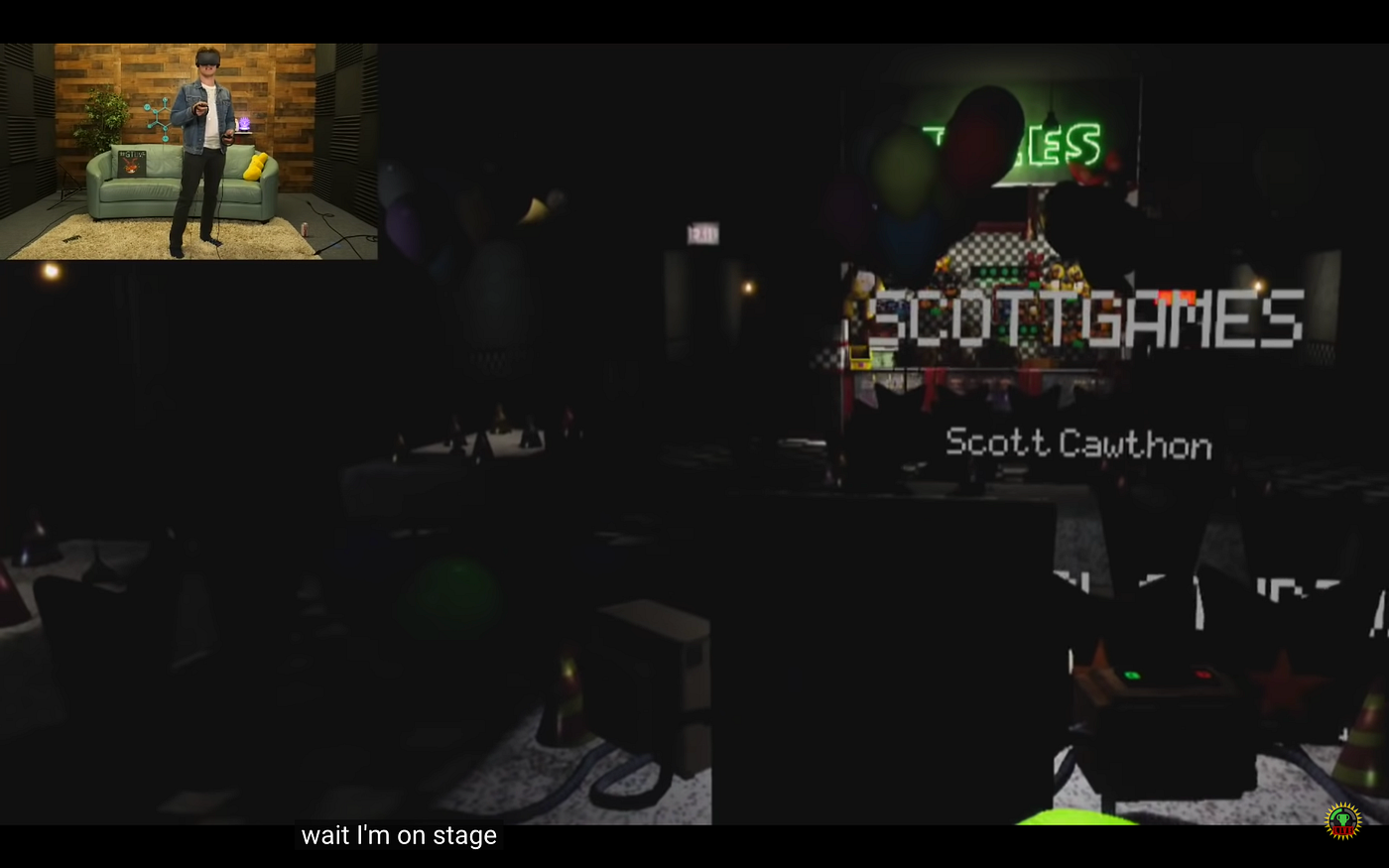
The moment MatPat figures out the dark ending of FNAF VR as the credits roll.
My stomach dropped as we both seemed to figure out what was happening at the same time; we were one of the countless children who were killed and stuffed inside of an animatronic suit throughout this franchise, forced to perform in animatronic shows for eternity. It was a combination of the game design as well as the slow realization that made this ending feel like a punch to the gut. If MatPat weren’t to have said anything, I might have missed it; it was that subtle. The same could go for those who were casually watching the gameplay while attending to other tasks. These small narrative moments and the emotion that is carried by periods of chatter and silence have an important impact of their own in interpreting the storyline. Without it, the VR experience wouldn’t be as strong or effective for all viewers, making this one of the biggest appeals of watching “Let’s Play” videos in general.
That being said, MatPat’s play-through of FNAF VR is just one instance of how video increases the personal experience of a VR game through viewing personalization, community interaction, and a simultaneous emotional enhancement and diminution; these characteristics can be expanded to other Let’s Players as each viewer has a certain type of gameplay and commentary that they prefer, the decision as to who to watch play a game being a personal choice in and of itself. But hey, that’s just a theory: a super meta theory on how the separation that video creates from a VR game helps improve the personalization of the storytelling experience.
메타데이터
- post_id
- d4ebbaeffdd9
- slug
- are-lets-plays-more-personal-than-vr-d4ebbaeffdd9
- url
- https://medium.com/@jordyndg/are-lets-plays-more-personal-than-vr-d4ebbaeffdd9
- canonical_url
- https://medium.com/@jordyndg/are-lets-plays-more-personal-than-vr-d4ebbaeffdd9
- author_url
- https://medium.com/@jordyndg
- status
- ok
- fetched_at
- 2026-07-26 02:27:45