TSA Exit Done Right: A Practical Playbook for Seamless Transition
Transition Service Agreements (TSA) are often seen as a safety net during carve-outs, mergers, or GCC setups — but the real success lies in…
TSA Exit Done Right: A Practical Playbook for Seamless Transition
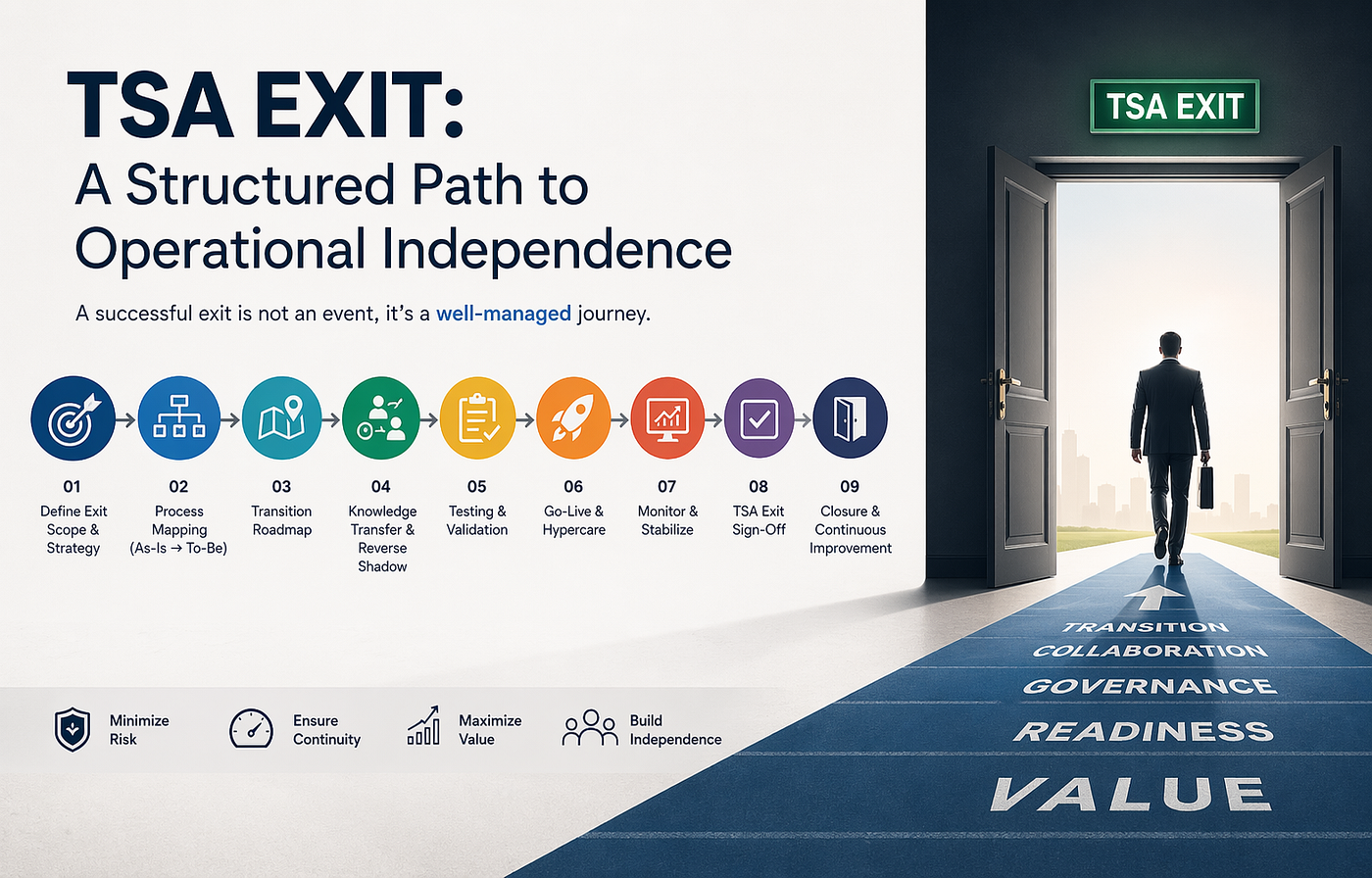
Transition Service Agreements (TSA) are often seen as a safety net during carve-outs, mergers, or GCC setups — but the real success lies in how effectively you exit them.
A poorly managed TSA exit can disrupt operations, impact customers, and erode business value. A well-executed one? It sets the foundation for a truly independent, scalable organization.
Here’s a structured, practical approach to managing a TSA Exit Program 👇
📌 1. Define Exit Scope & Strategy
⨀ Identify all TSA services across functions (Finance, IT, HR, Procurement, etc.)
⨀ Classify services into:
- Lift & Shift
- Transform & Migrate
- Retire
⨀ Define exit timelines aligned with business priorities
🗺️ 2. Detailed Process Mapping (As-Is → To-Be)
- Document current TSA-supported processes
- Identify gaps between current and future state
- Define ownership, systems, and controls in the To-Be model
⚙️ 3. Build Transition Roadmap
Break down exit into manageable workstreams:
- Technology separation
- Process transition
- Data migration
- Vendor transition
Define milestones, dependencies, and critical path
🧠 4. Knowledge Transfer (KT) & Reverse Shadow
- Conduct structured KT sessions from TSA provider to receiving team
- Shadow → Reverse Shadow → Independent Run
- Validate readiness through real-time scenarios
🏗️ 5. Set Up Governance Model
Weekly/bi-weekly governance cadence
⨀ Track:
- Milestones
- Risks & Issues
- Dependencies
⨀ Use dashboards for visibility (RAG status works well)
⚠️ 6. Risk & Issue Management
Identify key risks early:
- System readiness delays
- Data inconsistencies
- Resource constraints
Maintain mitigation plans and escalation protocols
🧪 7. Testing & Validation
Conduct:
- UAT (User Acceptance Testing)
- Parallel runs (if needed)
Validate:
- Process accuracy
- SLA adherence
- Compliance requirements
🚀 8. Go-Live & Hypercare
- Execute final cutover plan
- Provide hypercare support (2–4 weeks typically)
- Closely monitor KPIs and resolve early-stage issues
📊 9. TSA Exit Sign-Off & Closure
Confirm:
- All services exited successfully
- No residual dependencies
- SLA performance stabilized
- Formal sign-off from stakeholders
🔁 Typical TSA Exit Process Flow
TSA Scope → Process Mapping → Transition Roadmap → KT & Shadow → Testing → Go-Live → Hypercare → Exit Closure
💡 Pro Tips from Experience
- Start exit planning at the beginning of TSA — not at the end
- Over-communicate with stakeholders — silence creates risk
- Treat TSA exit as a program, not a task
- Build strong coordination between Business, IT, and Vendors
A TSA is temporary — but the impact of how you exit it is long-term.
If you’re working on a carve-out, GCC setup, or transformation program, investing in a strong TSA exit strategy is non-negotiable.
메타데이터
- post_id
- d505ce730344
- slug
- tsa-exit-done-right-a-practical-playbook-for-seamless-transition-d505ce730344
- url
- https://medium.com/@naveenpatrame/tsa-exit-done-right-a-practical-playbook-for-seamless-transition-d505ce730344
- canonical_url
- https://medium.com/@naveenpatrame/tsa-exit-done-right-a-practical-playbook-for-seamless-transition-d505ce730344
- author_url
- https://medium.com/@naveenpatrame
- status
- ok
- fetched_at
- 2026-06-14 11:28:49