Seven of the Best Marvel Comics Stories You’ll Never See in the Marvel Cinematic Universe
Have Superhero Films Gone the Way of Monster Movies?
Seven of the Best Marvel Comics Stories You’ll Never See in the Marvel Cinematic Universe
Have Superhero Films Gone the Way of Monster Movies?
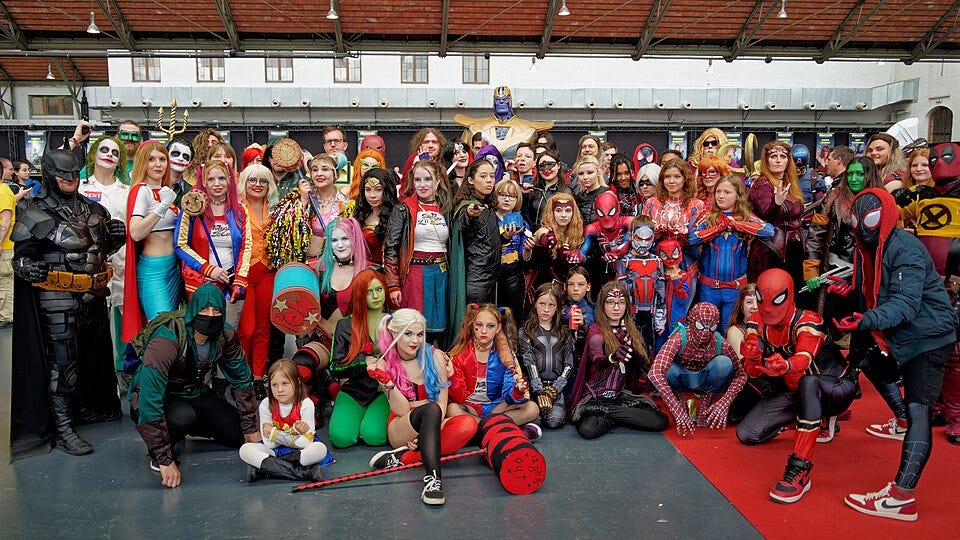
Miguel Discart & Kiri Karma, CC BY-SA 2.0 https://creativecommons.org/licenses/by-sa/2.0, via Wikimedia Commons
The MCU isn’t the first movie franchise to have this problem. Universal Pictures gave us Dracula (1931), Frankenstein (1931), The Mummy (1932), The Invisible Man (1933), and The Wolf Man (1941). After providing the origin stories and sequels, Universal began putting all their monsters in the same films, leading to The House of Frankenstein and The House of Dracula. They finally jumped the shark with three films featuring comedians Abbott and Costello meeting Dracula, Frankenstein’s Monster, and The Wolf Man in 1948, the Invisible Man in 1951, and The Mummy in 1955. Universal had no faith that a stand-alone monster movie would be enough. Like the current run of MCU films, Universal stopped telling small, great stories; everything had to contain multiple monsters, throwing them all against the wall, hoping something would stick.
Marvel has been making comics since its founding as Timely Publications in 1939. They’ve published around 80,000 individual issues, most of which weren’t on the scale of the Infinity War sagas and Secret Wars, which involved most of the major Marvel Universe heroes and villains. There have been some amazing Marvel stories limited to a single hero or at most two. Those stories are unlikely to make their way to the big screens. Maybe they’ll pop up on Marvel Television, where Wonder Man was a hit with a single major hero (and a sidekick).
Here are some of the best stories ever told, not featuring a dozen or more heroes. Sometimes, just one or two is more than enough:
1. Thor Alone Against the Celestials
Thor: Alone Against the Celestials by DeFalco, Tom: Very Good Paperback (1992) | HPB-Diamond
From Thor 387–389. Thor arrives on the distant world of Pangoria just as the Celestial Exitar the Exterminator descends to pass judgment on the planet. The terrified inhabitants believe annihilation is inevitable, but Thor refuses to abandon them. Declaring the world under his protection, he launches a desperate assault against the towering Space God. His most powerful strikes — lightning storms, Mjolnir’s full force, even the fury of the God of Thunder — fail to make Exitar so much as flinch. Realizing brute strength is useless, Thor does the unthinkable: he breaches Exitar’s armor. He enters the Celestial’s cosmic interior, battling through impossible energies in a last‑ditch effort to reach the being’s core.
Inside, Thor is overwhelmed by forces far beyond even divine comprehension and is expelled from Exitar’s body, battered and nearly broken. As Exitar completes his judgment, Thor braces for the planet’s destruction — only to witness a different outcome. Instead of extermination, the Celestial transforms Pangoria, purging its corruption and reshaping it into a more harmonious world. Thor survives, humbled by the realization that Celestial judgment operates on a scale and logic no god can challenge. His battle did not save the planet, but his courage ensured he stood with the innocent, even when he could not alter the cosmic verdict.
2. Daredevil vs Doctor Doom
Daredevil #38 (1968) Iconic Cover Art by Gene Colan | Comic Books — Silver Age, Marvel, Daredevil, Superhero / HipComic
From Daredevil 37–38. The two‑issue arc beginning in Daredevil #37 and concluding in Daredevil #38 is one of the strangest, most Silver‑Age‑delightful crossovers in Marvel history. In this story, a street‑level hero is thrown into the orbit of one of Marvel’s greatest super‑villains and somehow survives through wit, stubbornness, and sheer narrative audacity. It begins when Daredevil confronts what he believes is a routine threat, only to discover that the “criminal” he’s chasing is none other than Doctor Doom, operating in New York for reasons Matt cannot immediately discern. Doom, amused by Daredevil’s interference and intrigued by the possibilities, decides to use the hero in a way only Doom would consider logical: he switches bodies with him. Using a “Body‑Transferral Ray,” Doom traps Matt Murdock inside Doom’s armored form. At the same time, Doom takes over Daredevil’s body — gaining not only a disguise but the perfect tool for provoking the Fantastic Four.
From there, the story becomes a dual nightmare. Daredevil, trapped inside Doom’s armor, is imprisoned in the Latverian Embassy, forced to navigate a world where Doom’s visual senses replace his blindness, and where every guard believes he is their monarch. Meanwhile, Doom — wearing Daredevil’s body like a costume — strolls through New York, sowing chaos, testing the limits of his new identity, and preparing to use Daredevil’s reputation to manipulate the Fantastic Four into attacking him. Matt escapes captivity by tricking Doom’s guards into believing he is the real Doom, then races across Manhattan to warn the FF. But the Fantastic Four, understandably skeptical of a “Doctor Doom” claiming to be Daredevil, dismiss him. Matt then escalates: he orders Doom’s own guards to attack “Daredevil,” hoping to force Doom into revealing himself. Doom, however, quickly convinces his men of the truth and turns them back on Matt, forcing Daredevil to use Doom’s diplomatic immunity to have the police arrest the Latverian soldiers instead. It’s a comedy of errors wrapped in a Cold War thriller, all played straight. The Fantastic Four's appearance is just a cameo. The story is all Daredevil against Doom, despite the mismatch.
3. Doctor Strange and Doctor Doom vs. Mephisto
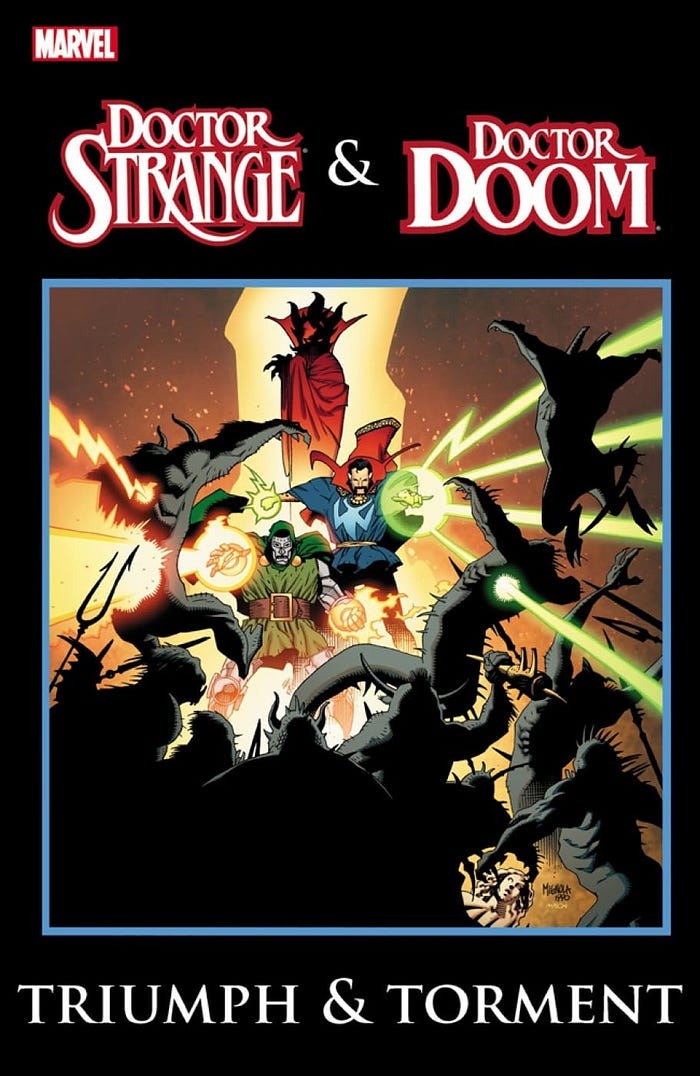
Dr. Strange & Dr. Doom: Triumph & Torment: Roger Stern, Gerry Conway, Mike Mignola, Kevin Nowlan, Gene Colan: 9780785184546: Amazon.com: Books
In Triumph and Torment, Doctor Strange wins the Vishanti's ancient mystical tournament and is crowned Sorcerer Supreme. As part of the ritual, he must grant a boon to the runner‑up, who turns out to be Doctor Doom. Doom immediately invokes this right, demanding that Strange help him with the one quest he has never been able to complete: descending into Hell to rescue the soul of his mother, Cynthia von Doom, from Mephisto. Bound by honor, Strange accompanies Doom to Latveria, where he witnesses the dictator’s humanity, discipline, and the deep wound left by his mother’s damnation. Together they enter Mephisto’s realm, battling demons, illusions, and the psychological traps designed to exploit their weaknesses. Doom’s brilliance and Strange’s compassion make them a formidable pair, but Mephisto is prepared — and he offers Doom a cruel bargain: Cynthia’s freedom in exchange for Strange’s soul.
Doom accepts, revealing both his ruthlessness and his desperation. But when Cynthia is briefly freed, she recoils in horror at her son’s willingness to sacrifice another for her sake. Her rejection becomes her redemption: by refusing a tainted rescue, her soul is finally purified, breaking Mephisto’s hold. Strange and Doom escape Hell, but the victory is bittersweet. Doom has achieved the “triumph” of freeing his mother, yet the “torment” of her disappointment lingers, deepening the tragedy at the core of his character. The story ends not with reconciliation but with a quiet, devastating truth: Doom’s greatest enemy is not Mephisto, nor Strange, but the moral flaw that keeps him forever just short of the man his mother hoped he would become.
4. The Death of Captain Marvel
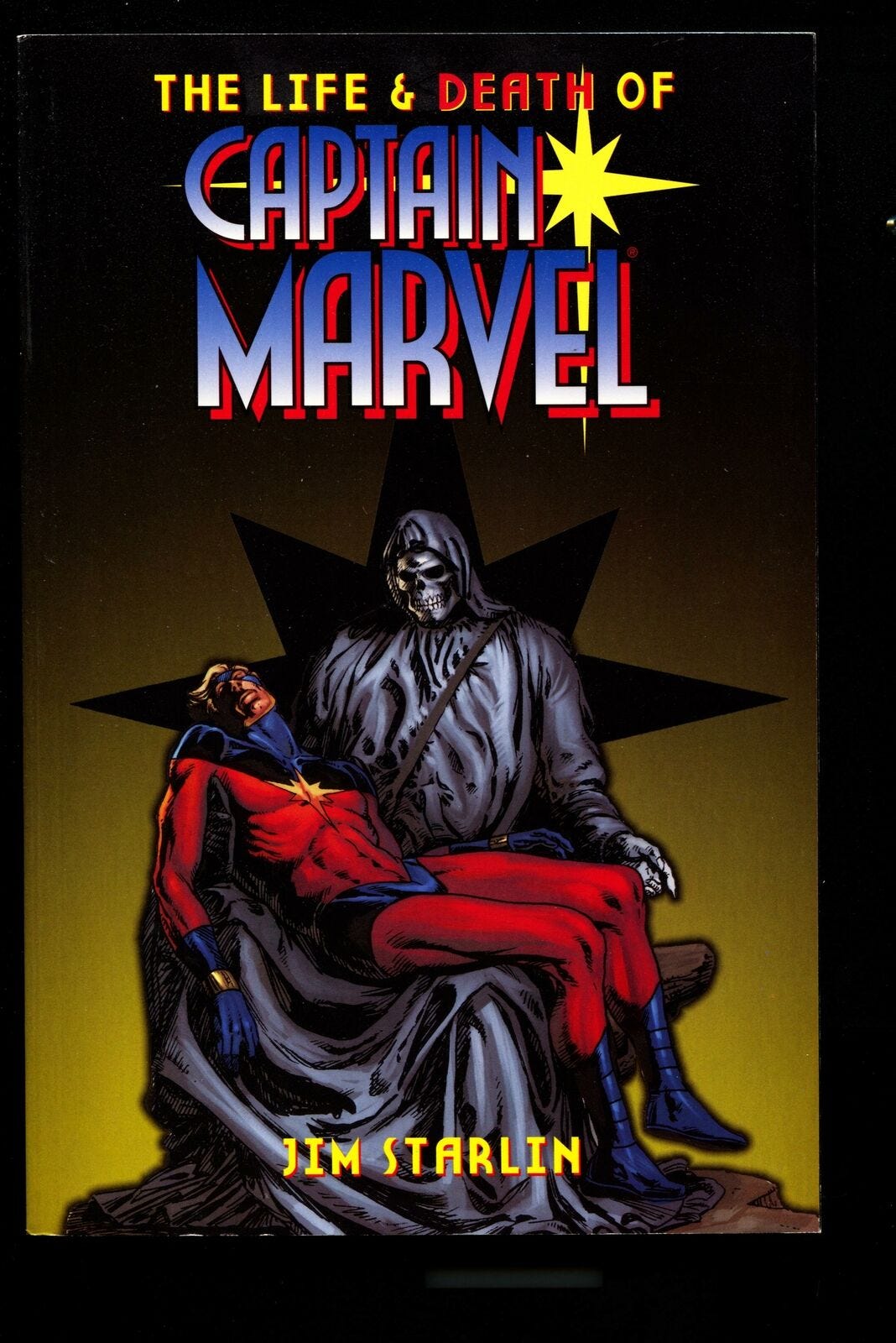
Death of Captain Marvel Omnibus: Englehart, Steve, Marvel Various, Milgrom, Al, Marvel Various, Aclin, Jeff: 9781302962531: Amazon.com: Books
Mar-Vell, the original Captain Marvel, discovers that exposure to the nerve gas “Compound 13” years earlier has caused an aggressive, incurable form of cancer. Despite his cosmic power, Kree physiology, and the combined efforts of Earth’s greatest scientific minds, nothing can stop the disease’s progression. As his condition worsens, Mar-Vell reflects on his life — his battles, his ideals, and the relationships that defined him. Rather than rage against the inevitable, he accepts his fate with dignity, choosing to spend his final days surrounded by those who knew him best. Heroes from across the Marvel Universe gather to honor him, not as a warrior, but as a man who lived with courage and compassion.
In his final moments, Mar-Vell slips into a coma, where he experiences a symbolic last battle against his old enemy, Thanos. But this time, the confrontation is not a struggle for victory — it is a passage. Thanos guides him toward acceptance, and Mar-Vell dies peacefully, becoming the first major Marvel hero to fall not in combat, but to a human illness no superpower could defeat. His death reshapes the Marvel Universe, leaving a legacy defined not by how he fought, but by how he faced the one enemy even heroes cannot overcome.
5. Spider-Man: Kraven’s Last Hunt
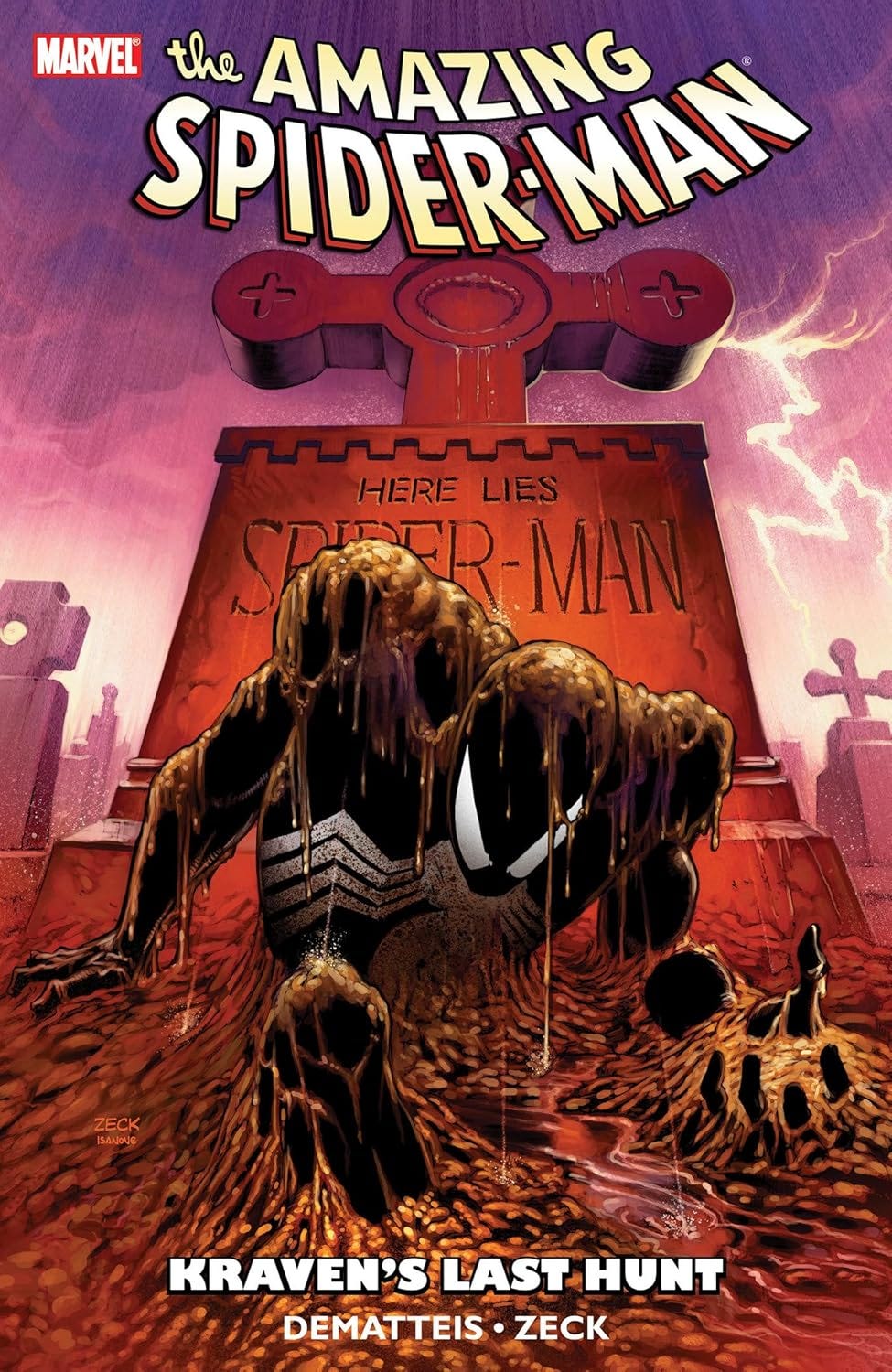
Spider-Man: Kraven’s Last Hunt: J. M. DeMatteis, Mike Zeck: 9780785134503: Amazon.com: Books
In Kraven’s Last Hunt, the aging hunter Sergei Kravinoff decides that the only way to prove his worth — to himself and to the world — is to defeat the one prey who has always eluded him finally: Spider‑Man. Convinced his life has been meaningless, Kraven stalks Peter Parker with military precision, shoots him with a tranquilizer dart, and buries him alive, believing he has symbolically “killed” the spider. To complete his triumph, Kraven dons a black Spider‑Man costume and prowls New York as a brutal, unrestrained version of the hero. While impersonating Spider‑Man, he savagely defeats the cannibalistic villain Vermin — something the real Peter could only do with Captain America’s help — and takes this as proof that he has surpassed his enemy in every way.
But Peter Parker claws his way out of the grave, driven not by vengeance but by the simple, stubborn will to live and return to Mary Jane. When he confronts Kraven, he finds not a gloating victor but a man who believes his mission is complete. Kraven refuses to fight, insisting he has already proven himself and no longer needs to harm Spider‑Man. Instead, he releases Vermin to show he has nothing left to prove — and then, alone in his mansion, Kraven takes his own life. The story ends not with a battle, but with a haunting meditation on identity, obsession, and the thin line between heroism and madness. It remains one of the most psychologically rich Spider‑Man tales ever told, a story where the villain’s inner collapse is more terrifying than any physical threat.
6. Black Widow: The Name of the Rose
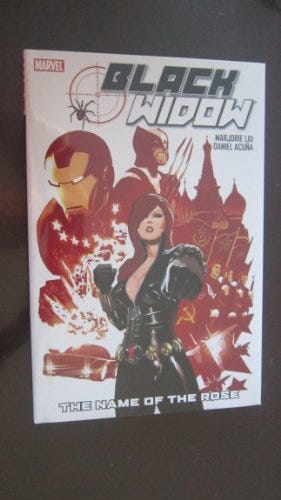
Black Widow: The Name of the Rose by Liu, Marjorie: Fine Hardcover (2011) 1st Edition | Pulpfiction Books
In The Name of the Rose, Natasha Romanoff wakes up in a hospital with no memory of how she got there — and discovers she has been shot, poisoned, and framed. Someone has leaked her most classified S.H.I.E.L.D. files, exposing every dark deed she’s ever committed as a spy. Overnight, she becomes a target for assassins, intelligence agencies, and former enemies who now know her secrets. As Natasha retraces her steps, she uncovers a conspiracy designed not to kill her, but to erase her identity, turning her into a ghost with no past and no allies. The attack is personal, precise, and rooted in the one thing she can never outrun: the life she lived before she became an Avenger.
Natasha’s investigation leads her into a brutal confrontation with a new enemy who knows her better than she knows herself — someone who has weaponized her own history against her. Forced to rely on her instincts rather than her reputation, she dismantles the conspiracy piece by piece, reclaiming her name and redefining who she is beyond the ledger of sins she carries. The story ends not with triumph, but with clarity: Natasha cannot change her past, but she can choose what it means. The Name of the Rose becomes a story about identity, accountability, and the cost of survival — a spy thriller wrapped around a character study of one of Marvel’s most complex heroes.
7. Captain America: Man Out of Time
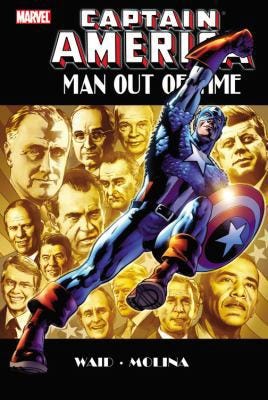
Captain America: Man Out of Time book by Mark Waid
We’ve heard Captain America referred to as the “Man out of time” in the first Avengers film, but never seen him make the transition. In Man Out of Time, Steve Rogers awakens after decades frozen in ice and is thrust into a world that has moved on without him. Though the Avengers welcome him as a hero, Steve struggles with profound dislocation — the loss of everyone he knew, the collapse of the world he fought to protect, and the moral ambiguity of modern geopolitics. Waid frames Steve not as a flawless icon but as a man grieving the life he lost, trying to reconcile 1940s ideals with a society that no longer resembles the one he sacrificed himself for. His attempts to adapt are sincere but painful: he visits the remnants of his old neighborhood, confronts the reality that Bucky is gone, and questions whether he still has a place in this new era.
When a mission sends him back in time to the final days of World War II, Steve faces an agonizing choice: remain in the past where he belongs or return to the future that needs him. Ultimately, he chooses duty over comfort, accepting that Captain America’s role is not tied to a single decade but to the ideals he embodies. Returning to the present with renewed purpose, Steve embraces the world as it is — flawed, complicated, and worth fighting for. Man Out of Time becomes a story not about a man displaced, but about a hero rediscovering why he matters, proving that Captain America’s greatest power has always been his unwavering moral clarity in a world that desperately needs it.
Marvel has so much material to draw from, yet limits itself to cinematic monstrosities rather than captivating stories. I've gotten more than I’ve hoped for in the MCU, but far less than is possible. We will see!
메타데이터
- post_id
- d5132c61cdc0
- slug
- seven-of-the-best-marvel-comics-stories-youll-never-see-in-the-marvel-cinematic-universe-d5132c61cdc0
- url
- https://medium.com/the-polis/seven-of-the-best-marvel-comics-stories-youll-never-see-in-the-marvel-cinematic-universe-d5132c61cdc0
- canonical_url
- https://medium.com/the-polis/seven-of-the-best-marvel-comics-stories-youll-never-see-in-the-marvel-cinematic-universe-d5132c61cdc0
- author_url
- https://medium.com/@williamspivey
- status
- ok
- fetched_at
- 2026-06-22 17:31:34