Reading Enlivex’s NAV per Share: A Framework for the RAIN Treasury
A mechanics-first guide to Treasury NAV per Share, mNAV, and how a prediction markets treasury is actually valued.
Reading Enlivex’s NAV per Share: A Framework for the RAIN Treasury
A mechanics-first guide to Treasury NAV per Share, mNAV, and how a prediction markets treasury is actually valued.
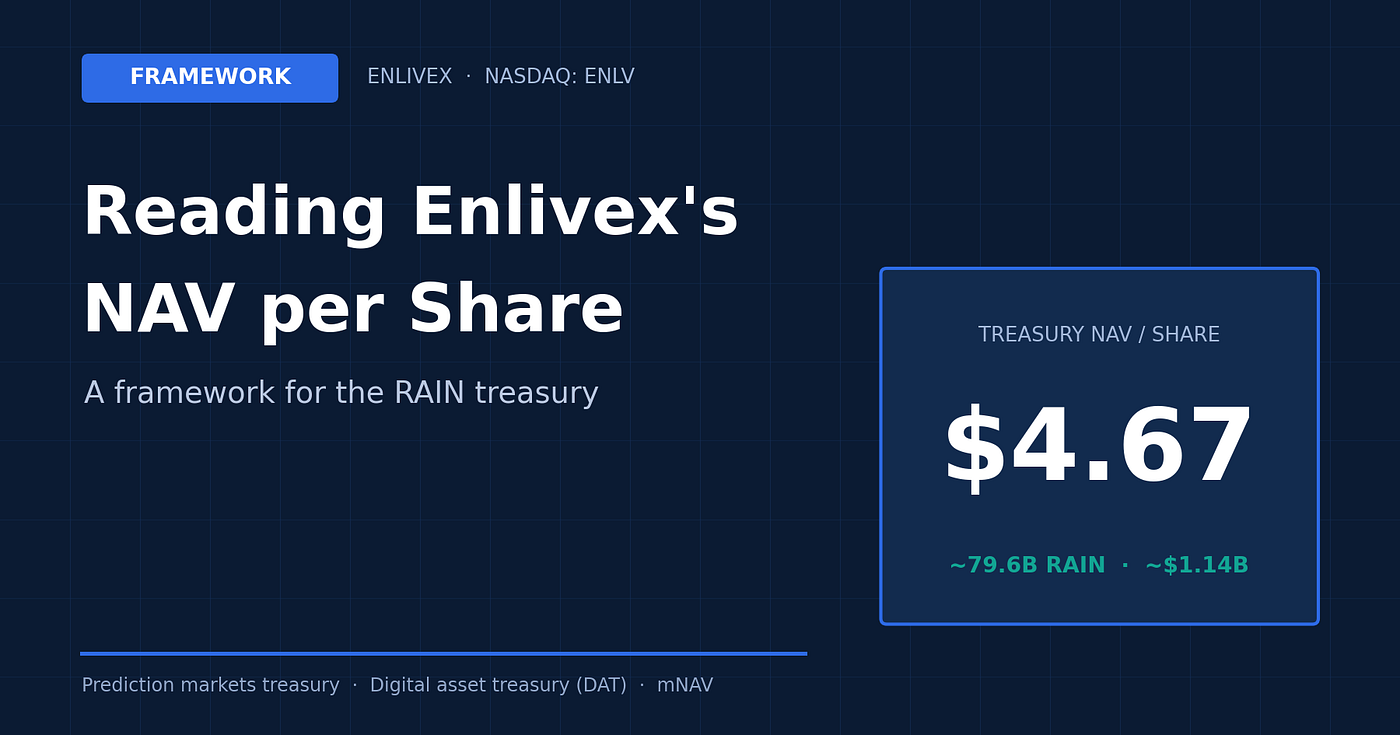
Reading Enlivex’s NAV per Share: a framework for the RAIN treasury.
One number. $4.67.
That figure is Enlivex’s Treasury NAV per Share, reported as of June 20, 2026. Behind it sits about 79.6 billion RAIN tokens, worth roughly $1.14 billion, according to the company’s treasury update.
Most readers see a headline like that and scroll on. That is a missed opportunity.
Here is the wider backdrop. By 2026, more than 200 public companies hold over $110 billion in digital assets, according to AMINA Bank. Reading those balance sheets has become a real skill.
NAV per share is the lens that makes them legible. And Enlivex is a clean case study, because it describes itself as the first and only Rain treasury company.
Learn to read its NAV per share, and you can read almost any digital asset treasury.
This is the framework. No hype. Just mechanics.
What Treasury NAV per Share actually measures
The math is simple. The meaning is precise.
You take the market value of the treasury’s holdings, subtract liabilities, and divide by shares outstanding. According to The Block, that gives a baseline value for each share.
For Enlivex, the treasury is RAIN. So the number answers one question. How much RAIN value backs each ordinary share.
The June 2026 update reported about $1.14 billion in RAIN, across roughly 79.6 billion tokens, and a Treasury NAV per Share of $4.67.
The figure is unaudited and marked to market, priced off the RAIN quote on CoinMarketCap. It updates live on the company dashboard.
The treasury itself began with a $212 million private placement in late 2025. According to CoinDesk, that transaction made Enlivex the first publicly traded US company to adopt a blockchain-based prediction markets token as its primary reserve asset. Former Italian prime minister Matteo Renzi joined the board at the same time.
The per-share framing matters because it normalizes for size. A billion dollar treasury means little until you divide it by the shares that have a claim on it. That is what turns a treasury headline into something you can actually compare, one company against another.
One caution before we go further. This metric captures the RAIN treasury only. It is not full company value. Hold that thought.
NAV per share is the single most useful lens for reading any digital asset treasury.
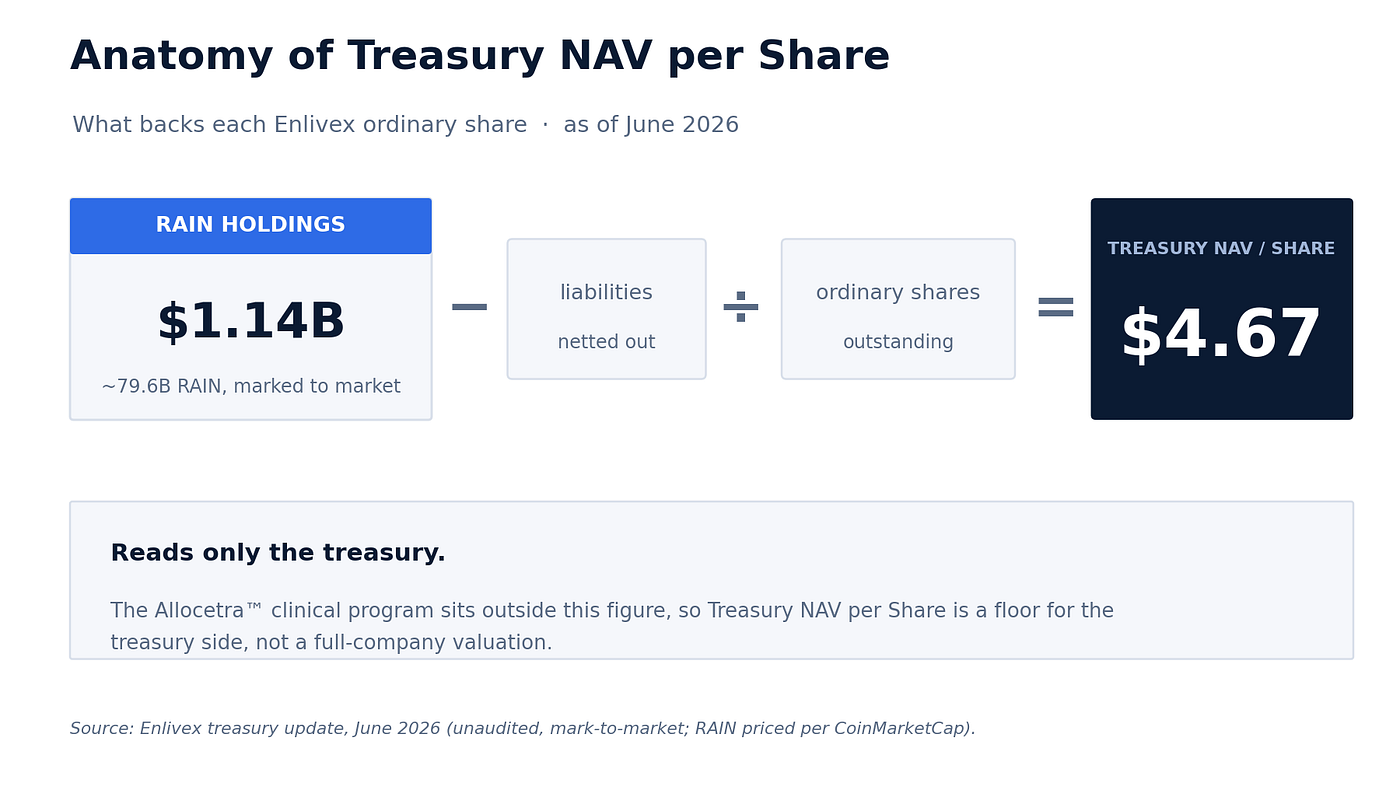
Anatomy of Treasury NAV per Share: RAIN holdings, minus liabilities, divided by shares outstanding.
The one number that reads a treasury: mNAV
NAV per share tells you what the treasury is worth. mNAV tells you what the market thinks of it.
mNAV is the multiple of net asset value. According to The Block, it is market capitalization divided by treasury value. The reading is intuitive:
- Above 1.0: the stock trades at a premium. That signals optimism, and easier access to fresh capital.
- Below 1.0: the stock trades at a discount. That signals skepticism, or a wait-and-see market.
- Around 1.0: the market prices the equity close to the treasury it holds.
Here is the honest part. Treasury equities rarely sit exactly at NAV. Forbes reported that a meaningful share of digital asset treasuries traded below their NAV in late 2025.
A discount can persist. It can also compress in a downturn, which is a documented risk across the category.
So reading that gap, premium or discount, is the whole job. Do not skip it.
What drives the gap? Liquidity, sentiment, and how much the market trusts the underlying asset. A premium lets a company raise capital and buy more of its reserve token, which can lift NAV per share further.
A discount does the reverse. The gap is not noise. It is the market casting a vote.
How Rain’s buyback-and-burn feeds NAV per share
This is where RAIN differs from a reserve that just sits there.
Rain is a decentralized prediction markets protocol on Arbitrum. According to Rain, 2.5% of every market’s trading volume is used to buy back and burn RAIN. Activity on the network removes tokens from supply. Permanently.
The Rain Foundation reported more than 100 million RAIN burned, and over 29,000 users, during open beta, as of April 27, 2026.
Now follow the logic to the balance sheet. Enlivex holds a fixed position in RAIN. As usage burns supply, the same demand is spread across fewer tokens. When that supports the token’s value, it feeds directly into Treasury NAV per Share.
The engine is designed to be value-generative. It is not a passive parking spot for cash.
There is a second layer here. Because Rain runs on Arbitrum, the burn is recorded on-chain. Anyone can verify it. That transparency is part of why the mechanism is credible, and why the treasury update leans on it as a structural feature rather than a marketing line.
Activity on the network removes tokens from supply. Permanently.
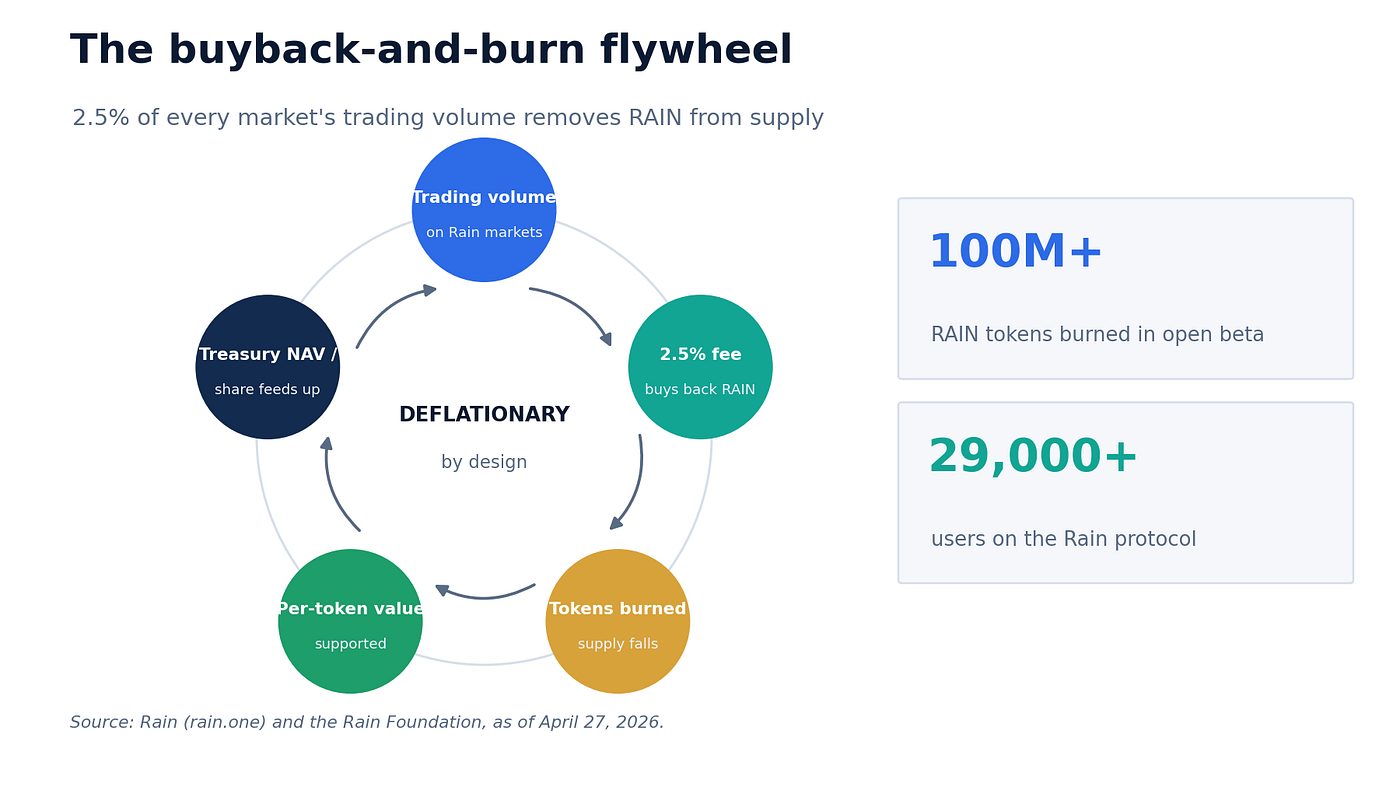
The buyback-and-burn flywheel: 2.5% of trading volume removes RAIN from supply.
Passive reserve versus productive engine
Most treasury companies you have heard of hold Bitcoin. Strategy, formerly MicroStrategy, held more than 712,000 BTC as of late January 2026, according to AMINA Bank. Bitcoin on a balance sheet is a store of value. It sits and waits.
RAIN is built to do work. Three drivers set it apart:
- Usage-linked burn, which ties token scarcity to real network activity.
- Governance rights, exercised through the Rain DAO.
- Exposure to prediction markets growth. The Rain Foundation reported a $100 million liquidity commitment in May 2026 that lifted Rain into the top three prediction market protocols by total value locked, alongside Polymarket and Kalshi.
Kevin Li of ParaFi Capital has compared mNAV to a price-to-earnings ratio for these companies, telling Forbes that growth comes from increasing digital assets per share. A productive reserve gives you more levers to do exactly that.
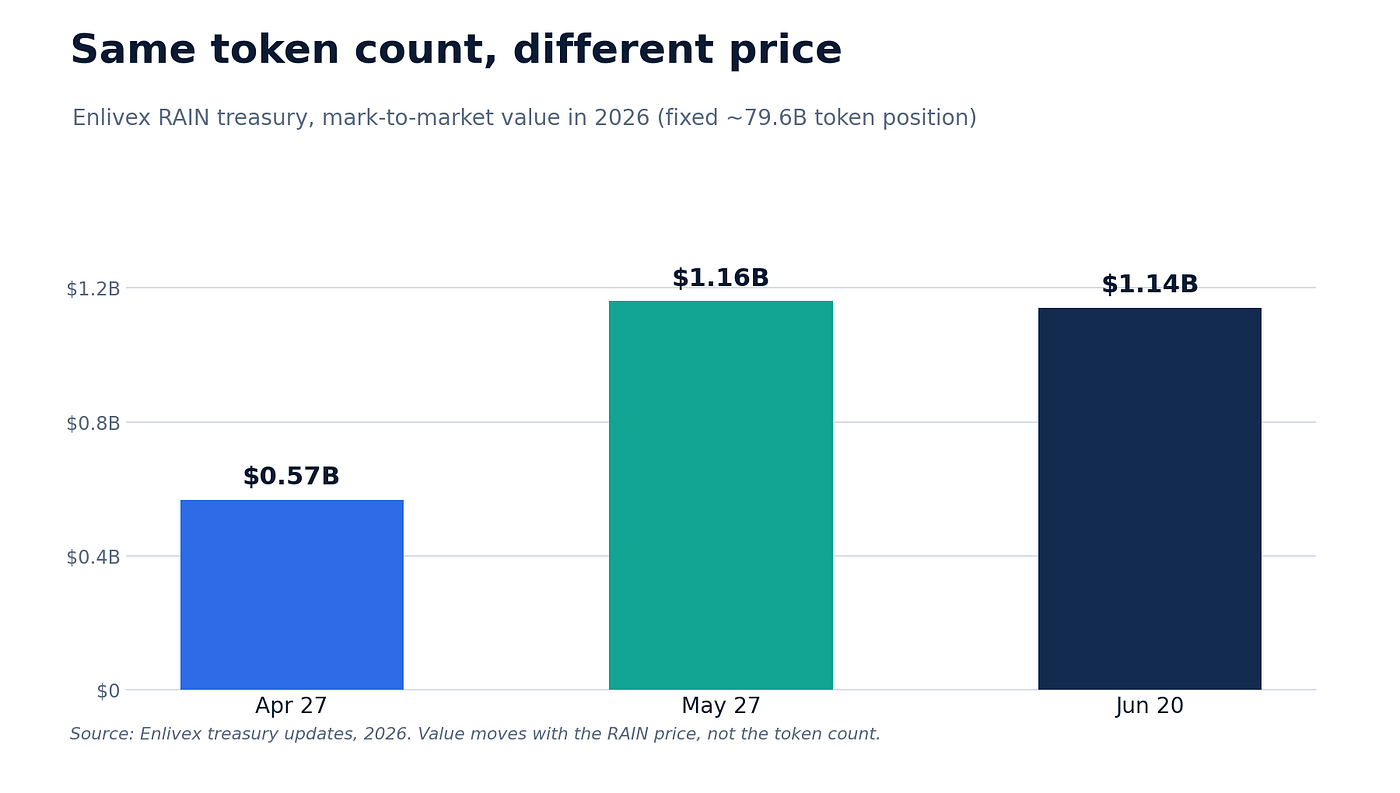
Same token count, different price: Enlivex’s RAIN treasury mark-to-market value in 2026.
The mark-to-market effect is easy to see. Enlivex reported RAIN holdings of about $567 million in late April 2026, roughly $1.16 billion in late May, and about $1.14 billion in June. Same token count. Different price.
RAIN now trades on exchanges including Kraken, WhiteBIT and Gate, which widens access and secondary liquidity.
For a shareholder, the distinction is not academic. A reserve that can grow through network usage gives the equity a path to compound, rather than simply track one asset’s spot price.
That is the structural case Enlivex is making with a prediction markets treasury.
Why the biological floor changes how you read NAV
Now return to that caution from earlier. Treasury NAV per Share measures one engine. Enlivex runs two.
The second engine is Allocetra™, a macrophage reprogramming immunotherapy for age-related knee osteoarthritis.
Per Enlivex, that is a $314 billion longevity market, and osteoarthritis affects more than 32.5 million Americans.
In Phase IIa data presented at OARSI 2026, Allocetra™ showed statistically significant, clinically meaningful improvements in pain and function versus placebo. The company has since dosed its first US patient in a Phase 2b trial.
Enlivex calls this the healthspan-wealthspan structure. One Nasdaq equity, two engines. The clinical program is the biological floor. The RAIN treasury is the forecasting engine.
The takeaway for valuation is direct. Treasury NAV per Share does not include Allocetra™. So the number is a floor for the treasury side, not a ceiling for the company.
Read the second engine on its own terms, on clinical milestones, not token price.
One Nasdaq equity, two engines.
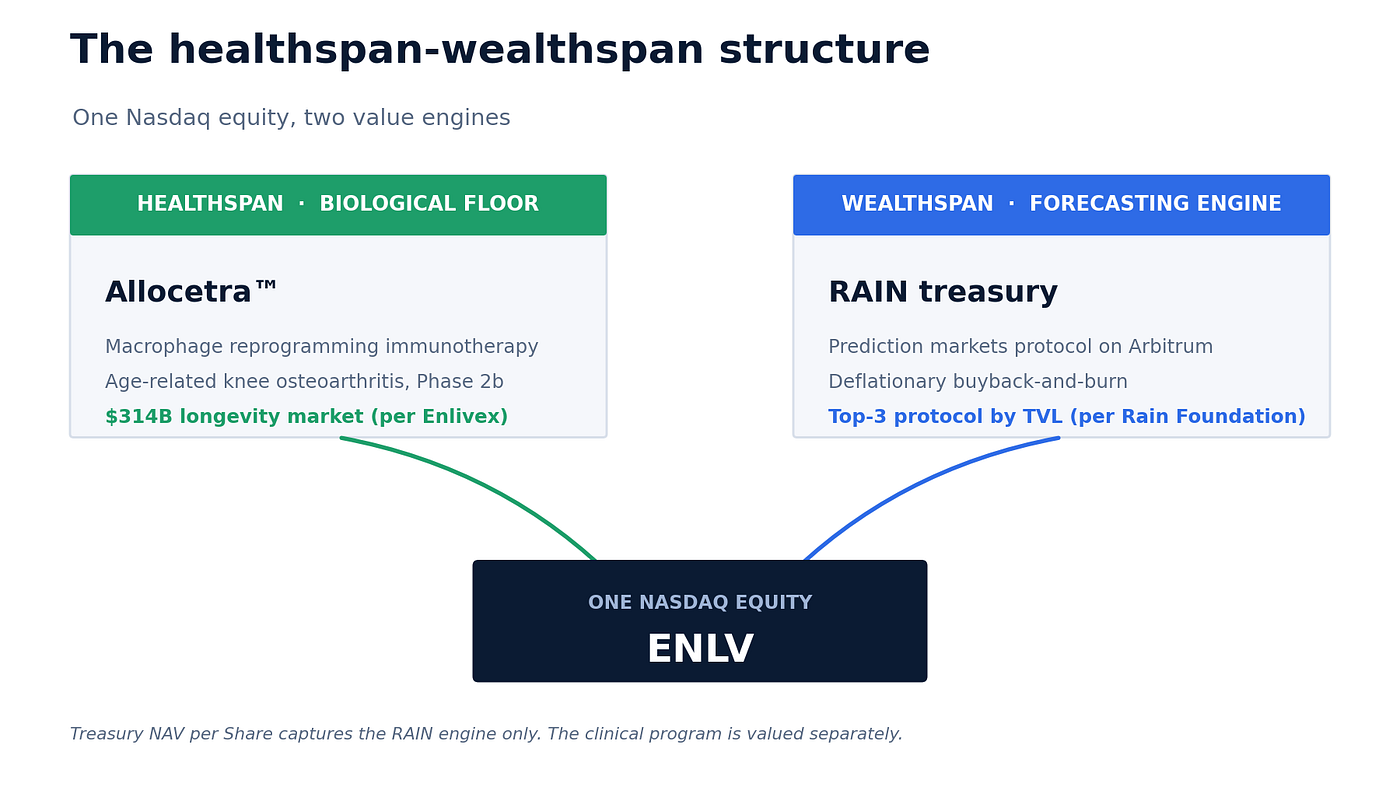
The healthspan-wealthspan structure: a biological floor and a forecasting engine under one Nasdaq equity.
The four-step framework
Put it together. Reading Enlivex’s NAV per share takes four moves.
- Start with the number. Pull the current Treasury NAV per Share from the live dashboard.
- Find the gap. Compare it to the ENLV share price to get the premium or discount, the mNAV.
- Check the source. The figure is unaudited, marked to market, and moves with the RAIN price. Freshness matters.
- Read the second engine separately. Allocetra™ sits outside the treasury NAV. Value it on clinical progress, not token price.
One more nuance for the careful reader. Enlivex also holds an option to acquire up to roughly 271 billion additional RAIN at a fixed price through 2027.
So there is a difference between RAIN held today and RAIN the company could hold. Serious analysts separate realized holdings from potential ones before drawing conclusions.
The number is public. The judgment is yours.
NAV per share is not the answer. It is the question you keep asking.
One number, checked honestly against the market, tells you whether investors agree with the treasury or not.
That is the entire point of the framework. The number is public. The dashboard is live. The rest is judgment.
Treat the dashboard as a starting point, not a scoreboard. Check the figure, measure the gap, and weigh the two engines on their own terms.
Do that consistently, and the headlines stop reading like headlines. They start reading like data.
This piece is educational and is not investment advice. It references forward-looking plans that are subject to regulatory and market risk. All figures are attributed to the sources named in the text.
메타데이터
- post_id
- d52fec3a449f
- slug
- reading-enlivexs-nav-per-share-a-framework-for-the-rain-treasury-d52fec3a449f
- url
- https://blog.venturemagazine.net/reading-enlivexs-nav-per-share-a-framework-for-the-rain-treasury-d52fec3a449f
- canonical_url
- https://blog.venturemagazine.net/reading-enlivexs-nav-per-share-a-framework-for-the-rain-treasury-d52fec3a449f
- author_url
- https://medium.com/@web3talkss
- status
- ok
- fetched_at
- 2026-07-13 06:23:13