Designing better user journeys.
I worked on a product that had a surprisingly common problem. The features were good. The interface looked modern. The onboarding…
Designing better user journeys.

I worked on a product that had a surprisingly common problem. The features were good. The interface looked modern. The onboarding experience had recently been redesigned. Yet users were still struggling. At first, the team focused on individual screens.
Maybe the dashboard needed improvement. Maybe navigation was unclear. Maybe certain workflows felt too complex. Those observations were valid.
But after mapping the entire experience, a bigger issue became visible. The problem wasn’t a screen. It was the journey. Users weren’t failing at a single step. They were losing momentum across multiple steps. Every part of the experience worked independently.
Together, they felt disconnected. That experience taught me something I’ve seen repeatedly throughout product design. Users don’t experience products as collections of screens. They experience journeys. And great products are often the result of great journeys.
Users think in goals, not screens:
One mistake product teams sometimes make is thinking about products screen by screen. The signup page. The dashboard. The settings page. The reporting section. Internally, this makes sense. Products are built in pieces. Users don’t think this way. Users arrive with goals.
They want to solve a problem. Complete a task. Achieve an outcome. The screens simply exist along the way. That’s why journey design matters. Because users evaluate the experience as a whole, not as individual parts.
Every journey creates momentum or friction:
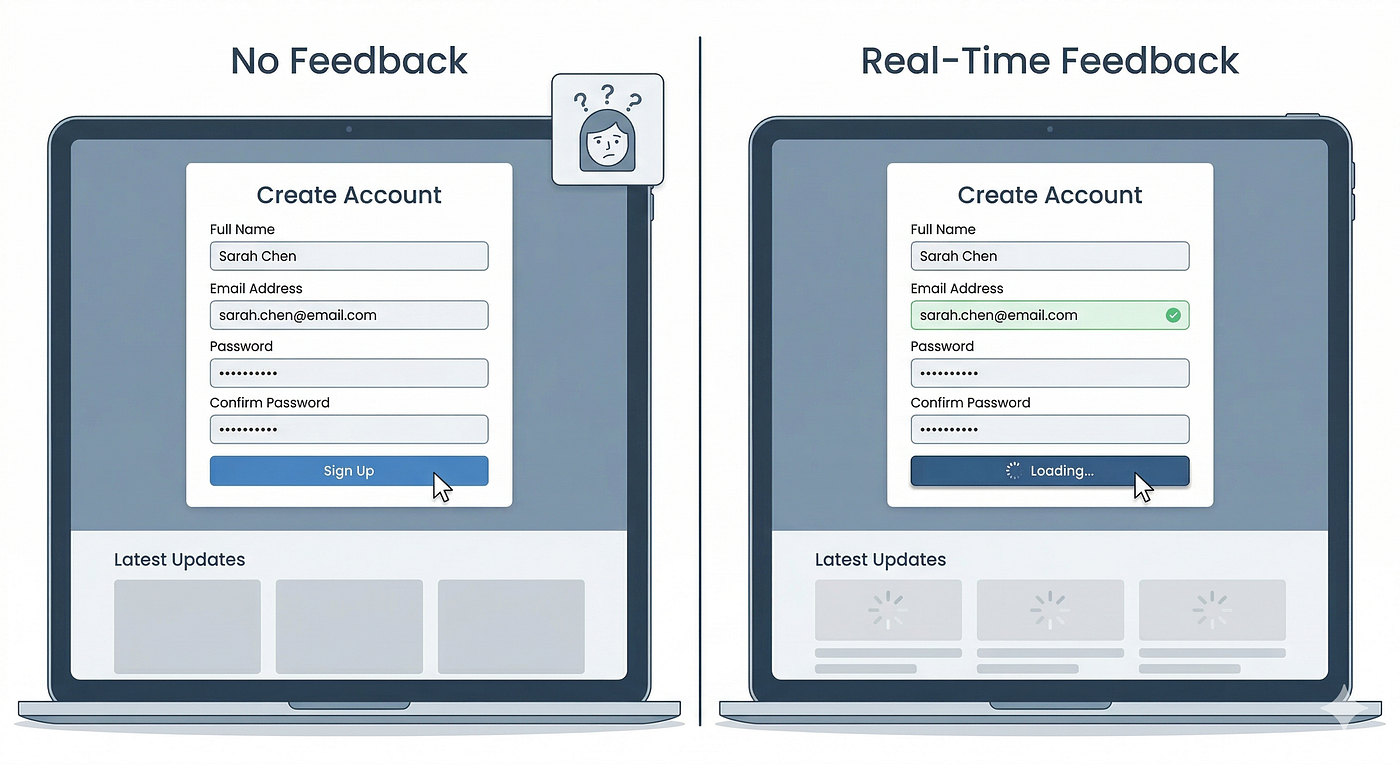
One concept I think about frequently is momentum. Every interaction either moves users forward or slows them down. Clear guidance creates momentum. Confusing decisions create friction. Fast progress creates momentum. Uncertainty creates friction.
The challenge is that friction often appears in small ways. A confusing label. An unnecessary step. An unexpected decision. Individually, these moments seem insignificant. Collectively, they shape the entire experience. And they determine whether users continue moving forward.
Great journeys reduce cognitive effort:
Earlier in this content series, we discussed cognitive load. User journeys play a major role in managing it. Every time users stop and ask:
🟣 What should I do next?” 🟣 Where should I go now?” 🟣 Why am I seeing this?”
The journey is demanding additional mental effort. Strong user journeys reduce those moments. They create clarity. They establish expectations. They help users understand progress. And when progress feels obvious, products feel easier to use.
Most journey problems start between screens:
One interesting thing I’ve noticed is that many usability problems don’t exist on screens. They exist between screens. The transition from onboarding to activation. The transition from discovery to action. The transition from setup to value.
These moments often receive less attention than interfaces themselves. But they are incredibly important. Because users don’t judge experiences based on isolated screens. They judge them based on how smoothly they move from one step to the next.
Better journeys improve business outcomes:
Many people think user journeys are primarily a UX concern. I see them as a business concern. Because journeys influence:
🟢 Activation 🟢 Conversion 🟢 Adoption 🟢 Retention 🟢 Customer satisfaction
Every business metric depends on users successfully progressing through an experience. If the journey creates friction, those metrics suffer. If the journey creates momentum, those metrics improve. That’s why journey design deserves strategic attention.
User journeys reveal hidden problems:
One reason I enjoy journey mapping is that it exposes issues that are otherwise difficult to see. A screen may appear effective in isolation. But when viewed as part of a larger flow, weaknesses become visible. Perhaps users don’t understand the next step.
Expectations may be unclear. Important information appears too late. Journey thinking helps uncover these gaps. And often, fixing them creates a bigger impact than redesigning individual interfaces.
How I think about user journeys:
Whenever I’m reviewing a product, I try to follow the user’s path from beginning to end. Not as a designer. As a user.
🟠 What is the first goal? 🟠 What motivates the next action? 🟠 What creates uncertainty? 🟠 What builds confidence? 🟠 Where does momentum slow down?
These questions often reveal opportunities that analytics alone cannot uncover. Because journeys are about experiences, not just interactions.
Great products feel continuous:
One characteristic of successful products is continuity. The experience feels connected. Users understand where they are. They understand why they’re there. And they understand what comes next. This may sound simple.
But it’s incredibly powerful. Because continuity reduces confusion, reduced confusion improves progress. The best user journeys rarely draw attention to themselves. They simply help people move forward.
Journey design is product design:
One misconception I still encounter is that user journeys belong exclusively to UX teams. I think journey design is product design. Because journeys determine how value is experienced. A great feature inside a broken journey often struggles. An average feature inside a great journey can feel remarkably effective. The journey influences perception, effort, and success. That’s why it deserves attention from the entire product team.
Final thoughts:
I’ve learned that users don’t remember individual screens. They remember experiences. They remember whether progress felt easy. Whether the product helped them succeed. Whether the journey felt smooth or frustrating.
That’s why designing better user journeys matters. Because products are not collections of pages. They’re sequences of decisions, actions, and outcomes. And when those experiences are designed intentionally, users are far more likely to reach the value waiting on the other side.

메타데이터
- post_id
- d5558ee4fe37
- slug
- designing-better-user-journeys-d5558ee4fe37
- url
- https://medium.com/@manjuruldesign/designing-better-user-journeys-d5558ee4fe37
- canonical_url
- https://medium.com/@manjuruldesign/designing-better-user-journeys-d5558ee4fe37
- author_url
- https://medium.com/@manjuruldesign
- status
- ok
- fetched_at
- 2026-06-20 20:29:01