The Only Moat Left Is the One You Specify
When every organization has agents that build, the durable advantage is the accumulated correctness of what they build against.
The Only Moat Left Is the One You Specify
When every organization has agents that build, the durable advantage is the accumulated correctness of what they build against.
Enterprise Experience Architecture presents: The Specification Economy — Article 4 of 4
A large energy trading firm brought me in for the work I am known for: take a product delivery organization that ships too slowly and make it ship fast. Reusable infrastructure across the trading floor. Scaled agile coordinating four regional desks instead of fighting them. Agentic workflows in the build pipeline so each desk’s engineers could produce status surfaces in a fraction of the time. Inside two program increments the velocity was real — surfaces that used to take a sprint were landing in a day.
Then I sat in a delivery review and pulled up the terminal-status surfaces the agents had been producing.
Four desks had built the same surface. Once per desk. Each one forked slightly, each one built against a force-majeure terminal closure that surfaced after the original design system was locked — and not one desk had filed it as a gap. Each desk hit the unnamed state, solved it locally, and shipped. One of those four forks was rendering a closed terminal as accepting cargo. A vessel was already underway. The demurrage clock had already started.
I had made them faster. That was the engagement. Faster was now the problem — because the thing the agents were building against was wrong, and I had just installed the machinery to reproduce that wrongness at speed, across every desk, in every increment.
The velocity was never the asset. What determined whether that velocity was worth anything was decided in a layer I had not been hired to touch — and it had been decided before I ever arrived.
Production Stopped Being the Moat
I have spent over twenty years being hired to solve one problem: enterprises that cannot produce applications fast enough, consistently enough, at the quality their scale demands. The work was always some version of the same thing — reduce the cost and time of producing a surface without losing control of it. For most of those twenty years, that was where the advantage lived. The organization that produced faster, with fewer defects, at lower cost per surface, won. Production was hard, and hard things are where you build a lead.
That era is over. Not ending — over.
When any agent in the pipeline can assemble an operational surface in minutes against a specification, the marginal cost of producing that surface collapses toward zero. The market has the receipts: enterprise API analysis puts blended inference pricing down roughly sixty-seven percent in the past year — about eighteen dollars per million tokens to about six — and Gartner has it falling more than ninety percent further by 2030. The thing I spent two decades helping companies do faster is now cheap, and getting cheaper on a published curve, for everyone.
Cheap is not the same as successful. Gartner projects that more than forty percent of agentic AI projects will be cancelled by the end of 2027 — mostly for cost overruns and unclear value, not technical failure. Read those two numbers side by side. The price of production is collapsing and the project failure rate is climbing, on the same population of deployments, at the same time. That is not a contradiction. It is the proof that price was never the variable separating the projects that worked from the ones that didn’t.
Here is what that does to a competitive lead. When production was expensive, the gap between a strong delivery organization and a weak one showed up in production — in speed, in cost, in defect rate. That is the gap I was hired to close, over and over. Now production is a commodity input that every company in your sector buys at the same price. The trading firm and its closest competitor run the same agents at the same per-token rate. Their desks build at the same speed. Whatever separates them no longer lives in the production layer — because the production layer is identical.
It lives in what the agents build against.
This is the Specification Economy — the worldview that when production approaches zero marginal cost, the specification becomes the primary unit of economic value. The only thing left worth paying for is the precision of what the agents execute against. This series opened by proving that ambiguity in that specification carries a metered cost. It built the instrument that makes the cost legible to finance, then the operating function that keeps the specification true after launch. This article is the consequence the first three were building toward: when the specification is the only variable that still differs between you and your competitor, the specification is the only moat you have left.
When production costs nothing, the only thing left worth paying for is the specification that makes production correct.

When every company runs the same agents at the same token price, the only variable left is what those agents build against.
Same Model In. Different Companies Out.
I install a version of the same delivery model at Fortune 100 clients in the same sector. Reusable infrastructure, scaled agile, agentic workflows. Same model. The outcomes are not the same — and the divergence has almost nothing to do with the model I bring.
Take the trading firm and a peer institution: same sector, same agent fleet at the same token price, same scaled-agile cadence, the same four regional desks. On an org chart, the same company twice. Eighteen months into running agents, they are not the same company at all. One ships terminal-status surfaces clean on the first pass and rarely revisits them. The other rebuilds the same surface every quarter, files production incidents against states nobody specified, and burns sprint capacity remediating forks.
Eleven months into that engagement, the lagging peer’s terminal-status surface rendered an embargoed counterparty’s cargo as clear to load — a sanctions-screening state nobody had enumerated, because nobody had been asked to. The shipment moved before compliance caught it. Six figures in remediation, a self-report to the regulator, and a quarter of board-level scrutiny on a surface that had shipped looking finished. That is not a rework story. That is the line item that lands on a CFO’s desk with no explanation attached — because nobody in the room can trace it back to a specification gap that existed before the agents ever touched the surface.

Same sector. Same agents. Same token price. Same cadence. The only thing that diverged was what each firm’s agents built against.
The difference was not the delivery model. Both ran a competent one. The difference was authored in the first month of agentic deployment, in the specification layer, and it has been compounding every increment since. One organization ran a State Inventory — a structured enumeration of every condition its surfaces could enter — before the agents touched anything. The other pointed the agents at the existing design system and started shipping.
That was the whole divergence. And here is the part that matters for everyone reading who has not yet felt it: the cost of that divergence surfaces first on the AI inference costs — the computational fee the enterprise pays every time an agent runs, metered per token. That bill is real, it is growing, and it is mostly invisible to product and delivery leadership today. It lives with the technology controllers and the financial analysts who track cloud spend. It reached the product table only in the last few months, and a large part of the enterprise has not heard the term yet.
You do not need to have seen that bill to be authoring it. I had not been looking at it either — it was not the layer I was hired to touch. The symptoms I could see were in my own domain: the forks, the rework, the same surface built four times. The bill is where those symptoms are quietly being priced. The job now is to connect the two before the second meter arrives.
A competitor can copy your surface in an afternoon. They cannot copy the eighteen months of discovery that told you which states it had to govern.
The Asset Nobody Has on the Balance Sheet
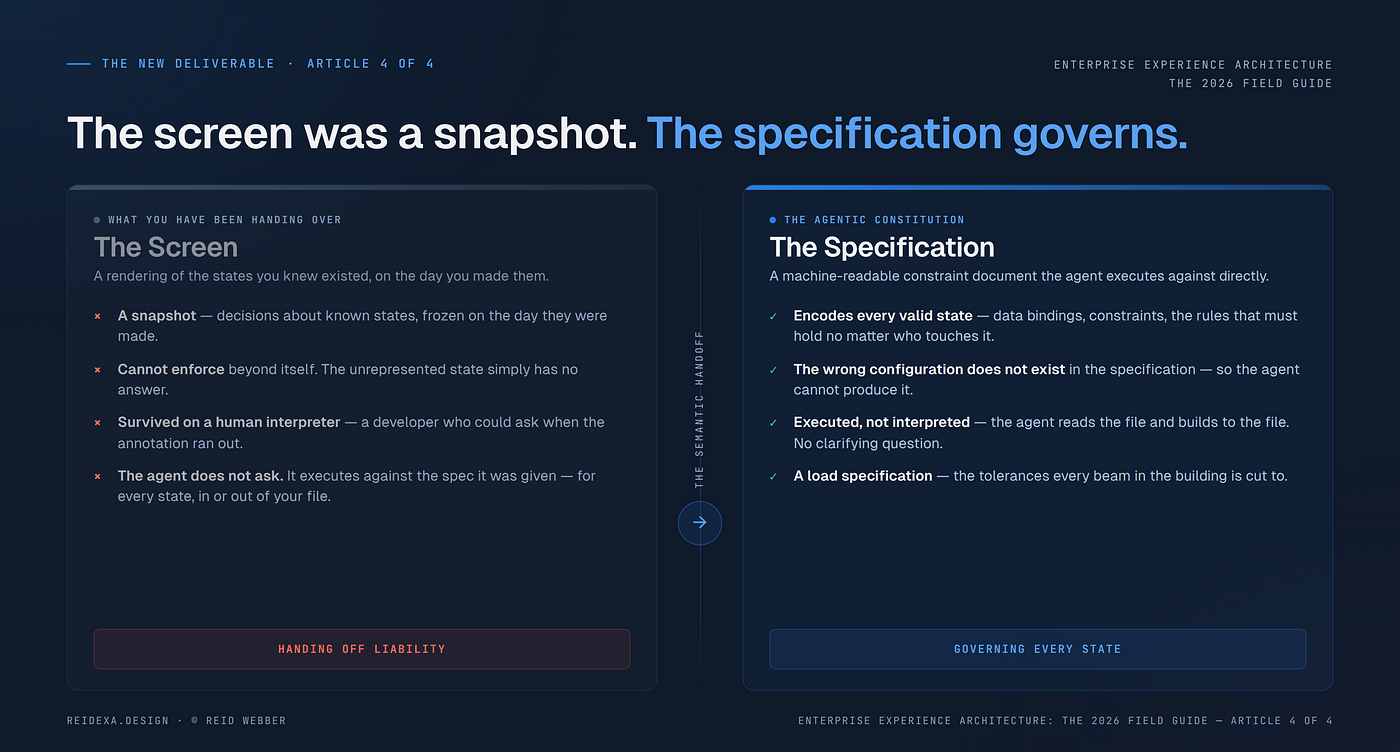
Ask the CFO at either trading firm to show you the asset that explains the difference, and they cannot. There is no line item called “accumulated specification correctness.” There is no depreciation schedule for a governed Agentic Constitution — the machine-readable constraint file that tells every agent what each enterprise state requires and what it must never do when it meets one. The most valuable thing the leading organization owns does not appear in any system the finance function runs.
That does not make it less real. It makes it the most under-measured asset in the agentic enterprise.
Consider what the leading organization actually accumulated. Every state its architects named before an agent built against it. Every force-majeure closure, every embargo declaration, every charter-party penalty clause — the architects enumerated it, costed it, and encoded it before a demurrage dispute could discover it for them. They read every regulatory update on a schedule and amended it into the constitution before it became a dark state, the enterprise condition that exists operationally but has never been named, mapped, or encoded. Eighteen months of that is not documentation. It is a versioned, auditable record of correctness that every agent in the fleet now executes against on the first pass.
The other organization accumulated the inverse. Eighteen months of Specification Debt — the compounding weight of undocumented decisions, unnamed states, and untranslated business rules that never entered the specification layer. Every deferred state-naming decision became a dark state. Every dark state became a surface where the agents loop, or guess. That debt does not sit still. The agents reprice it every increment, at machine speed, on a bill nobody has yet traced back to its source.
The reason the asset is invisible is the same reason it is durable. A competitor can copy your product surface in an afternoon — point their agents at a screenshot and regenerate it. What they cannot copy is the eighteen months of discovery that told you the terminal-closure state existed in the first place. The screen is reproducible. The specification behind it is the accumulated output of every stakeholder interview, every legacy audit, every production incident you turned into a named state instead of a recurring liability. That does not transfer with a screenshot. That is institutional knowledge, encoded for execution — and it is the moat.
The Retry Tax Becomes a Compounding Spread
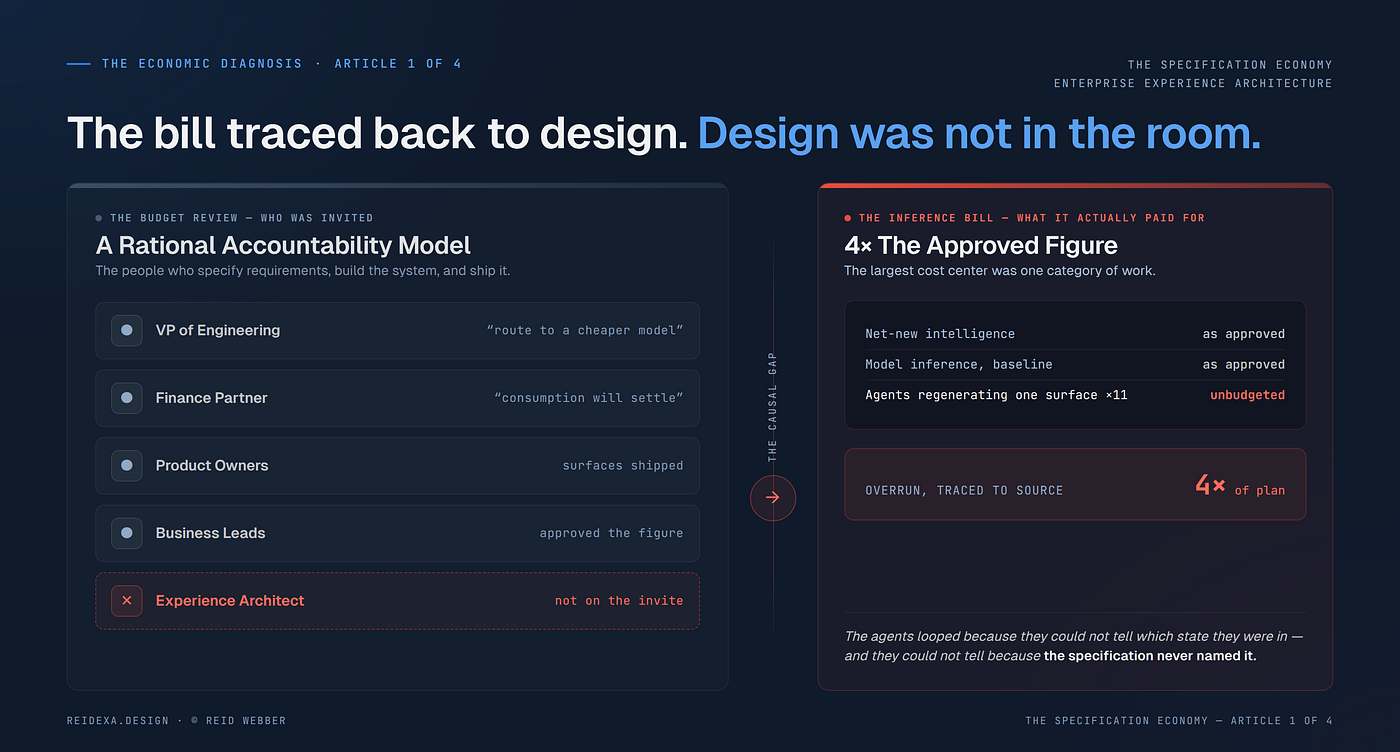
Article 1 named the **Retry Tax** — the metered cost of ambiguity, the inference burned every time an agent loops against a specification it cannot resolve. Enterprise API analysis puts a single retry loop at up to fifty times the tokens of one clean pass. In Article 1 that was the diagnosis of a single overrun. Here it is the mechanism that drives two identical companies apart.
Run it forward. Both trading firms deploy the same agents. The leading organization’s agents meet a terminal-closure state, find it named in the constitution with explicit required and forbidden behavior, and resolve it on the first pass. The other’s agents meet the same state, find nothing, and loop — or worse, generate a plausible guess and ship it. Same token price. Same agent. Different specification. One pays once. The other pays the Retry Tax every session, in production, until someone finally names the state.
That is the Margin Multiplier in its purest form. Good architecture compounds value by eliminating rework at the source. Bad architecture compounds liability at exactly the same velocity — and the agent does not slow down to ask which one it is building against. Fifty times the tokens, on one loop, on one surface, in one session. Multiply that by every session the lagging desk runs and the multiplier stops being a unit-economics curiosity. It becomes the spread. The volume that is coming will not forgive an ungoverned state. It will meter it, at scale, on a curve.
The spread is not linear. Each ungoverned state the leading organization named in month one is a loop the other is still paying for in month eighteen — and the lagging one keeps adding dark states faster than it closes them, because it never built the discovery function. The gap between two identical companies running identical agents at an identical price widens every increment. That is the moat, seen from the wrong side of it.
The deflation curve was supposed to make every agentic deployment more affordable. Instead it is exposing which organizations specified correctly and which ones spent eighteen months scaling a gap. Cheap tokens did not rescue the lagging company. They let its specification debt scale faster — at the same per-token rate, on the same agents, paid by the company that never named the state.

Two ledgers, same starting point, opposite directions — and neither one has a line item on any balance sheet the finance function runs.
You Are Already Accumulating One — In Which Direction Is the Question
If your organization is not yet running agents at scale, do not read these two trading firms as a future problem. Read them as a present one with a delayed invoice. A team building human surfaces today is accruing Specification Debt right now, at human speed — every unnamed state, every business rule living in an operations manager’s memory instead of a constraint file, every architectural decision nobody wrote down. At human speed that debt is denominated in sprint capacity and remediation cycles. Slow enough to feel manageable.
It does not stay at human speed. The day agents enter the pipeline, they reprice the entire accumulated debt at machine speed — without warning, without a transition period, and without the option to rebuild the specification before the first deployment runs against it. When the executor was human, an unnamed state was survivable: a developer hit the edge case and walked to a stakeholder’s desk to ask. An agent does not walk anywhere. It loops, or it generates something — and “something” is not an acceptable output from a surface that renders a terminal’s status to an operator in the eighth hour of a trading shift, the exact point where Cognitive Endurance — the capacity to hold peak precision before fatigue starts generating errors — is thinnest, and a wrong render is most likely to clear unchallenged.
The two trading firms did not start diverging when the agents arrived. They started diverging in the years before, in the direction each one was already accumulating. The agents did not author the gap. They repriced it.
The moat is being dug right now, at every organization, in one direction or the other. The only question is whether you are deepening yours or your competitor’s.
The Experience Architecture Maturity Model
Knowing the moat exists is not the same as knowing where you stand in it. Most product and delivery leaders cannot answer the only question that matters — are we compounding correctness or compounding debt? — because they have never located themselves on the curve.
You do not need to have seen the inference bill to be authoring it — I said as much earlier in this piece. What you can see from your seat are the symptoms it is pricing: rework, drift, the same surface rebuilt, states found in production instead of named in advance. The point of the model is to let you read your stage from the symptoms you already have, before the second meter forces the conversation.
The Experience Architecture Maturity Model is the instrument that locates you. Four stages. Each has a defining mechanism, a way to recognize you are in it from inside the delivery org, and one specific next move — not “improve governance,” but the actual tool-level action that moves you forward. Read it as a diagnostic you run this week, not a poster. Find your stage by its symptoms, then take the named move.
Maturity here is not measured in how many agents you have deployed or how fast they ship. A team can be deep into agentic delivery — running scaled agile across the program, shipping every increment on cadence — and still sit at Stage 1. The axis is governance of what the agents build against, not velocity of what they build. Fast delivery against an ungoverned specification is not maturity. It is debt, accruing faster. I have installed exactly that, and watched it manufacture forks at speed. Velocity without governance is the most expensive thing in this model.
Stage 1 — Ungoverned.
The Mechanism: Your teams build against a static design system — and a static design system governs exactly the states the original design team knew about on the day they built it. Every state that surfaced after that day is ungoverned, forked, or a production incident waiting to be filed. Most organizations are here without knowing it, because the design system looks complete: it renders, and it has a component for everything anyone thought to ask for. What it cannot govern is the state nobody named.
The Symptoms — what you can see from your desk:
- The same surface rebuilt by three different desks, each solving the same edge case locally and moving on
- Defects that trace back to a state nobody specified
- A production incident rate that refuses to fall even as the team gains experience
The Next Move: Before your next agentic increment, run a State Inventory on the three highest-consequence surfaces in your product — the ones that carry liability, compliance exposure, or operational error cost when they render wrong. Enumerate every state each surface can enter before any agent builds against it. The Retry Tax — the inference cost an agent burns looping against a specification it cannot resolve — has two sources: ambiguous specifications for the states you named, and ungoverned specifications for the ones you never did. The first you feel as rework today. The second lands on the inference bill the day agents scale — and only the State Inventory addresses it.
Stage 2 — Constrained.
The Mechanism: You have authored an Agentic Constitution. You have named the high-consequence states and encoded the required and forbidden behaviors, and the agents now execute against constraint files instead of interpreting a screenshot an engineer redlined. Rework on governed surfaces drops measurably — the same edge case stops returning three increments in a row. But constrained is not the same as defended. A constitution is accurate the day you commit it and begins drifting the day after, as desks build against it, the backend shifts underneath it, and regulators rewrite the rules it answers to.
The Symptoms — what you can see from your desk:
- A constitution that exists, paired with a quiet assumption that the work is therefore done
- An early improvement real enough to tempt you into declaring victory and walking away
- A single source of truth starting to fork into versions nobody is watching
The Next Move: Install the Logic-Review Gate as a definition of “ready to build,” not a new meeting — a mandatory constraint-reviewed check before any agent-facing surface enters an increment, owned by a named Governance Architect, the role that holds sign-off authority over constraint files the way a release manager holds it over code. A constitution with no function to defend it is a snapshot, not governance. Stage 2 to Stage 3 is the move from authoring the document to running the discipline.
Stage 3 — Instrumented.
The Mechanism: The governance function is live and producing data. The Logic-Review Gate catches deviations before merge. The amendment protocol distinguishes a structural signal — the same override surfacing across three desks, which is one specification gap appearing three times — from a preference request: the gate returns those at intake, without review. You are no longer just defending the specification. It is improving on a measured curve.
The Symptoms — what you can see from your desk:
- You are measuring the rate at which agents loop before resolving a surface, deviations caught before merge, and the ratio of dark states named upstream versus discovered as production incidents
- The discovery ratio moves in the right direction quarter over quarter
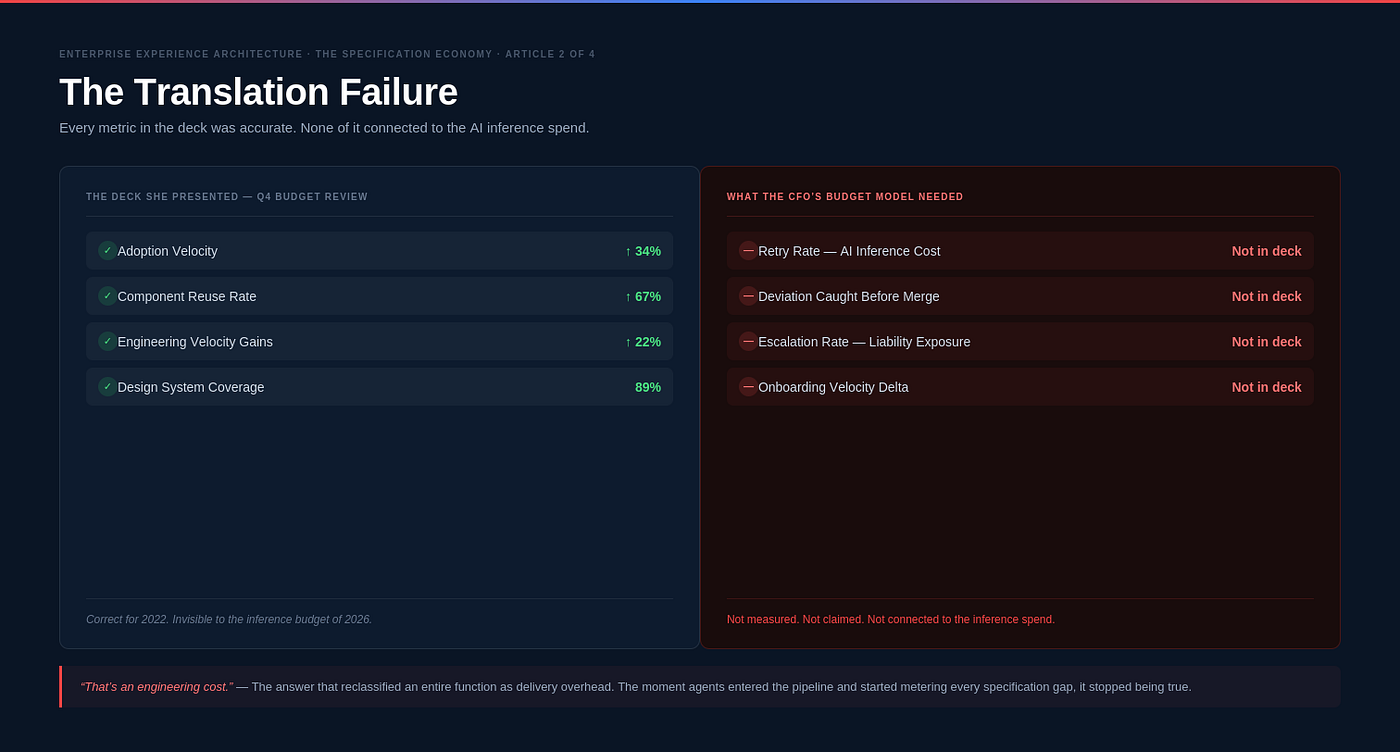
- Finance starts bringing questions to you instead of the reverse — the same metrics that prove the gate is working are the first numbers connecting your delivery discipline to the inference bill the controllers have been watching alone, and the same inputs an industry auditor, an EU AI Act compliance review, or a SOC 2 assessment will require. That regulatory case is its own argument in its own piece.
The Next Move: Close the Continuous Learning Loop — the mechanism that feeds production telemetry back into the constitution automatically, instead of waiting for someone to notice the drift. Pipe production telemetry — component overrides, consumption anomalies, override-frequency patterns — directly into the Governance Architect’s queue on trigger, not on a standing weekly meeting, so the specification learns from every deployment at the speed the system runs rather than the speed the next calendar slot allows.
Stage 4 — Compounding.
The Mechanism: The specification improves automatically with use. Every deployment surfaces new states; the learning loop feeds them back; the constitution gets more precise without anyone manually hunting for gaps. This is where the moat does its compounding — not because you work harder than the team at Stage 1, but because your architecture is now doing the accumulating for you. The asset grows while you sleep.
The Symptoms — what you can see from your desk:
- Rework trends toward zero on mature surfaces while organizations at Stage 1 rebuild the same edge case every quarter
- New product lines inherit a specification that is already correct
- Onboarding a new architect takes days instead of a quarter, because the institutional knowledge lives in the State Inventory rather than in people’s heads
- Cost per surface keeps falling even as delivery volume rises — the signal the controllers eventually read as a falling inference bill, two stages after you authored it
The Next Move: This is the frontier, and the next move is not a refinement of the last three. It is a different class of problem. Read on.

The Experience Architecture Maturity Model: locate your organization by the symptoms you can see, then take the named move. Maturity is governance of what agents build against — not velocity of what they build.
The Frontier the Current Constitution Does Not Reach
The maturity model has a fourth stage and no fifth, and that is not an oversight. Stage 4 is where the framework this series built reaches the edge of what it governs — and naming that edge honestly is more useful than pretending the model closes every gap.
Everything in The Specification Economy governs one thing: what agents build against a specification the architect authored in advance. The State Inventory enumerates states ahead of the build. The constitution encodes behavior ahead of the build. The Logic-Review Gate approves constraints ahead of the build. The entire discipline rests on a pre-authored document that exists before the agent runs. That model is correct. It is the source of every dollar of margin the first three articles demonstrated. It also has a structural boundary.
The boundary is this. A static constitution can still contain what it cannot predict. A constraint that says agent must not render a guess — the discipline Article 1 named for a single surface — will refuse an unmatched state instead of inventing one. That containment is real. It stops the wrong render. What it cannot do is adjudicate whether the composition is correct. A refusal rule tells an agent what to do when it does not recognize the configuration in front of it. It does not tell anyone — the agent, or whoever reviews after the fact — whether the configuration that five agents just assembled, handing context between one another in a sequence no architect specified, resolves to the right operational outcome. The constitution can contain the unknown. It cannot certify the composed result, because no pre-authored document can evaluate a configuration that did not exist when the document was written. When a fleet of agents hands context between one another and composes an operator’s surface dynamically at runtime, the thing the operator finally sees was never reviewed by any gate. It did not exist until the moment it rendered. The constitution governed the parts. It contained the unknown in the assembly. It did not adjudicate the assembly. And adjudication is where the next class of liability lives.
This is not a gap in how well you ran the playbook. An organization can reach Stage 4, run every discipline this series defined flawlessly, and still face it — because it is a limit of the pre-authored model itself, not a failure to execute that model. Multi-agent orchestration, where agents hand context across one another to compose a surface no single agent built, exceeds what any constitution written in advance can fully constrain. You can govern each agent’s behavior. Governing what emerges when they hand off to each other in real time is a different problem — and the framework that built your moat names it without solving it.
Do not read that as a reason to defer Stage 1 while you wait for someone to solve Stage 5. It is the opposite case. An organization that has not yet governed what its agents build against a document written in advance has no chance of governing what they assemble in real time, from inputs no document anticipated. None. The pre-authored constitution is not a competing track to the runtime problem. It is the prerequisite for surviving it. You cannot defend a surface assembled on the fly if you have never successfully defended one written down in advance — the discipline is the same muscle, exercised on a harder problem. Stage 4 is not the finish line this series promised. It is the entry fee for the next one.
So the question Article 1 asked — why is the bill four times what we approved? — has an answer now, across four articles. Because the specification was ambiguous. Because the ambiguity went unmeasured. Because no function defended the specification after launch. Because the gap compounded into a moat pointed the wrong way. That question is closed.
The question that replaces it is not.
When the surface is generated in real time, per session, by agents handing off to one another against a constitution that was written before any of it existed — who governs what is generated?
Not who governs what the agents build. That question is answered. Who governs what they generate, in the moment, from a configuration no architect ever reviewed and no document ever anticipated.
I do not have a constraint file for that. Neither does anyone else. It is the newest dark state in the discipline — and like every dark state, it is already accruing cost on systems that have not yet named it.
That is the next thing worth specifying. The moat you can build today is the one you author in advance. The moat that comes next belongs to whoever can govern what was never written down at all.
Series One established the architectural foundation this argument builds on: why the static design system is obsolete and why AI needs a constitution, not a better library. The Specification Economy opened with the diagnosis — why “good enough” is the most expensive thing you will ever ship — then built the meter that makes specification quality legible to finance and the operating function that keeps the specification true after launch.
Enterprise Experience Architecture presents: The Specification Economy — Article 4 of 4. Explore the full EXA framework at reidexa.design/exa.
메타데이터
- post_id
- d55ff210383e
- slug
- the-only-moat-left-is-the-one-you-specify-d55ff210383e
- url
- https://medium.com/enterprise-experience-architecture/the-only-moat-left-is-the-one-you-specify-d55ff210383e
- canonical_url
- https://medium.com/enterprise-experience-architecture/the-only-moat-left-is-the-one-you-specify-d55ff210383e
- author_url
- https://medium.com/@reidw918
- status
- ok
- fetched_at
- 2026-06-24 23:31:39