A Beginner’s Guide to Exo-planet: Trappist-1e
~ Jean Jipson
A Beginner’s Guide to Exo-Planets: Trappist-1e
~ Jean Jipson
Earlier, during our interstellar journey, we explored the fascinating exoplanet Gliese 667cc in the constellation Scorpius, revealing its potential for habitability. Today, we plunge deeper into the cosmic abyss, setting the course for another fascinating destination nearly 40 light years from Earth. Fasten your seat belts, the crew of Pioneer-4, and let’s head for the TRAPPIST-1 system, an extraordinary star system located in the constellation of Aquarius. Destination: TRAPPIST-1e!
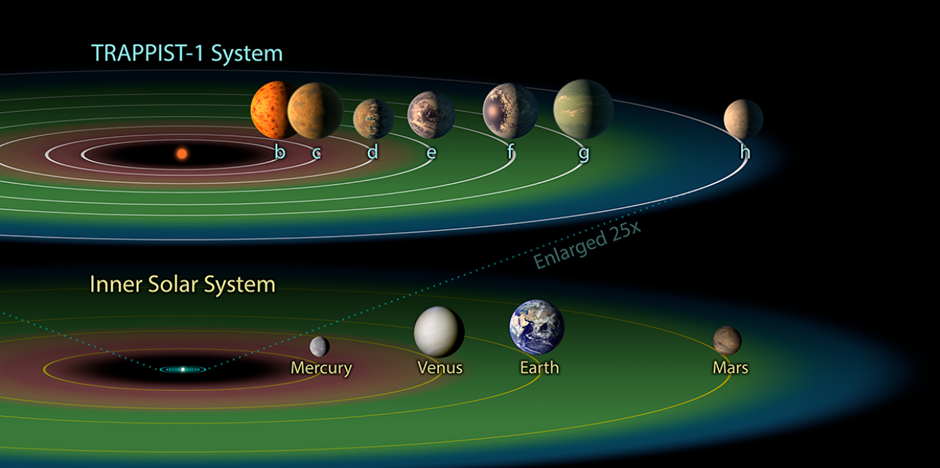
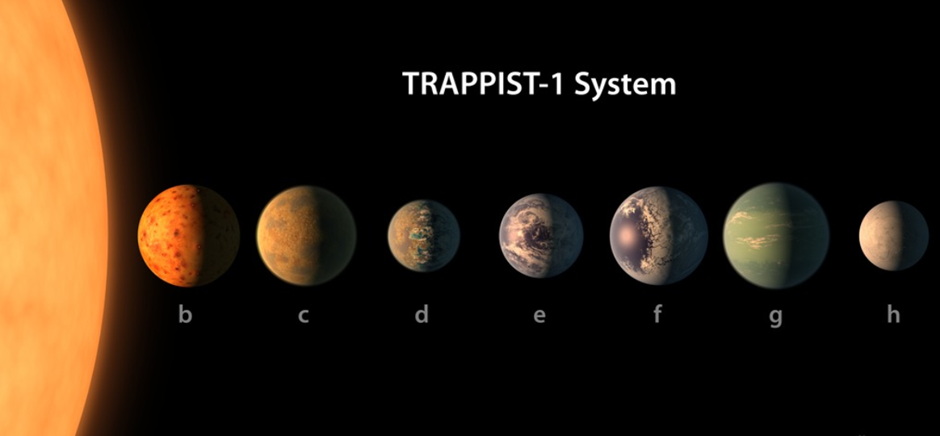
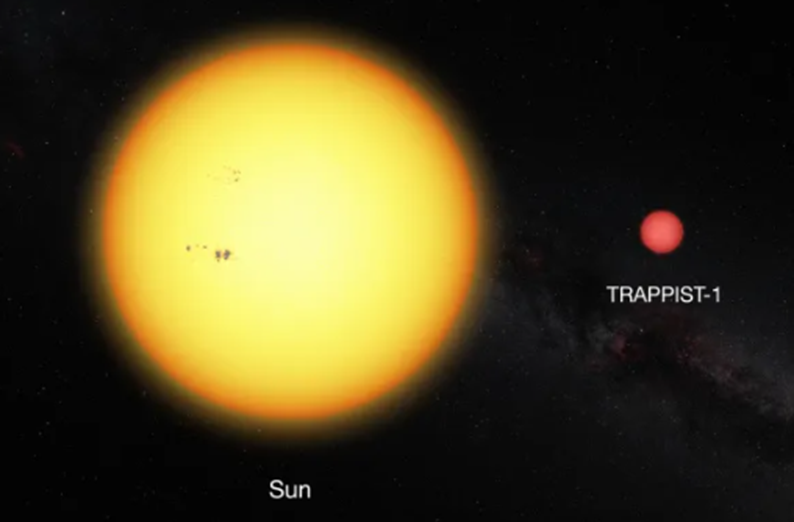
As we glide closer to TRAPPIST-1, we are greeted by an ultra-cool red dwarf star — a miniature sun — whose size is a mere fraction of our own, only 9% the mass of the Sun. It stands like a humble sentinel in the cosmos, harboring a retinue of seven Earth-sized planets, each orbiting so closely that they appear to intertwine like the notes in a symphony. Within this gravitational embrace, our focus rests upon TRAPPIST-1e, the fourth orb from the star, an alluring candidate positioned within the habitable zone — the serendipitous region where conditions may allow liquid water to flow like life’s vital currents. In this star system, the seven planets orbit much closer to their star than Mercury does to the Sun. The entire TRAPPIST-1 planetary system fits comfortably within a tenth of the distance between the Sun and Earth.
https://hubblesite.org/contents/media/images/2017/07/3986-Image.html?news=true
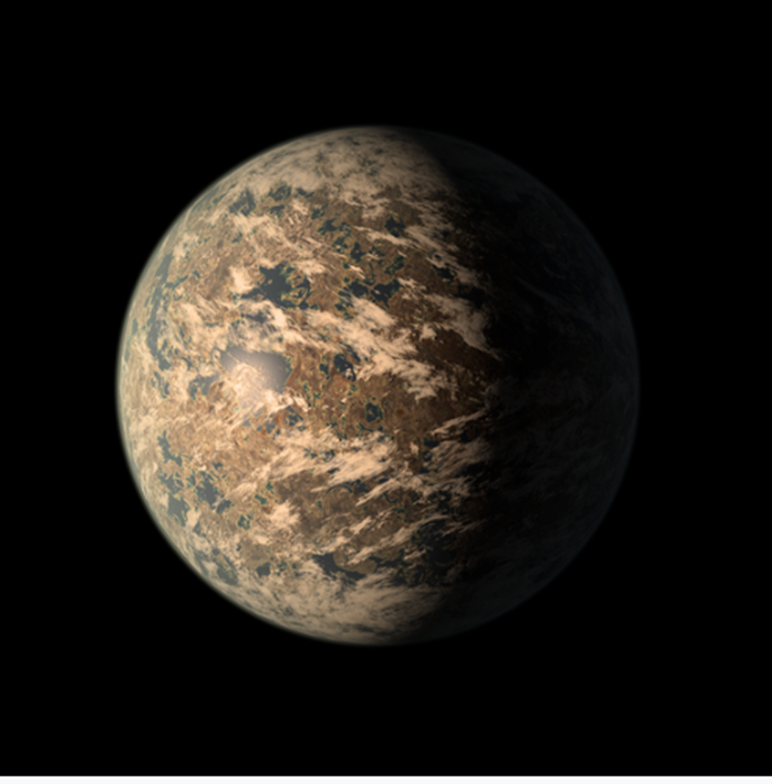
Our onboard analysis confirms that TRAPPIST-1e is one of the most promising candidates for potential habitability in this system. Although it is only about 75% of Earth’s mass and slightly smaller, its density is about the same as Earth’s, indicating a hard, rocky surface. This density suggests that TRAPPIST-1e has a rich composition of silicate rocks and possibly a metallic core, similar to our planet. Unlike its planetary counterparts, some of which may have dense and humid atmospheres or be encased in ice, TRAPPIST-1e may offer a more Earth-like environment with the possibility of holding liquid water on its surface. TRAPPIST-1e offers a tantalizing prospect of an environment that may host liquid water, inviting us to ponder: could life flourish here, much like a budding flower breaking through the surface after a long winter?
https://en.wikipedia.org/wiki/TRAPPIST-1e
Due to its proximity to TRAPPIST-1, a year in TRAPPIST-1e is only 6 Earth days. The planet is tidally locked, which means that one side is constantly facing the star while the other remains in darkness. This results in extreme temperature differences between the two hemispheres, but the narrow band between the day and night sides, known as the termination line, can have an ideal temperature for life. This “twilight zone” could house a thin atmosphere, which could moderate the climate and potentially allow for the presence of liquid water.
TRAPPIST-1e, with its six sisters, was discovered using the transit method. The TRAPPIST-1 planets are so close together that if you could stand on the surface of one, you might see some of the neighboring planets hovering above. Astronomers observed slight dips in the brightness of the star TRAPPIST-1 as each planet passed in front of it, blocking a small portion of the star’s light. The planets were first discovered by the TRAPPIST telescope (Transiting Planets and Planetesimals Small Telescope) in Chile and then confirmed by the Spitzer Space Telescope, which provided more detailed observations. This system quickly became a primary target for the James Webb Space Telescope (JWST). Launched on December 25, 2021, JWST has already turned its powerful instruments towards TRAPPIST-1e. The telescope’s advanced capabilities allow it to analyze the planet’s atmosphere in unprecedented detail, looking for biosignatures, that is, chemical indicators such as oxygen, methane, or other gases that may suggest the presence of life.
NASA/JPL-Caltech/R. Hurt, T. Pyle (IPAC)
Under the leadership of Nicole Lewis and her dedicated team, the quest for biosignatures unfolds — a search for chemical markers like oxygen, methane, and other compounds that could signify the presence of life. The TRAPPIST-1 system captures the imaginations of astronomers for several compelling reasons:
1. Proximity: At only 39 light years away, it is close enough to allow for detailed study.
2. Frequent transits: The orbits of the planets are aligned in such a way that they often pass their star, providing many opportunities to study its atmosphere.
3. Cool host stars: TRAPPIST-1 is an ultra-cool dwarf star, emitting much less radiation than our Sun. This means the habitable zone is much closer, allowing planets like TRAPPIST-1e to stay soft despite their tight orbits.
4. Potential for life: The possibility of liquid water in TRAPPIST-1e, as well as its density of the Earth, makes it one of the most promising candidates to host life outside our solar system.
https://www.drewexmachina.com/2018/04/18/alien-skies-the-view-from-trappist-1e/
As we continue our exploration, we look forward to unveiling the secrets of TRAPPIST-1e’s atmosphere and its neighboring worlds. Scientists remain particularly keen to discover whether this planet has a substantial atmosphere, the nature of its gaseous composition and whether clouds or traces of water vapor may adorn its skies. Thus, through the collaborative efforts of ground-based telescopes and ambitious space missions, TRAPPIST-1e emerges as a beacon of hope — a distant world that could potentially nurture the delicate dance of life, waiting for humanity to take the next step into its promising embrace.
메타데이터
- post_id
- d5717fb7da75
- slug
- a-beginners-guide-to-exo-planet-trappist-1e-d5717fb7da75
- url
- https://medium.com/@aichevit/a-beginners-guide-to-exo-planet-trappist-1e-d5717fb7da75
- canonical_url
- https://medium.com/@aichevit/a-beginners-guide-to-exo-planet-trappist-1e-d5717fb7da75
- author_url
- https://medium.com/@aichevit
- status
- ok
- fetched_at
- 2026-07-13 09:20:14