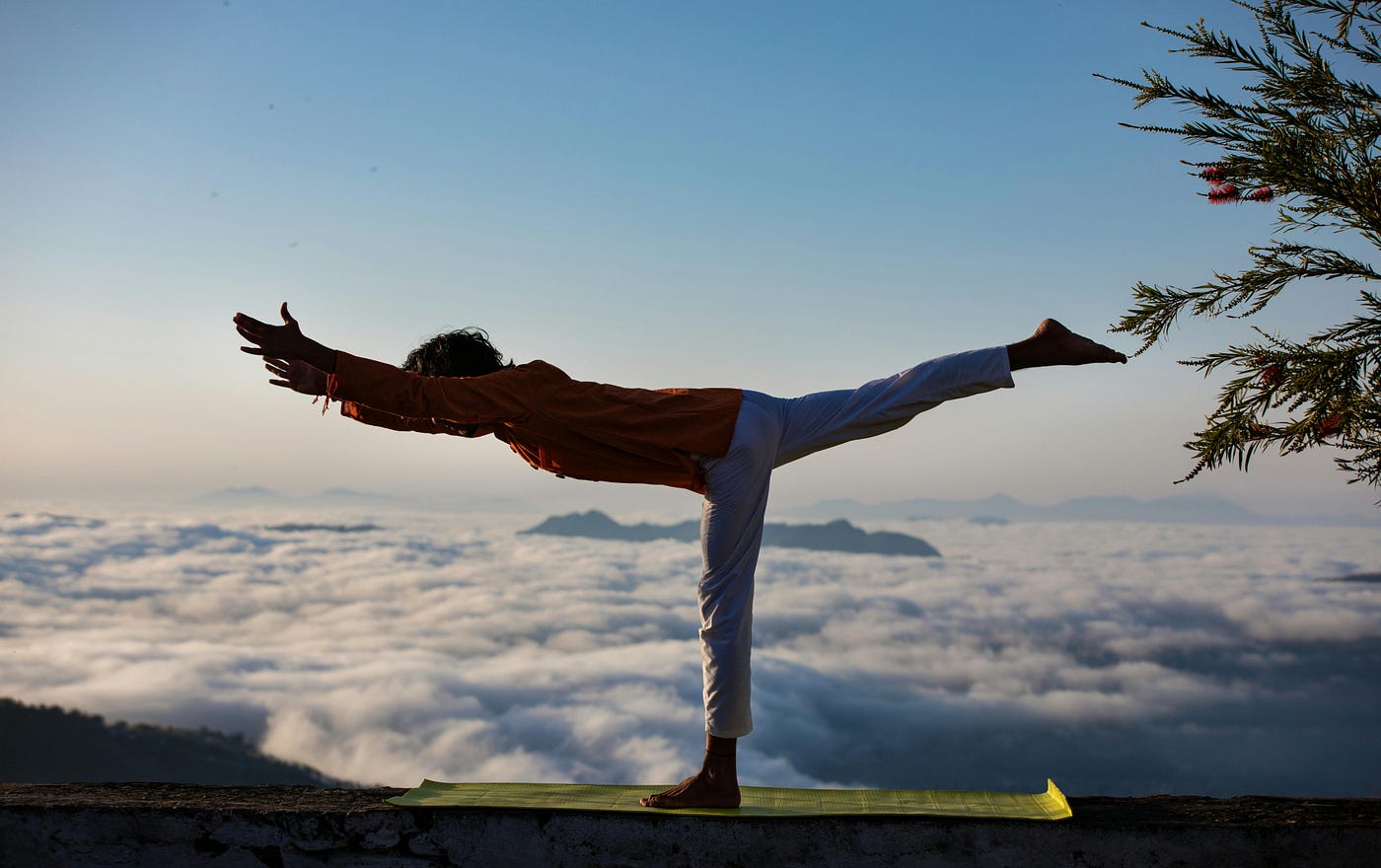
Why India Still Shapes the Way Yoga Is Studied
By Sukhvinder Singh Chaitanya | Founder, Yoga Chaitanya International Institute | ERYT-500 | 20,000+ teaching hours
Why India Still Shapes the Way Yoga Is Studied
By Sukhvinder Singh Chaitanya | Founder, Yoga Chaitanya International Institute | ERYT-500 | 20,000+ teaching hours
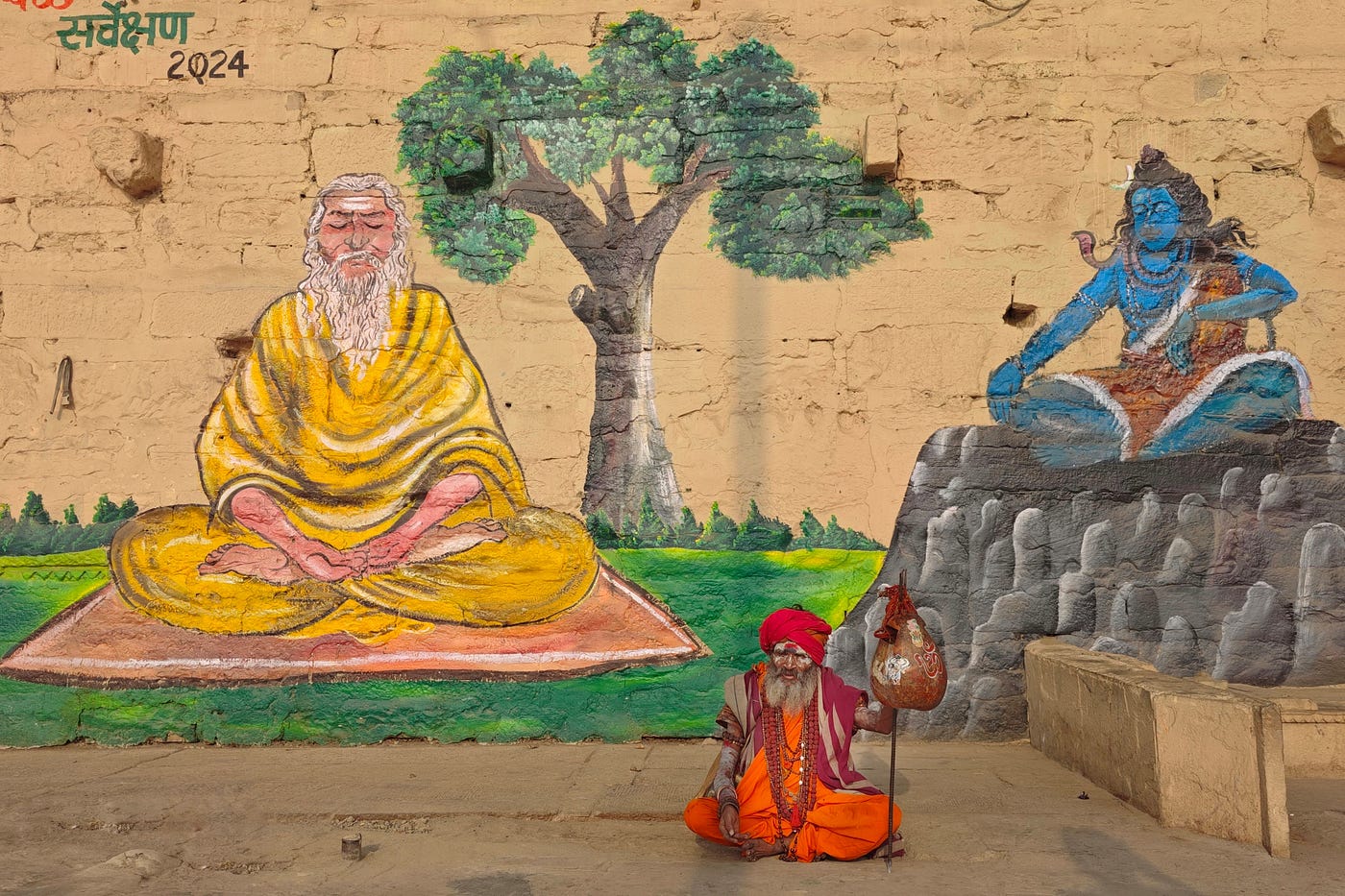
A monk in quiet yoga practice, representing how India continues to shape the study of yoga through tradition, discipline, and living practice.
Most yoga asanas taught in studios today are less than 100 years old. The physical postures as a system were largely codified in the 20th century, yet the philosophy, ethics, breathing disciplines, and meditative frameworks that give those postures their meaning are more than 2,000 years old. Somewhere between the ancient texts and the modern mat, most of that context went missing.
Have you ever wondered why yoga feels like exercise in one class and like a complete practice in another? Why can two teachers use the same posture and produce entirely different experiences? Why do some students practice for a decade and still feel they are only scratching the surface?
Studying yoga in India does not automatically answer these questions. But India still holds the strongest thread connecting yoga’s living traditions to modern study formats. This article explores why yoga in India’s history continues to shape how yoga is taught, what traditional yoga study actually included, how yoga education in India has evolved, and what a student should realistically look for in any serious program. This is the most complete overview of this topic currently available. In this guide, you will learn:
• What studying yoga in India actually means beyond certification.
• How the history of yoga in India shaped every practice element you study today.
• What the Guru-Shishya model gave students that class formats rarely do.
• How modern yoga education in India has built formal structures around traditional depth.
• What to look for when choosing a serious yoga program, in India or anywhere.
Let’s dive right in.
What does studying yoga in India actually mean?
Studying yoga in India means learning yoga close to its philosophical, textual, cultural, and practice traditions, not only its postures.
The phrase studying yoga in India carries more weight than location. Students sometimes imagine that flying to Rishikesh or Goa automatically gives them access to authentic yoga. It does not. What India offers is context, and context is only available when the program you choose is genuinely built around it.
Context means: the Sanskrit terms your teacher uses are grounded in specific philosophical frameworks, not fashionable vocabulary. The pranayama practice has a sequence and a reason. The meditation sits inside a lineage that has been tested over time. The daily rhythm reflects a way of living, not a schedule. When these elements are present, regardless of geography, you are closer to what yoga was always meant to be.
India gives you the best chance of finding this combination in one place because the cultural soil, the living teachers, the texts, and the practice environments have been accumulating for centuries. But a sincere student in Berlin studying with a properly trained teacher and a genuine curriculum is doing better yoga than a tourist completing a certificate-only program in Mysore. The value is depth, not passport stamps.
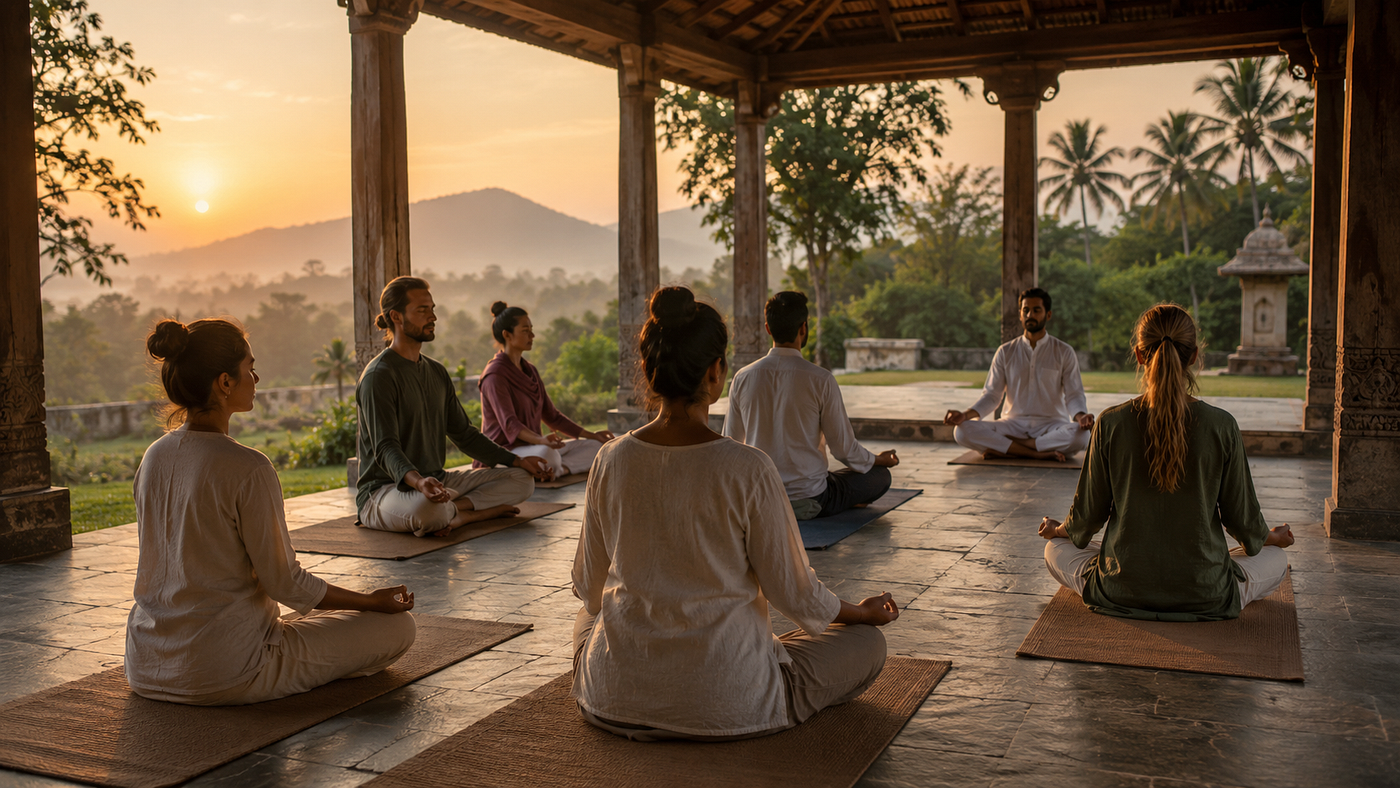
Morning pranayama practice in an open-air yoga shala, showing how yoga education in India is shaped by discipline, teacher guidance, and shared practice.
How does the history of yoga in India shape what students study today?
Yoga in Indian history is not one straight line; it moved through Vedic, classical, post-classical, Hatha, devotional, and modern phases, each adding a distinct layer.
Every element of a modern yoga curriculum traces back to specific historical moments in India. Understanding these moments helps a student understand why they are being asked to do what they are doing.
The Vedic and Upanishadic roots. The earliest references to yoga appear in the Vedic scriptures, possibly written over 5,000 years ago. The word yoga derives from the Sanskrit root yuj, meaning to yoke or unite. These early texts were not posture manuals. They were explorations of consciousness, self, and liberation. The concept of disciplining attention inward has been the constant thread from that period forward.
**Patanjali’s Yoga Sutras.* Around the 2nd century BCE, Patanjali codified a comprehensive eight-limbed framework: ethics (yama, niyama), posture (asana), breath (pranayama), sense withdrawal (pratyahara), concentration (dharana), meditation (dhyana), and absorption (samadhi*). Critically, posture receives only three of the 196 sutras. The bulk of the system is about the mind. As Britannica identifies, yoga is one of the six classical schools of Indian philosophy, not a fitness method.
The Bhagavad Gita. The Gita introduced three parallel paths: karma yoga (action without attachment), bhakti yoga (devotion), and jnana yoga (knowledge). These are not metaphors. They describe different orientations of practice, all leading toward the same internal freedom. A serious yoga teacher needs to understand all three.
The Hatha Yoga traditions. The Hatha Yoga Pradipika and Gheranda Samhita formalised the physical practices: asana, pranayama, mudra, bandha, and purification techniques. These texts treat the body as a vehicle for transformation, not as the destination.
Modern teachers who have carried yoga globally. The Government of India’s Ministry of External Affairs traces yoga’s modern transmission through Vivekananda (who introduced yoga to the West in 1893), Krishnamacharya (who systematised postural practice in the 20th century), and B.K.S. Iyengar (who made alignment and accessibility central to teaching). Without this period, yoga would not have the global reach it has today. What travelled well was the physical method. What often did not travel as fully was the philosophical scaffolding around it.
What the Guru-Shishya model gave students that modern classes rarely do
Traditional yoga study was not a transaction. It was a relationship. The Guru-Shishya parampara, the teacher-student lineage, was the mechanism through which yoga knowledge was transmitted across generations. ***UNESCO recognises yoga as India’s intangible cultural heritage ***and notes that yoga was traditionally transmitted through this model, with teachers as custodians of knowledge and embodied skill.
What did the Guru-Shishya model actually provide? Time, observation, and correction. A student lived in proximity to the teacher, sometimes for years. The teacher observed posture, breathing patterns, emotional responses, and daily conduct. Corrections were made not only to the spine but to the student’s entire orientation to practice. Knowledge was transmitted in the right conditions, at the right time, to a student who had demonstrated readiness.
Here is the observation I keep returning to after twelve years of teaching. The moment a student understands that asana is preparation, not achievement, everything changes. The pace slows. The breath deepens. Questions shift from ‘how do I improve my posture?’ to ‘what is this practice revealing about how I hold tension, avoid discomfort, or override my own signals?’ That shift does not come from a syllabus. It comes from a sustained teaching relationship.
Traditional does not mean unstructured. It means embodied and guided. The Guru-Shishya model produced extraordinary depth precisely because it combined daily practice, ethical framework, philosophical inquiry, and individual attention over an extended period. Modern certification formats can include all of these elements. Whether they do depends entirely on the school, the teacher, and the curriculum design.
How has yoga education in India changed in modern times?
Modern yoga education in India now spans ashrams, residential teacher trainings, university degree programmes, and government-recognised institutional structures.
India has built formal infrastructure around yoga education that did not exist two generations ago. The University Grants Commission (UGC) recognised yoga at graduation and post-graduation levels and introduced *Yoga as a UGC-NET *subject from January 2017. The 2019–20 All India Survey on Higher Education recorded 131 universities offering yoga-related courses. Dedicated institutions like S-VYASA University in Bangalore integrate clinical research with traditional practice at postgraduate and doctoral levels.
This institutionalisation matters for students in two ways. First, it means that yoga in India is no longer exclusively available through ashrams or individual teachers. Students can pursue structured academic pathways, earn formally recognised qualifications, and engage with yoga as a field of serious scholarly and clinical inquiry. Second, it means that the range of options is wider than ever, which makes informed selection more important, not less.
The most effective programs, whether in universities, ashrams, or residential teacher training institutes, combine what modern education provides (structured curriculum, assessments, certifications, safety standards) with what traditional study always included (philosophy, pranayama, meditation, teaching relationship, daily rhythm). The presence of both is what you should look for.
Why do students still choose to study yoga in India?
India remains important for yoga study because students encounter yoga as a lived culture, where practice, language, philosophy, food, rhythm, and teaching interact in the same place.
The practical reasons students travel to India for yoga education are straightforward. Sanskrit terms are encountered in daily conversation, not only on a terminology list. Ayurveda is practised in the kitchen, not just referenced in a lecture. The daily schedule reflects a yogic rhythm because that rhythm is culturally present. Access to teachers trained within long-standing Indian traditions is more concentrated here than anywhere else in the world.
But there is also something less quantifiable. When you study yoga in the country where these ideas originated, where the texts were composed, and the teaching traditions were preserved, the practice sits differently. You are not importing an idea into a foreign environment. You are stepping into the environment where the idea has always lived. That experience changes how students listen, how they ask questions, and how they integrate what they learn.
Not every course in India delivers this. A certificate-only program running in India is not more valuable than a rigorous, well-taught program in another country simply because of its location. The value of India is contextual depth, and that depth is available when the school, the teacher, and the curriculum are genuinely built around it.
My Experience With Yoga Education in India
I have taught yoga in India for over two decades, across Goa and the Himalayan foothills, and one pattern appears consistently across residential teacher training students, regardless of where they come from.
Students who arrive having studied yoga primarily through class formats, drop-in sessions, online videos, and studio memberships often know a great deal about postures and almost nothing about what connects the postures to everything else. They have practiced extensively. But they have rarely been asked to sit with a text, to practice pranayama in a progressive sequence over weeks, or to examine how their ethical conduct and their physical practice are the same inquiry.
At Yoga Chaitanya International Institute, in both our Goa and Himalayan Yoga TTC programs, the first shift we aim to create is this: from yoga as something you do to yoga as something you understand. That shift requires time, repetition, a teacher who can observe and respond, and a curriculum that treats philosophy, pranayama, meditation, and asana as one integrated system rather than separate modules. India gives us the cultural environment where this integration makes immediate, lived sense, where the context is in the air, not just on a syllabus.
I have seen students with ten years of studio practice discover, in their first week of a residential program in India, that they had never really breathed with full awareness. That is not a failure of their earlier practice. It is what happens when context is missing, and nobody was there to point at it.
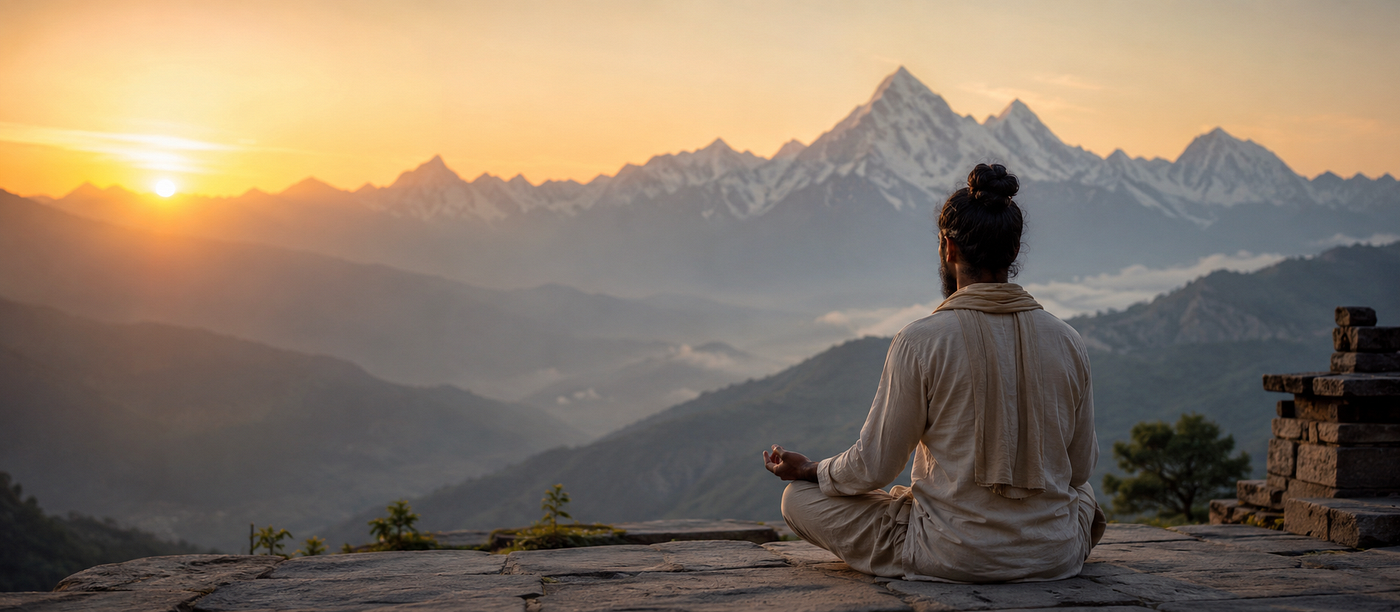
Early morning meditation in the Himalayas, showing how India continues to shape yoga study through practice, silence, and tradition.
Is studying yoga in India always more authentic?
No. A course in India can be shallow if it is only certificate-focused. A course outside India can be sincere if it is well-taught and textually grounded. The value of India is contextual depth, not automatic superiority. What determines quality is teacher experience, curriculum depth, philosophy content, progressive pranayama instruction, safe asana instruction, ethical clarity, and a structured daily practice rhythm. Those elements can be present or absent anywhere in the world.
What is traditional yoga study?
Traditional yoga study encompasses asana, pranayama, meditation, ethics, philosophy, discipline, teacher guidance, and daily self-observation, not postures alone. It is characterised by a teaching relationship built over time, where the student is corrected not only in physical alignment but in attention, breathing, and conduct. Traditional does not mean historical or inaccessible. It means that practice is embedded in a complete framework rather than extracted from it.
What should I check before joining a yoga education program in India?
Check the teacher’s training background and lineage, not only their certifications. Read the curriculum carefully, confirm philosophy, pranayama, and meditation are genuinely included as subjects, not footnotes. Ask about batch size, daily schedule, and how Asana safety and modification are taught. Read student reviews with attention to depth of experience, not only comfort and location. Avoid choosing based on price, photos, or marketing language alone.
Is studying yoga in India only for advanced practitioners?
No. Sincere beginners benefit from studying yoga in India if the program is structured, progressive, and designed to teach foundations safely. The most important qualification is not prior experience; it is genuine curiosity about practice beyond postures. Students who arrive willing to observe, be corrected, and follow a daily rhythm get the most from a residential program, regardless of their existing level.
The context that travels with you
Yoga can be practiced anywhere. But the conditions that shaped yoga, the texts, the teaching relationships, the philosophical frameworks, the languages, the living disciplines, still have their strongest concentration in India. Studying yoga here gives students something that a class cannot: the understanding of why each element of the practice exists, where it came from, and what it is actually designed to do.
For serious students, this context does not stay in India. It travels home with them, into every class they teach or practice they maintain. Yoga stops being something they do and becomes something they understand.
If you want to explore what a structured residential program combining practice, philosophy, pranayama, Ayurvedic context, and teaching methodology looks like, ***Yoga Chaitanya International Institute offers 200-hour residential teacher training programs in Goa and the Himalayas***. You can explore the full approach at yogachaitanya.com.
I hope this gave you a clearer picture of what India actually offers yoga students, and what to look for in any serious program. I would love to hear your experience. What has shaped your own understanding of yoga most deeply? Leave a response below.
메타데이터
- post_id
- d580c711e78c
- slug
- why-india-still-shapes-the-way-yoga-is-studied-d580c711e78c
- url
- https://medium.com/@yogachaitanyainstitute/why-india-still-shapes-the-way-yoga-is-studied-d580c711e78c
- canonical_url
- https://medium.com/@yogachaitanyainstitute/why-india-still-shapes-the-way-yoga-is-studied-d580c711e78c
- author_url
- https://medium.com/@yogachaitanyainstitute
- status
- ok
- fetched_at
- 2026-06-09 15:37:30