Programming in the 22nd Century: Python Won’t Survive
The Future of Software Won’t Speak Python
Programming in the 22nd Century: Python Won’t Survive
The Future of Software Won’t Speak Python
A few months ago, I was cleaning up an old Python project I’d built years earlier.
Nothing unusual. Just a simple maintenance task.
Or so I thought.
One package had been deprecated. Another dependency had changed its API. A third library no longer supported the latest version of Python. Half the time wasn’t spent writing code — it was spent negotiating with an ecosystem that had evolved faster than the application itself.
While fixing the project, a strange thought crossed my mind
If keeping a Python application alive for five years is hard, what are the chances Python survives another hundred?
That question sent me down a rabbit hole.
Not because I dislike Python. Quite the opposite.
I’ve spent years building software with it. I’ve used it for web applications, APIs, automation tools, data analysis, machine learning, scripting, and countless side projects. Python has paid my bills. It has launched startups. It has powered scientific discoveries and AI breakthroughs.
But when people talk about the future, they often make one mistake
They assume today’s winners remain winners forever.
History disagrees.
And that’s exactly why I believe that by the 22nd century, Python probably won’t survive not because it failed, but because technology itself will move beyond it.
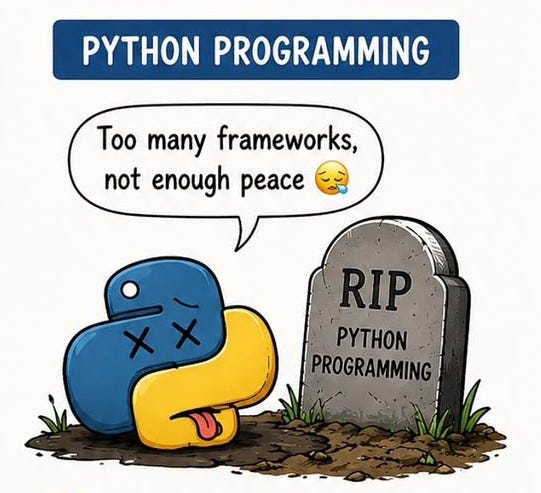
Created in Canva
Before You Grab Your Pitchfork
Let’s clarify something.
This is not a prediction that Python is dying.
Python is thriving.
In fact, it’s one of the most successful programming languages ever created.
According to the annual developer surveys from Stack Overflow Developer Survey and popularity indexes like TIOBE Index, Python consistently ranks among the most used and most loved languages worldwide.
AI development heavily relies on Python. Data science relies on Python. Automation relies on Python. Education relies on Python.
Python isn’t going anywhere tomorrow.
It probably isn’t going anywhere in 20 years.
But 100 years?
That’s a completely different conversation.
No Programming Language Has Ever Ruled Forever
Developers love arguing about programming languages.
It’s basically our version of sports fandom.
But history teaches a brutal lesson
Every dominant language eventually becomes legacy technology.
Once upon a time
- FORTRAN was revolutionary.
- COBOL ruled business software.
- Pascal dominated education.
- Perl owned scripting.
- Visual Basic powered corporate development.
- Java was supposed to run everything.
Most of those languages still exist. But they no longer define the future.
They define the past.
The important distinction isn’t whether a language survives.
It’s whether developers choose it first.
And eventually every language loses that battle.
Python will too.
Not because it’s bad. Because everything gets replaced.
Everything.
Python’s Biggest Strength Is Also Its Biggest Weakness
Python became successful because it made programming easier.
Readable syntax. Fast development. Huge ecosystem. Low barrier to entry.
You can teach someone Python and have them building useful software surprisingly quickly.
That’s remarkable.
But here’s the uncomfortable truth
Python optimizes for humans writing code.
The future may not require humans to write much code at all.
Think about that.
Many of Python’s advantages disappear if software creation becomes increasingly automated.
If AI systems generate 90% of application logic, does indentation matter? Does syntax simplicity matter? Does language elegance matter?
The things we celebrate today may become irrelevant tomorrow.
AI Is Quietly Changing The Entire Game
Every few months, AI coding tools become better.
Not perfect. But undeniably better.
Today we have tools that can
- Generate functions.
- Build APIs.
- Write tests.
- Refactor code.
- Explain bugs.
- Create documentation.
Tomorrow they’ll do more.
Far more.
Many developers still view AI as an assistant.
That assumption may age badly.
Imagine software development in 2126.
A product manager describes a business problem. An AI system designs architecture.
Another system validates security. Another optimizes performance. Another continuously updates the application.
Humans supervise. Machines build.
In that world, the primary interface may no longer be Python.
Or Java. Or Rust. Or any language we recognize today.
The interface might simply be intent.
Natural Language May Replace Traditional Programming
This idea makes many engineers uncomfortable.
I understand why.
We’ve invested years mastering programming languages.
But let’s be honest.
Programming languages are already a translation layer.
Humans have ideas.
Languages convert those ideas into machine instructions.
That’s all they are.
An abstraction. A useful abstraction. But still an abstraction.
If future systems can understand intent directly, the abstraction changes.
Instead of
for customer in customers:
    if customer.subscription_active:
        send_invoice(customer)
You might simply say
Send invoices to all customers with active subscriptions and ensure compliance with regional tax laws.
The system handles everything else.
Validation. Scaling. Optimization. Deployment. Monitoring. Security. Localization.
The human focuses on outcomes.
Not implementation details.
Performance Still Matters
Python has another challenge.
It’s slow.
There. I said it.
Every Python developer knows it. We just don’t always talk about it.
Python succeeds despite performance limitations because hardware keeps improving and because most developers value productivity over raw speed.
But future systems may demand dramatically different performance characteristics.
Massive simulations. Planet scale AI. Quantum assisted computing. Autonomous infrastructure. Real time global optimization.
Nobody knows exactly what computing will look like a century from now.
But history suggests performance requirements always grow faster than expected.
Languages optimized around human readability may eventually lose ground to systems optimized around machine efficiency.
The Real Competitor Isn’t Rust, Go, or Whatever Comes Next
When developers discuss Python’s future, they often compare it to modern languages.
Rust. Go. Zig. Swift. Kotlin.
That’s thinking too small.
The biggest threat to Python isn’t another programming language.
It’s the possibility that programming languages themselves become secondary.
Consider transportation.
People once argued whether horses were better than horse-drawn carriages.
Then cars arrived.
The entire debate became irrelevant.
The future may not choose a better language.
It may choose a different paradigm entirely.
Software Development Is Becoming More Abstract Every Decade
Look at the historical trend.
Early developers managed hardware directly.
Then assembly arrived. Then higher level languages. Then frameworks. Then cloud platforms. Then serverless infrastructure. Then low code systems. Then AI assisted development.
Each generation moves further away from machine details.
Not closer.
Abstraction wins. Again and again. And again.
The direction is obvious.
Developers spend less time telling computers how to do things.
They spend more time telling computers what they want.
That’s a profound shift.
And Python, despite its simplicity, is still fundamentally a “how” language.
The Future Developer Might Not Look Like Today’s Developer
This is the part that fascinates me most.
What if software engineers in the 22nd century don’t spend their days writing code?
What if they spend their days
- Defining goals.
- Reviewing AI generated architectures.
- Managing autonomous systems.
- Verifying compliance.
- Designing user experiences.
- Auditing machine decisions.
In other words
Less coding.
More system thinking. More problem solving. More judgment.
The value of engineers may shift away from syntax knowledge and toward strategic reasoning.
Knowing Python syntax could become as relevant as knowing punch-card programming today.
Interesting historically. Rarely essential practically.
Why Python’s Legacy Will Still Matter
Even if Python disappears someday, its influence won’t.
Many ideas Python popularized are likely to survive
- Readability matters.
- Simplicity matters.
- Developer productivity matters.
- Batteries included ecosystems matter.
- Accessibility matters.
Future tools may abandon Python’s syntax.
They probably won’t abandon its philosophy.
In that sense, Python may never truly die.
Its DNA will simply spread into whatever comes next.
Much like how older languages continue influencing modern ones.
Technology evolves.
Ideas persist.
Reality: Python Will Probably Outlive Most Of Us
Before anyone starts writing Python’s obituary, let’s stay grounded.
Python remains one of the strongest ecosystems in software development.
Companies have invested billions into Python-based infrastructure.
Universities teach it. Researchers depend on it. AI frameworks depend on it. Millions of developers depend on it.
That doesn’t disappear overnight.
Or even over decades.
The likely future isn’t a sudden collapse.
It’s gradual evolution.
Python slowly becoming one layer inside increasingly intelligent systems.
Still present. Still useful.
But no longer the center of the universe.
Created in Canva
Finally
When people hear the title “Python Won’t Survive,” they often assume it’s an attack on Python.
It’s actually the opposite.
It’s a reminder of how successful Python has been.
Only dominant technologies earn the privilege of eventually being replaced.
Nobody wonders whether forgotten technologies will survive 100 years.
We only ask that question about technologies important enough to shape history.
Python has already earned its place in that history.
But if the last century taught us anything, it’s this:
The future doesn’t belong to today’s tools.
It belongs to whatever solves tomorrow’s problems better.
Maybe that’s a faster language.
Maybe it’s an AI-native platform.
Maybe it’s something we haven’t imagined yet.
Whatever it is, I doubt developers in the 22nd century will be arguing about Python versus JavaScript on social media.
Somehow, I find that both comforting and terrifying.
And honestly?
That’s what makes the future so interesting.
What do you think?
Will Python still be relevant in 2126, or will programming itself evolve beyond traditional languages?
I’d love to hear your perspective.
Leave a comment, start a debate, or tell me where you think software development is heading next.
If this article made you think, share it with a developer friend, teammate, or that one colleague who insists Python will rule forever.
And if you want to revisit these ideas later, save this article you might enjoy comparing these predictions with reality a few years from now.
메타데이터
- post_id
- d58ab5ff6103
- slug
- programming-in-the-22nd-century-python-wont-survive-d58ab5ff6103
- url
- https://medium.com/pythonic-af/programming-in-the-22nd-century-python-wont-survive-d58ab5ff6103
- canonical_url
- https://medium.com/pythonic-af/programming-in-the-22nd-century-python-wont-survive-d58ab5ff6103
- author_url
- https://medium.com/@dmarcus12
- status
- ok
- fetched_at
- 2026-06-17 12:55:42