Starting My Legal Design Journey: Understanding the Foundations
At the beginning of this semester, I realized that although I had learned to interpret legal norms, I had not learned to make them…
Starting My Legal Design Journey: Understanding the Foundations

Photo by Tima Miroshnichenko on Pexels
At the beginning of this semester, I realized that although I had learned to interpret legal norms, I had not learned to make them understandable. This realization led me to legal design. I approach it not as an expert explaining the method, but as a novice trying to build competence step by step.
Legal design is usually described as an approach that combines law, design thinking, and a human-centered approach. Its goal is not to “simplify” the law in a reductive sense or to replace legal doctrine with visual aesthetics. Instead, it aims to preserve legal accuracy while improving usability and accessibility. This distinction is central to Margaret Hagan’s work, particularly in her book Law by Design, where legal design is presented as the application of design methodologies to legal systems and services. And I highly recommend reading it.
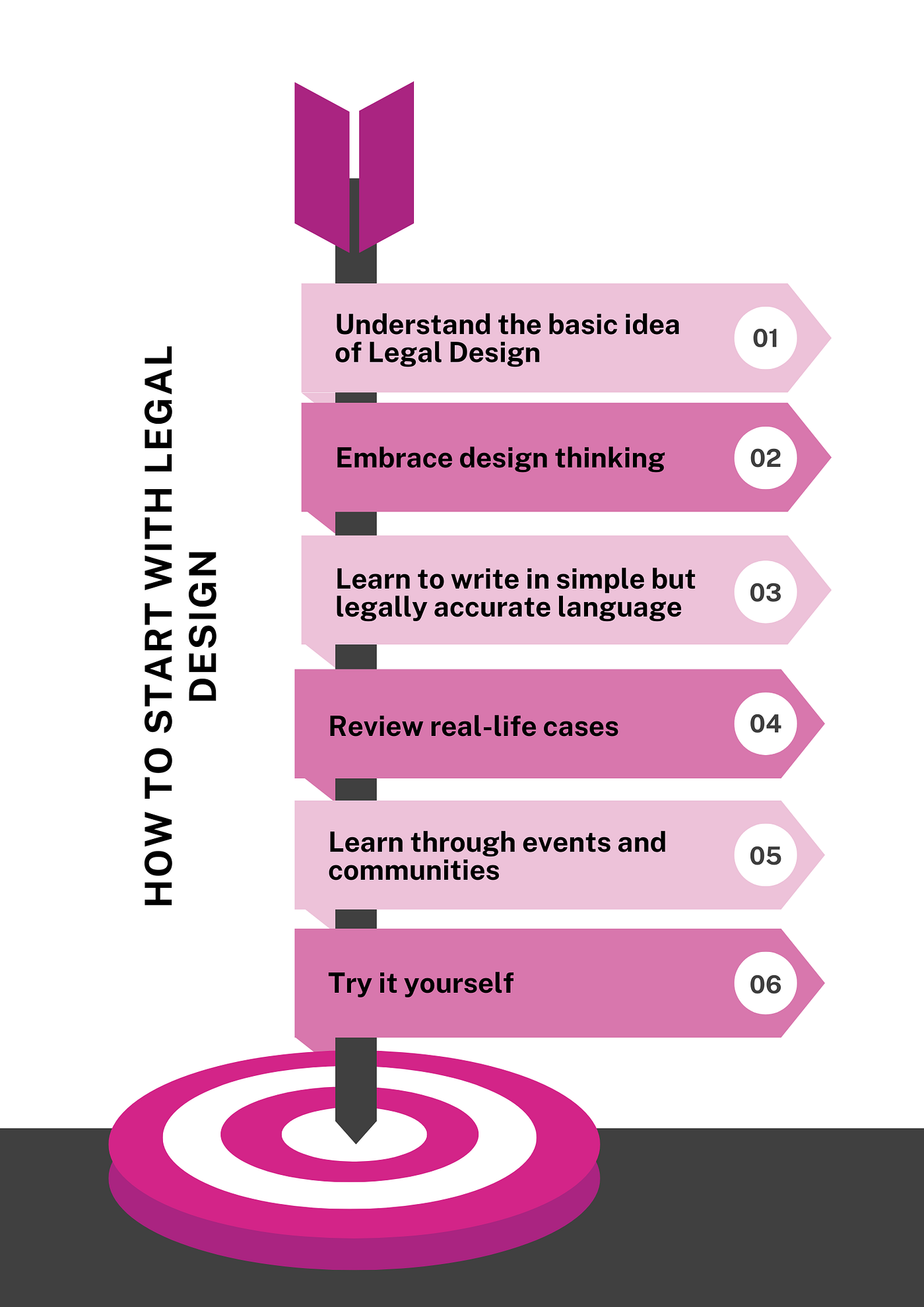
My very first step was conceptual clarification. Before diving into books, I needed to understand the theoretical foundations. I studied introductory materials from various websites, blogs, and articles, such as Stanford Legal Design Lab or Lawyers Design School, which demonstrate how courts, contracts, and legal processes can be redesigned to better serve users. Some may say that such resources may not be reliable or sufficiently accredited, but for a beginner who needs to start with a basic understanding, this is still a good option. Continuing with legal design, what surprised me most was that these projects are not just about a beautiful appearance. They are well-thought-out solutions that were created based on studying people’s needs and multiple checks and refinements. From an academic perspective, legal design can be linked to broader movements such as access to justice, the promotion of plain language, and innovation in legal technology. The first book I read on legal design, Legal Design: Integrating Business, Design, and Legal Thinking with Technology by Compagnucci, Haapio, Hagan & Doherty, presents as a growing interdisciplinary field shaped by diverse practices and experiences. Through contributions from academics, designers, practitioners, and activists, the book illustrates how design thinking is being applied in areas such as contract drafting, access to justice, policy-making, legal education, and digital legal tools. I found it particularly challenging that this book goes beyond doctrinal analysis and emphasizes experimental and user-centered approaches borrowed from design and social research, which requires skills that go beyond traditional legal education.
Looking back, I can identify an important moment in my training. Initially, I believed that good legal writing necessarily implied technical density. It seemed to me that long sentences and complex constructions make the text serious and strict. However, research on plain legal language shows that complexity often obscures meaning without increasing accuracy. It turns out that accuracy and clarity are not necessarily contradictory, this contradiction may arise simply because of the rules and habits accepted in the profession. At this early stage, my main learning outcomes are cognitive rather than practical. I am trying to shift from lawyer-oriented thinking to user-oriented thinking. Here you need to ask other questions: who will use the document? What decisions should they make? What information do they really need to get at that moment?
To structure this learning process, I am treating this series of three blogs as a reflective journal. I think this format will be more interesting for readers than a regular article. Recommendations for reflective practice advise keeping a journal to show how skills and knowledge are developing, to note important events, and to connect experience with literature. Therefore, my goal is not only to describe what legal design is, but also to track how my understanding of this topic grows and changes. In my next blog, I will discuss how design thinking underpins legal design and share my experience of trying to use an empathy-based approach when working with legal documents.
At this point, my position is quite clear: legal design is not a shortcut to simplifying the law, nor is it merely a visual improvement. It is a structured, research-based approach that challenges traditional legal communication. As a novice specialist, my task is to understand its basics before attempting to implement it. Therefore, this process of reflection is the first step in this direction.
메타데이터
- post_id
- d59e43d6451f
- slug
- starting-my-legal-design-journey-understanding-the-foundations-d59e43d6451f
- url
- https://medium.com/taltech-legal-lab/starting-my-legal-design-journey-understanding-the-foundations-d59e43d6451f
- canonical_url
- https://medium.com/taltech-legal-lab/starting-my-legal-design-journey-understanding-the-foundations-d59e43d6451f
- author_url
- https://medium.com/@ksenija.siht
- status
- ok
- fetched_at
- 2026-06-14 11:28:49