Remote Data Science Jobs Are Becoming a Top Career Choice in 2026, IABAC
Remote data science jobs are no longer a nice extra. In 2026, they are becoming one of the most attractive career paths for professionals…
Remote Data Science Jobs Are Becoming a Top Career Choice in 2026, IABAC
Data Science Jobs
**Remote data science jobs** are no longer a nice extra. In 2026, they are becoming one of the most attractive career paths for professionals who want strong pay, flexible work, and real growth.
What makes this field so powerful is simple: every business runs on data now. Companies need people who can study that data, find patterns, and turn numbers into decisions. And because remote work has opened the door to global hiring, employers are now willing to look far beyond their own city or country to find the right talent.
That means more opportunities, stronger competition, and better salaries for skilled data professionals.
In this blog, I will explain why remote data science jobs are growing so fast, what skills employers expect, how certifications like IABAC can help, what salary trends look like, and how you can build a practical roadmap toward a remote data science career.
Why Remote Data Science Jobs Are Growing So Fast
There are a few big reasons remote **Data Science** roles are rising in 2026.
1. Data is growing everywhere
Every app, website, device, and platform produces data. Businesses are collecting customer behavior, sales numbers, product usage, financial records, and marketing results every second. But collecting data is not enough. Companies need people who can make sense of it.
That is where data scientists come in. They help organizations answer important questions like:
- What will customers buy next?
- Which users may leave?
- How can sales improve?
- What patterns are hidden in the data?
- How can AI systems make better predictions?
This is why data science is still one of the most valuable careers in tech.
2. Companies now hire globally
Remote work has changed hiring forever. A company no longer needs to limit itself to local talent. If a skilled data scientist lives in another city or country, they can still contribute effectively from home.
This gives companies access to a wider talent pool. It also gives job seekers access to jobs that were once out of reach. A strong candidate in India, for example, may now compete for roles with companies in the US, Europe, or the Middle East.
That global hiring trend is one reason remote salaries are rising.
3. Flexibility matters more than ever
Many professionals want more control over their time. Remote work gives them that. It saves travel time, improves work-life balance, and often allows people to live in lower-cost places while earning strong salaries.
For employers, this is also a win. Remote teams often attract better talent, improve retention, and reduce office-related costs.
What Employers Expect From a Remote Data Scientist
A remote data scientist must do more than just know theory. Employers want someone who can work independently, communicate clearly, and deliver useful results.
Here are the main skills that matter.
1. Python, SQL, and data tools
Python is still the most common programming language for data science. SQL is essential because so much business data lives in databases. You should also know tools like:
- pandas
- NumPy
- scikit-learn
- Jupyter Notebook
- Matplotlib or Seaborn
These tools help you clean data, explore patterns, and build models.
2. Statistics and machine learning basics
You do not need to be a mathematician, but you do need a strong base in statistics and machine learning. Employers often expect you to understand:
- averages, variance, and standard deviation
- probability
- hypothesis testing
- regression
- classification
- model evaluation
- overfitting and underfitting
These concepts help you build reliable models and explain your work with confidence.
3. Data cleaning and feature engineering
A large part of the job is not glamorous, but it is essential. Real-world data is messy. It may contain missing values, duplicates, wrong formats, or outliers.
A good data scientist knows how to clean that data and create useful new features from it. In many cases, this work matters more than the model itself.
4. Cloud and deployment skills
More companies now want data scientists who can do more than build notebooks. They want people who can help take a model into production.
That is why cloud tools and deployment knowledge matter. Helpful tools include:
- AWS
- Azure
- Google Cloud
- Docker
- Streamlit
- Flask
Even basic familiarity with these tools can make you stand out.
5. Communication and business understanding
This is one of the most overlooked skills in data science. A great model is useless if you cannot explain it.
Remote data scientists must be able to write clearly, speak confidently, and connect their work to business value. You should be able to answer questions like:
- What problem does this solve?
- Why does this result matter?
- How does this help revenue, cost, or customer experience?
That is what separates a good analyst from a high-impact data scientist.
Why Certifications Still Matter
Certifications are not everything, but they do help when used the right way.
A certification can show employers that you have studied the fundamentals and completed a structured learning path. This is especially useful if you are changing careers or entering the field for the first time.
IABAC certifications are designed around practical, job-ready learning. They are useful because they focus on real-world data science skills, not just theory. If you are trying to build credibility for remote roles, a recognized certification can support your resume and help you stand out.
Still, the most important thing is not the certificate itself. It is what you can do with the knowledge.
A certificate plus a strong project portfolio is much more powerful than a certificate alone.
Build Projects, Not Just Notes
If you want a remote data science job, you need proof of skill. That proof usually comes from projects.
Recruiters and hiring managers often care more about your portfolio than your course list. They want to see how you think, how you solve problems, and how you communicate results.
A simple project workflow looks like this:
flowchart TD
A[Collect Data] → B[Clean and Preprocess]
B → C[Explore the Data]
C → D[Engineer Features]
D → E[Train a Model]
E → F[Evaluate and Validate]
F → G[Deploy and Monitor]
A strong project should include:
- a clear problem statement
- a real dataset
- data cleaning steps
- exploratory analysis
- a model or prediction method
- clear evaluation metrics
- simple visuals
- a short explanation of business value
Good project ideas include:
- fraud detection
- customer churn prediction
- sales forecasting
- loan default prediction
- product recommendation
- sentiment analysis
- demand forecasting
Even one or two polished end-to-end projects can make a big difference in your job search.
Salary Trends for Remote Data Science Jobs
Salary is one of the biggest reasons people are drawn to data science.
Remote roles often pay well because employers are competing for talent across borders. That means your location may matter less than your ability to deliver results.
Here is a simple salary trend example based on gradual growth:
- 2020 — Average Remote Data Science Salary: USD 80,000
- 2021 — Average Remote Data Science Salary: USD 90,000
- 2022 — Average Remote Data Science Salary: USD 100,000
- 2023 — Average Remote Data Science Salary: USD 110,000
- 2024 — Average Remote Data Science Salary: USD 120,000
- 2025 — Average Remote Data Science Salary: USD 125,000
- 2026 — Average Remote Data Science Salary: USD 130,000
This is only a model, but it reflects the direction the market is moving in.
Global salary ranges
In broad terms, salaries often look like this:
- Entry-Level Data Scientist — USD 45,000 to USD 80,000 per year
- Mid-Level Data Scientist — USD 80,000 to USD 130,000 per year
- Senior-Level Data Scientist — USD 130,000 to USD 220,000+ per year
India salary bands
For India, the ranges vary by company, skill level, and experience. A simple estimate looks like this:
- Entry-Level Data Scientist (0–3 years of experience) — ₹0 to ₹3 lakh per year
- Mid-Level Data Scientist (3–6 years of experience) — ₹3 to ₹6 lakh per year
- Senior Data Scientist (6–10 years of experience) — ₹6 to ₹10 lakh per year
- Lead / Expert-Level Data Scientist (10–15 years of experience) — ₹10 to ₹15 lakh per year
In top companies or roles involving cloud, AI, and production systems, salaries can go much higher.
A Simple Career Timeline for Remote Data Science
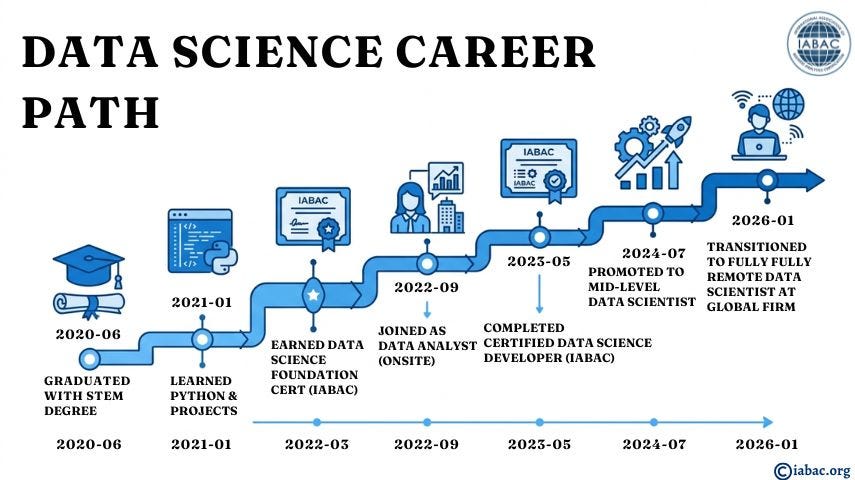
Many people want to know how the career path actually looks. Here is a realistic example of how someone may grow into a remote data science role over time.
Data Science Career Path
Data Science Career Path
- June 2020 — Graduated with a STEM degree
- January 2021 — Learned Python and started small projects
- March 2022 — Earned IABAC Data Science Foundation certification
- September 2022 — Joined as a Data Analyst in an onsite role
- May 2023 — Completed Certified Data Science Developer (IABAC)
- July 2024 — Promoted to Mid-Level Data Scientist
- January 2026 — Transitioned to a Fully Remote Data Scientist role at a global firm
This is the kind of path many professionals follow: learn the basics, build projects, earn a certification, gain experience, and then move into a more advanced or remote role.
How to Prepare for a Remote Data Science Job
If you are serious about this path, here is the best approach.
1. Start with the fundamentals
Focus first on Python, SQL, and statistics. These three skills form the base of almost everything in data science.
Do not rush. Small daily practice is better than random long study sessions.
2. Build real projects early
Do not wait until you “know everything.” Build while learning.
Start with simple datasets and gradually move to more complex ones. The goal is to show progress and problem-solving, not perfection.
3. Learn to explain your work
A remote job means less face-to-face help. That means your writing matters more.
Practice explaining:
- what you did
- why you did it
- what the result means
- how it helps the business
A clear GitHub README or project write-up can make a strong impression.
4. Use certifications wisely
Choose a certification that matches your career goal. A good certification gives structure, but it should never replace project work.
Think of certifications as milestones, not the finish line.
5. Learn cloud and deployment basics
Even simple deployment knowledge can help you stand out. Try building a small Streamlit app, using Google Colab, or creating a basic Flask API.
These small steps show that you understand how models are used in the real world.
6. Prepare for interviews
Remote interviews often test both technical and communication skills. Be ready for:
- SQL questions
- Python exercises
- case studies
- model evaluation questions
- project explanations
Practice speaking clearly and calmly. In remote interviews, your explanation matters as much as your answer.
7. Keep learning
Data science changes quickly. New tools, models, and workflows appear all the time.
Make it a habit to learn something new every week. Read articles, work on projects, and follow industry updates. That steady learning is what keeps your skills relevant.
Final Thoughts
Remote data science jobs are becoming a top career choice in 2026 because they offer something many professionals want: strong demand, good pay, flexibility, and room to grow. But the people who succeed in this field are not the ones who only collect certificates. They are the ones who build real projects, understand business problems, communicate clearly, and keep learning.
If you start with Python, SQL, statistics, and one solid project, you are already moving in the right direction. Add a structured certification, keep improving your portfolio, and learn how to explain your work well.
That is how you build a career that is not just remote, but future-ready.
If you’d like, I can turn this into a more SEO-friendly blog version with a stronger headline, meta title, meta description, and keyword-rich subheadings.
메타데이터
- post_id
- d5a3efdabc92
- slug
- remote-data-science-jobs-are-becoming-a-top-career-choice-in-2026-iabac-d5a3efdabc92
- url
- https://medium.com/@shanitha.va/remote-data-science-jobs-are-becoming-a-top-career-choice-in-2026-iabac-d5a3efdabc92
- canonical_url
- https://medium.com/@shanitha.va/remote-data-science-jobs-are-becoming-a-top-career-choice-in-2026-iabac-d5a3efdabc92
- author_url
- https://medium.com/@shanitha.va
- status
- ok
- fetched_at
- 2026-06-09 15:37:30