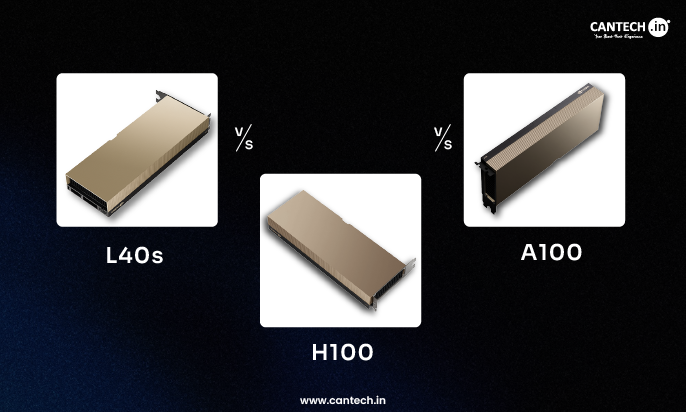
Why Choose the NVIDIA A100 GPU for AI Training & Server-Scale Deep Learning
In the era of generative AI, huge language models, and deep-learning systems powering research or production, the hardware underpinning…
Why Choose the NVIDIA A100 GPU for AI Training & Server-Scale Deep Learning
In the era of generative AI, huge language models, and deep-learning systems powering research or production, the hardware underpinning these workloads matters enormously. The NVIDIA A100 GPU is a powerhouse designed precisely for these server-scale deep-learning tasks. According to Cantech’s blog, it has become the workhorse for organizations doing serious AI and HPC (high-performance computing) work.
Here’s a breakdown of what the A100 is, what makes it special, how it compares to the previous generation, why it’s particularly suited for server-scale deep learning, and why you might want to consider it (if you’re doing large-scale AI).

What is the NVIDIA A100 GPU?
The A100 is a data-center GPU built on NVIDIA’s “Ampere” architecture, meant not for gaming or desktop-workstations but for server-grade AI training, HPC, and large-scale deep-learning workflows.
It comes in two primary memory configurations (40 GB and 80 GB), uses HBM2e memory, and is designed to handle very large datasets, large model parameters, high throughput, multi-GPU clusters, and heavy parallel compute
Key Innovations & Why They Matter
Here are some of the major innovations in the A100, and what impact they have for AI/deep learning:
- Third-generation Tensor Cores: These specialized cores accelerate matrix multiplications and tensor operations that are central to deep learning. The A100 supports formats like TF32 (Tensor Float 32) which allow major speed-ups without rewriting code.
- Multi-Instance GPU (MIG) support: One physical A100 GPU can be partitioned into up to seven isolated GPU instances (each with its own memory, cores, etc). This helps in utilizing a GPU more efficiently when you have many smaller workloads or multi-tenant use-cases.
- Structural sparsity support: Many deep-learning models naturally contain a lot of “zero” or unused weights. The A100 can exploit this sparsity in hardware, improving speed (especially for inference) when models are designed accordingly.
- High memory capacity & bandwidth: With 40/80 GB HBM2e, and memory bandwidth reaching up to ~2.0 TB/s (as cited in the blog for the A100 vs V100) the A100 handles very large model states, huge datasets, and high I/O demand.
- Scalability in multi-GPU clusters: The A100 design supports very high GPU-to-GPU bandwidth (NVLink / NVSwitch) so that when you combine multiple GPUs in a server, the interconnect isn’t the bottleneck.
Why the A100 is Particularly Suited for Server-Scale Deep Learning
For organizations doing large-scale AI work, the A100 brings major advantages:
- Large models & datasets: Many modern models (e.g., large language models, large vision models) require vast memory to load weights, activations, and process big batches. The 40/80 GB memory of A100 helps.
- Faster iteration & experimentation: With high compute, tensor core acceleration, and scalable GPU clusters, training times shrink significantly — letting researchers iterate more quickly.
- Better utilization: With MIG, you can partition a GPU to serve multiple tasks — or for multi-user or multi-project setups — improving ROI rather than one GPU idle part of the time.
- Scalability for clusters: When multiple GPUs are tied in a server (or across servers), interconnect bandwidth (NVLink/NVSwitch) becomes critical. A100 supports high-speed inter-GPU links, reducing bottlenecks in distributed training.
- Efficient for inference & mixed-workloads: With structural sparsity support and Tensor Cores that handle mixed-precision, the A100 is efficient not just in training but also in inference or hybrid workloads.
Considerations & When to Think Twice
While the A100 is impressive, you should also consider:
- Cost: Being high-end hardware, the A100 or A100-based servers cost more. If your model size, dataset, or traffic is modest, you might get by with lower-spec GPUs and save cost.
- Bottlenecks elsewhere: Even with a powerful GPU, training performance can still be held back by CPU, storage I/O, network, data pipeline. The system needs to be balanced (fast CPUs, NVMe storage, good network) to keep the GPU fed.
- Software compatibility: For full benefit of MIG, sparsity, etc, your software stack (frameworks, libraries) need to support those features. Otherwise you may not see full acceleration.
- Ongoing management: If you operate on-premises, cooling, power, maintenance become major concerns. If you use a hosted server, check SLAs, uptime, support, backup and security.
- Scale appropriate: If you’re training very large models (10B+ parameters, huge clusters), you might need even more specialised hardware (e.g., H100, dedicated multi-node clusters). The A100 is excellent, but not always the biggest scale option.
Final Thoughts
If you are in the realm of serious AI training — large datasets, big models, multi-GPU clusters, requiring high throughput — the NVIDIA A100 GPU is a compelling choice. With its advanced architecture, large memory, huge bandwidth, MIG support and enterprise readiness, it’s built for server-scale deep learning.
For those looking to deploy these capabilities without building hardware themselves, Cantech’s A100 GPU server offering provides an accessible path: you get high-end infrastructure, flexibility, support and the ability to scale.
If I were writing this for Medium: the key takeaway is this upgrade your hardware when your workload demands it. If you’re hitting bottlenecks, recurring long training times, inability to scale experiments or serve many users in parallel — the A100 is a next-level investment. For smaller workloads, you might postpone that investment.
If you’d like, I can format this article in Markdown ready for Medium, and include visuals / images of the A100 architecture, comparison charts, and embed a call-to-action for Indian server hosting. Would you like me to prepare that version?
메타데이터
- post_id
- d5bc5d5cc183
- slug
- why-choose-the-nvidia-a100-gpu-for-ai-training-server-scale-deep-learning-d5bc5d5cc183
- url
- https://medium.com/@shubham2.cantech/why-choose-the-nvidia-a100-gpu-for-ai-training-server-scale-deep-learning-d5bc5d5cc183
- canonical_url
- https://medium.com/@shubham2.cantech/why-choose-the-nvidia-a100-gpu-for-ai-training-server-scale-deep-learning-d5bc5d5cc183
- author_url
- https://medium.com/@shubham2.cantech
- status
- ok
- fetched_at
- 2026-06-23 17:05:31