From Feature Coding to System Design
There was a time when a developer’s responsibility was clearly defined: implement the feature, close the ticket, move to the next task…
From Feature Coding to System Design
There was a time when a developer’s responsibility was clearly defined: implement the feature, close the ticket, move to the next task. Business logic lived in controllers. Databases stored data. Infrastructure was someone else’s problem.
That world is gone.
In 2026, senior developers are no longer judged solely by how efficiently they ship features. They are evaluated by how well they design systems. The shift from feature coding to system design is not a trend — it is a structural evolution in how modern software is built.
As applications grow more distributed, AI-powered, and cloud-native, developers must think beyond individual endpoints and start thinking in terms of architecture, scalability, security, and long-term maintainability.
Why Feature-First Development Is No Longer Enough
Feature-focused development worked when:
- Applications were monolithic
- Traffic was predictable
- Teams were small
- Infrastructure was static
- Data complexity was limited
Today’s systems are different.
Modern **web development and [app development](https://www.sachhsoft.com/)** operate in environments where:
- Microservices communicate asynchronously
- APIs integrate with third-party services
- AI systems influence decisions
- Hybrid cloud infrastructure distributes workloads
- Security threats evolve continuously
A feature is no longer isolated. It interacts with an ecosystem.
Shipping code without understanding system impact creates long-term instability.
Complexity Has Shifted Inward
Frontend tooling has become more abstracted and developer-friendly. Backend frameworks scaffold quickly. CI/CD automates deployment. AI tools assist coding.
So where did the complexity go?
It moved into the system.
Today’s complexity lives in:
- Distributed data flows
- Service orchestration
- Latency optimization
- Cost management
- Observability
- Compliance requirements
Senior developers cannot afford to focus only on writing functional code. They must understand how systems behave under load, failure, and scale.
The Rise of Distributed Architectures
Modern applications rarely run in a single environment.
They span:
- Cloud regions
- Edge nodes
- On-prem infrastructure
- Third-party APIs
- AI services
Each architectural decision affects:
- Performance
- Reliability
- Security
- Cost
When developers build features today, they are also making architectural tradeoffs — whether they realize it or not.
That’s why the most effective developers now think like architects.
AI Has Changed System Responsibilities
AI integration adds another layer of system-level thinking.
AI-powered features require:
- Inference pipelines
- Model version control
- Data validation
- Observability for decision accuracy
- Guardrails against misuse
AI solutions are not simple API calls. They influence product behavior, risk profiles, and operational costs.
Developers integrating AI must understand:
- Latency tradeoffs
- Data sensitivity
- Failure scenarios
- Cost implications per inference
This requires architectural awareness, not just implementation skills.
Cloud Economics Demand System Thinking
In earlier cloud adoption phases, teams could over-provision resources without significant scrutiny. That is no longer the case.
AI workloads, edge deployments, and global user bases are reshaping cost models.
Senior developers now need to consider:
- Data transfer costs
- GPU usage
- Auto-scaling behavior
- Infrastructure efficiency
- Resource contention
Code decisions directly affect financial outcomes.
System design thinking connects technical choices with business impact.
Reliability Is an Architectural Responsibility
Feature coding focuses on what happens when things go right. System design focuses on what happens when things go wrong.
Modern systems must tolerate:
- Network interruptions
- Partial service failures
- Database replication lag
- Rate limiting
- Unexpected traffic spikes
Designing for resilience means:
- Building idempotent services
- Implementing retry strategies
- Creating fallback mechanisms
- Ensuring observability
Reliability is no longer handled by operations teams alone. It starts in code design.
Security Is Embedded in System Design
Security is no longer a final review step.
Architectural decisions determine:
- Trust boundaries
- Access control models
- Data exposure risks
- Service authentication patterns
Developers must think about:
- Least privilege principles
- Zero-trust communication
- Secure data handling
- API surface exposure
Security flaws often originate from architectural shortcuts, not syntax errors.
Senior Developers as System Multipliers
The difference between a mid-level developer and a senior developer in 2026 is not just experience. It is perspective.
Senior developers:
- Anticipate scaling issues
- Design for maintainability
- Consider cross-team impact
- Evaluate tradeoffs holistically
- Align technical decisions with product strategy
They think about how today’s feature affects next year’s roadmap.
That mindset is architectural.
Collaboration Is Now Architectural
Modern development is cross-functional.
Senior developers regularly collaborate with:
- Product managers
- Security teams
- DevOps engineers
- Data scientists
- Finance stakeholders
System design thinking helps translate technical constraints into business discussions.
Architecture is no longer confined to whiteboards. It is embedded in daily development conversations.
Tools Are Evolving — Expectations Are Rising
AI-assisted coding tools accelerate implementation. Boilerplates reduce setup time. Frameworks abstract repetitive logic.
As implementation becomes faster, expectations increase.
Developers are now expected to:
- Make smarter tradeoffs
- Deliver scalable foundations
- Avoid architectural debt
- Design modular systems
- Think in domains, not endpoints
The bar has shifted upward.
From Writing Code to Designing Systems
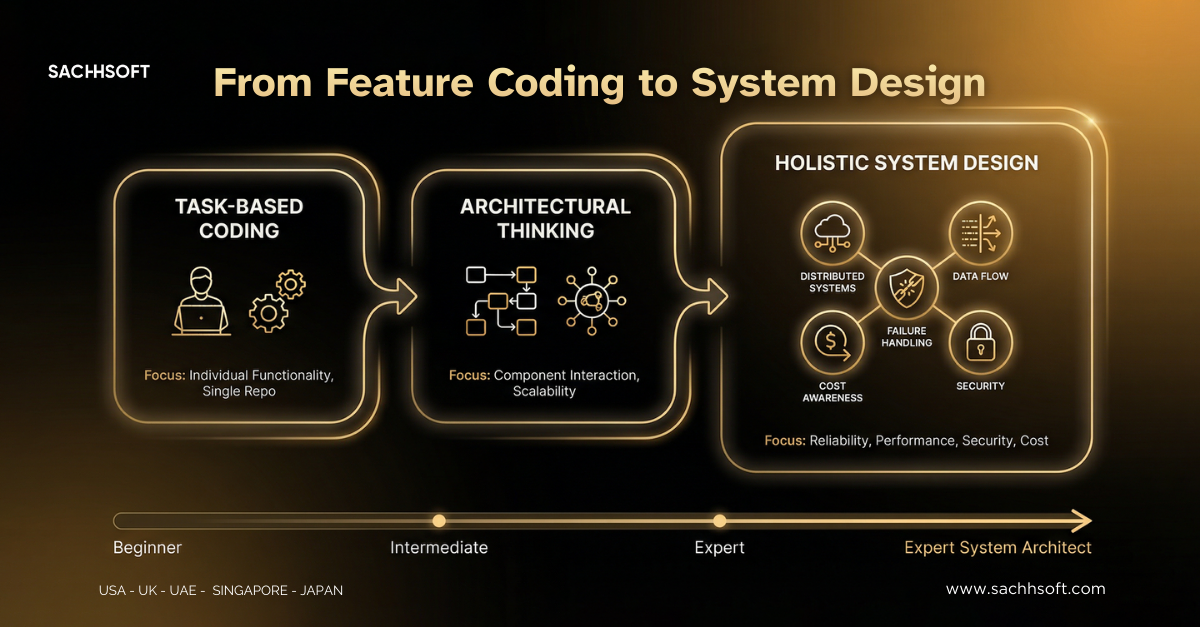
The transition from feature coding to system design involves:
- Thinking in components, not files
- Designing APIs as contracts, not just routes
- Modeling data flows before implementation
- Considering long-term evolution
- Planning for failure, not just success
This shift does not require becoming a full-time architect. It requires expanding perspective.
Every feature lives inside a system. Every system lives inside a business context.
The Long-Term Advantage of Architectural Thinking
Developers who embrace system design thinking gain:
- Greater influence in technical decisions
- Broader career opportunities
- Stronger cross-team collaboration
- Higher trust from leadership
- Deeper technical mastery
They move from executing tasks to shaping direction.
That evolution defines modern seniority.
Final Thoughts
Software development has entered a phase where complexity, distribution, AI integration, and cloud economics intersect. In this environment, writing clean feature code is necessary — but not sufficient.
Senior developers now think like architects because systems demand it. They consider scalability, security, reliability, and cost as part of everyday coding decisions.
The future belongs to developers who understand that every line of code participates in a larger system.
At **Sachhsoft**, we build scalable platforms across web development, app development, and AI solutions by combining strong engineering execution with system-level thinking — because modern software requires both precision and architectural vision.
메타데이터
- post_id
- d5c7f3680071
- slug
- from-feature-coding-to-system-design-d5c7f3680071
- url
- https://medium.com/@sachhsoft/from-feature-coding-to-system-design-d5c7f3680071
- canonical_url
- https://medium.com/@sachhsoft/from-feature-coding-to-system-design-d5c7f3680071
- author_url
- https://medium.com/@sachhsoft
- status
- ok
- fetched_at
- 2026-07-15 09:23:51