Cornelius à Lapide, S.J. on Isa. 7:15
DR: Therefore the Lord himself shall give you a sign. Behold a virgin shall conceive, and bear a son, and his name shall be called…
Cornelius à Lapide, S.J. on Isa. 7:15
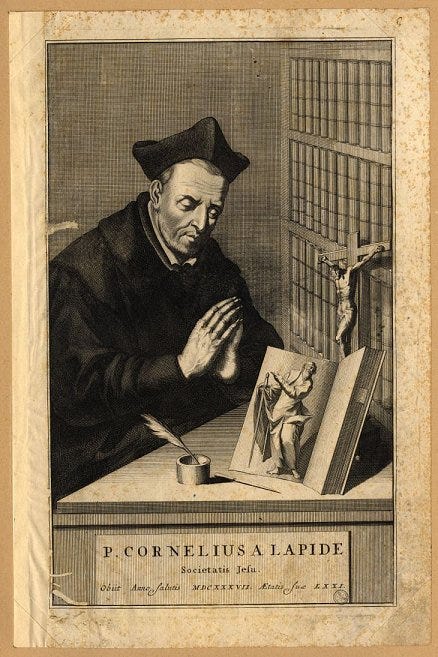
DR: Therefore the Lord himself shall give you a sign. Behold a virgin shall conceive, and bear a son, and his name shall be called Emmanuel. He shall eat butter and honey, that he may know to refuse the evil, and to choose the good.
VG: Propter hoc dabit Dominus ipse vobis signum: ecce virgo concipiet, et pariet filium, et vocabitur nomen ejus Emmanuel. Butyrum et mel comedet, ut sciat reprobare malum, et eligere bonum.
—
He shall eat butter and honey, that he may know to refuse ] First, Abulensis, in his treatise on these words, Behold, a virgin shall conceive, says that Isaiah signifies by these words that Christ as man will be very prudent and intelligent, and as an indication of this, the eating of honey and butter is mentioned, which are usually thought to make men very sharp and intelligent. But this is the opinion of carnal Rabbis, although John Huarte, a physician, attempts to support it with many physical arguments in his Examination of Wits.
Second, and rightly, St. Jerome, Cyril, Rupert, and Bernard (soon to be cited) hold that by these words, Isaiah signifies only that this divine child would not be phantasmal, as the Manichaeans claimed, but would be a true man, similar to other infants and nourished with infantile foods. As if to say: God, born of a virgin, will humble Himself to the point of needing and consuming honey and butter like an infant. This is so that the wisdom of God may appear as milk in human infancy, as a certain Doctor says.
It alludes to the foods with which infants were fed in Judea, a land so abundant in milk and honey that it is often described as flowing with them. Thus, this child will eat butter and honey so that He may know how to reject evil — that is, so that, when hungry, He may discern foods by taste and, gradually through experience, other things as well, determining whether they are good or bad. As if to say: This child will be nourished with appropriate food, grow, and mature into greater strength and age, by which He will acquire, through experiential knowledge, the ability to discern not only foods but all things, distinguishing good from evil.
So teach St. Basil, Jerome, Cyril, Chrysostom, St. Justin in Dialogue with Trypho, and St. Augustine in Genesis According to the Letter, Book 8, Chapter 14, among others. Isidore Clarius and Delrio add in Adagium 693 that this signifies Christ as a child choosing sweet things and rejecting bitter ones. For the Hebrews, “honey” represents all sweet things, such as sugar, grapes, figs, dates, and all sweet and honey-like fruits, as noted by R. David and Genebrard in Psalm 80:17 and Prado in Ezekiel 16:13. Thus, Judea is called a land flowing with milk and honey, meaning sweet and tasty fruits like honey. Of this, Deuteronomy 32:13 says, “That He might suck honey out of the rock.” Martial, in Book 7 against a bad poet, says: “Give the infant honey-apples,” meaning sweet fruits.
Therefore, it is entirely incorrect for some recent interpreters to explain it as if Christ, like other children, would be subject to childhood illnesses. It is common for children to suffer and become weak when they begin teething, for which physicians, like Galen in De Simplicibus Medicamentis Book 10, Chapter 10, and Pliny in Book 28, Chapter 19, recommend honey and butter. This interpretation is wrong, I say, for Christ, throughout His life, was subject to no illness but always had a sound and robust body, as theologians universally teach with St. Thomas in Summa Theologiae, Part III, Question 14, Article 4.
Moreover, honey is not only a food for children but is also said by physicians and confirmed by experience to contribute to maintaining health and promoting longevity. Thus, that robust old man, when asked how he had reached such an advanced and vigorous age, replied: “By using honey internally and oil externally.”
Hence, symbolically, milk signifies motherhood and fertility (as it is both an effect and a sign of these) of the Blessed Virgin; honey signifies virginity, for honey is produced by bees, which are generated without bodily union. Thus, it is said of the Blessed Virgin in Canticle of Canticles 4:11: “Honey and milk are under your tongue.” Although there have been various opinions about the generation of bees, and some have thought they are born from the union of male and female, with Pliny expressing doubt about this (Natural History, Book 11, Chapter 16), the nearly unanimous view is that bees are virginal, as they are never observed to mate — so admits Pliny — and thus lack distinct sexes. There are not separate males and females, but rather, they lay eggs or seed from themselves, nurturing and hatching it so that a small worm is born, and then a young bee, referred to as a nymph.
This view is supported by Aristotle (On the Generation of Animals, Chapter 10), Virgil, St. Ambrose, St. Gregory, Prudentius, Albertus Magnus, Scaliger, and others, as cited and followed by Ulysses Aldrovandus in his De Insectis, chapter on the generation of bees.
Symbolically as well, Richard of St. Victor (On Emmanuel, Book 1, Part 1, Chapter 14) says: “If the Lord of the angels, for the sake of humans, by eating and drinking, became a partaker with the beasts, why, conversely, should man not much more become a partaker with the angels for His sake? ‘Butter and honey,’ it says, ‘he will eat’; why does it not rather say bread and meat? What are butter and honey, if not the delicacies of flies? Certainly, the former comes from unclean creatures, and the latter from venomous ones. For bees carry stings and contain venom. Observe how they labor and fight for honey, often to the point of losing their lives in the wound. And flies throw themselves into and immerse themselves in milk, even surrendering their lives for it. Therefore, our Emmanuel eats butter and honey, and for our sake, descends to the level of participation with flies. Was it not enough for God to share with beasts for the sake of humans, unless He also shared with flies for our sake?”
Mystically, the same author (ibid., Part 1, Book 1, Chapter 21) says: “Honey, he says, comes from heaven through the mediation of dew, and butter from flesh through the mediation of milk. For what is butter if not a certain richness of milk? And what is honey if not a certain sweet and flowing thickness of dew? In milk is understood the sweetness of the heart; in butter, the exultation of the heart. Butter is gathered from milk, and true exultation of the heart is generated from true sweetness of the heart. According to the abundance of kindness, so also will be the abundance of joy. If we consider the heart of Christ, nothing is sweeter than it, nothing more kind than it, no heart has exulted more abundantly than it.”
Hence, in Chapters 23 and 24, he teaches that from the Father and the Holy Spirit, the sweetness of all grace, consolation, and glory was instilled into our Emmanuel from the moment of His conception.
Tropologically, St. Ambrose, or whoever is the author of the latter book On the Faith of the Resurrection at the beginning, says: “The child will be filled with the Holy Spirit, whose teaching is sweeter to us than honey and the honeycomb. For honey is a symbol of wisdom (Prov. 24:13), and milk of innocence.” Hence, Homer calls just men γαλακτοφάγους, that is, milk-eaters, as Clement of Alexandria testifies (Pedagogue, Book 1, Chapter 6). And this is mystically hinted at here in verse 22, according to the Chaldean, which is what Christ says in Matthew 11:28 and following: Learn from me, for I am meek and humble of heart.
Beautifully, St. Bernard says in Sermon 2 on Advent: In this sheep, namely Christ, you will find a sweet nature, a good nature; and very good, like butter, not coagulum or the curd of sin. Thus, Christ is also the bee that feeds among the lilies, inhabiting the flowery homeland of the Angels; whence He flew to Nazareth, which means ‘flower,’ to the flower of the virginity of Mary, and brought to us only the honey of mercy, but reserved the sting for the wicked on the day of judgment.
For this reason, formerly, to those recently baptized and clothed in white garments, milk and honey were given (the same is still done by the Ethiopians, as is evident from their Ritual, vol. 4 of the Bibliotheca of the Holy Fathers), so that it might signify, first, their infancy in Christ; second, the sweetness of Christian life; and third, the humility and meekness of infancy. Hence, the first sacred reading they heard, namely on Saturday of the Lord’s day in white garments, was that epistle of St. Peter: “As newborn babes, desire the pure milk of the word, that you may grow thereby” (1 Peter 2:2). Thus, Tertullian says in Book 1, Against Marcion, 14: “God, the Creator, nourishes His own through the fellowship of honey and milk”; and in the book De Corona Militis, chapter 3: “Hence, we first taste the harmony of milk and honey.” Similarly, St. Jerome in Isaiah 55: “Hence, St. Agnes said: ‘I received honey and milk from His mouth.’”
Finally, Origen, in his second homily on these words of Isaiah, says, “Emmanuel,” he says, “eats butter and honey, and He seeks from each of us to eat butter. How He seeks butter and honey from each of us, His word will teach. Our works are sweet, our words most sweet and useful, they are the honey that Emmanuel eats, He who was born of the Virgin. But if our words are full of bitterness, anger, irritability, trouble, foul language, vices, and contention, ‘He has given me gall to eat,’ and the Savior does not eat from these words. However, the Savior will eat from the words of men if their words are sweet. We can apply this to the Scriptures: ‘Behold, I stand at the door and knock; if anyone hears my voice and opens the door, I will come in and dine with him, and he with me.’ Therefore, He promises to dine with us from our own words: but it is certain that we will dine with Him if we dine with Him. By eating of our good words, works, and understanding, He nourishes us with His spiritual, divine, and better food. For this reason, because it is blessed to receive the Savior with the open doors of our hearts, let us prepare for Him honey and all His banquet, so that He may lead us to the great feast of the Father in the kingdom of heaven, which is in Christ Jesus, to whom be glory and dominion forever and ever. Amen.”
that he may know to refuse the evil ] Calvin here, from this verse and the following, argues that the soul of Christ, during His infancy, lacked the use of reason and understanding. And concerning this, he says, the ignorance of Christ is testified to by Luke when he says: “And He grew in wisdom and age, and in favor with God and men.” Therefore, it was fitting that for a time He should be similar to infant children, so that with respect to His humanity, He would be without understanding. Bucer and Whitaker agree with Calvin.
But this error is refuted first from Jeremiah 31:22: A woman shall encompass a man. Therefore, Christ was in the womb a man, not by the size of His body, but by wisdom and grace.
Secondly, from Isaiah 9:6, where this little one is called Wonderful, Counselor, and, as the Septuagint translates, Angel of Great Counsel. And in chapter 11:1: There shall come forth a rod out of the root of Jesse, and a flower shall rise out of his root. And the Spirit of the Lord shall rest upon him, the Spirit of wisdom and understanding, etc. The flower rising from the rod is Christ born of the Virgin; therefore, upon the flower — not only upon the fruit, that is, upon Christ as an infant, not merely as a man — the Spirit of wisdom rested.
Thirdly, from St. Paul in Hebrews 10:5: Entering into the world, he says — surely Christ Jesus on the day and hour when the Word was made flesh — Sacrifice and offering you did not desire, but a body you have prepared for me; burnt offerings and sin offerings did not please you. Then I said: Behold, I come. Finally, the Apostle adds: By this will, we have been sanctified through the offering of the body of Jesus Christ once for all. Therefore, Christ, from the beginning of His incarnation, had an act of reason and will by which He offered Himself and His death to the Father for the redemption of mankind. Furthermore, at the first instant of Christ’s conception, the fullness of divinity dwelled in Him bodily; therefore, at that time, all the treasures of wisdom and knowledge were hidden in Him, as the same Apostle says. And St. Luke, in chapter 2:40, states: The child grew and became strong, filled with wisdom. For this fullness of wisdom, just as of grace and glory, was owed to Him by virtue of the hypostatic union with the Word, and from this, it flowed, as it were, naturally.
Fourthly, St. John the Baptist, sanctified in the womb, possessed the use of reason. Hence, the infant leaped in the womb as soon as the Blessed Virgin greeted his mother Elizabeth, concerning which the Church sings:
While reclining in the hidden chamber of the womb,
You perceived the King dwelling in the bridal chamber;
Thus, through the merits of the child,
Both parents reveal the hidden mysteries.
What was given to John, was it not given to Christ?
Fifthly, St. Jerome says here: “Still wrapped in swaddling clothes and fed with butter and honey, He will possess the judgment of good and evil, so that through these words we may understand that the infancy of the human body did not diminish divine wisdom.”
Thus also say the other Fathers, interpreters, and Scholastic Doctors, with St. Thomas, who attribute to Christ, besides the divine knowledge He had as God, a double knowledge as man from the first instant of the Incarnation: first, the beatific knowledge, namely, the vision of God and all things in God; second, infused knowledge, by which He knew all things outside of God through infused light. They also add a third, acquired knowledge, by which Christ learned and experienced through human experience the same things He already knew through infused knowledge.
See St. Thomas and the Scholastics, Summa Theologiae III, q. 10, 11, 12. Regarding this third type of knowledge, both Isaiah and St. Luke speak here.
Thus, the sense is: “That He may know to reject the evil and choose the good,” as if to say: What was ironically stated about Adam after sin in Genesis 3, “Behold, Adam has become like one of us, knowing good and evil,” will be truly said of Emmanuel.
Secondly, St. Jerome, Haymo, and St. Thomas interpret the word ut as “although,” as if to say: “This child will be wiser than other children, and He will know how to reject evil and choose good; and although He will be such, yet like others, He will eat butter and honey.” To this, Vatablus and Adam join, who take ut to mean “as,” as if to say: “This child will eat honey as an infant, yet at the same time will know to reject evil; for He will be the Word as an infant, a wise child.” However, in Hebrew, lamed signifies “so that,” not “although.”
Thirdly, St. Thomas takes ut causally and antecedently, as if to say: “This child will eat so that He may grow to adulthood, at which point, through experience, He will learn and know how to reject evil and choose good, which previously He only knew through infused knowledge.” Thus, the Septuagint translates ut as “before He knows,” etc.
Fourthly, and most plainly, Sanchez interprets ut as “until,” for which the Chaldean translates donec (“until”). This is the meaning of the Hebrew lamed in ledato, as if to say: “Emmanuel will eat the food of infants, honey and butter, until He grows and matures to that age at which children usually have the ability to understand and discern between good and evil.” That is to say, not only will Emmanuel be born, but He will also be nurtured and grow like other children to adulthood.
Morally, St. Bernard in Sermon 3 on the Nativity concludes: Evil, then, is bodily pleasure, as well as praise and honor; whereas good is affliction, contempt, and reproach, because these the wise Child, the Word made infant, chose, and those He rejected. Either Christ is mistaken, or the world is in error. But it is impossible for divine Wisdom to be mistaken; therefore, the world errs, and so do all followers of vanity and worldly things, as the Psalm says: I said, they always err in their heart. Christ, who is the way, the truth, and the life, teaches by word and example what is truly good, what is evil, what must be avoided, and what must be embraced to attain a blessed life. Oh, that all Christians would weigh this worthily, impress it upon their hearts, and express it in their actions! For in this reasoning and its practice lies the essence of Christian wisdom. The reason is that pleasure inflames the concupiscence of corrupt nature, while the cross extinguishes it.
메타데이터
- post_id
- d5c7f85a3249
- slug
- cornelius-à-lapide-s-j-on-isa-7-15-d5c7f85a3249
- url
- https://medium.com/@admirator.cartusiensium/cornelius-%C3%A0-lapide-s-j-on-isa-7-15-d5c7f85a3249
- canonical_url
- https://medium.com/@admirator.cartusiensium/cornelius-%C3%A0-lapide-s-j-on-isa-7-15-d5c7f85a3249
- author_url
- https://medium.com/@admirator.cartusiensium
- status
- ok
- fetched_at
- 2026-07-21 02:56:48


