World Cup Takeaways #3
June 22nd to June 28th
World Cup Takeaways #3
June 22nd to June 28th
Hello! The group stages are over and the knockout stage has begun! We’ve already played more games at this World Cup than the entire World Cup in Qatar, but the games have flown by.
All of the hosts qualified for the Round of 32 and used their home-field advantage effectively, building off the atmospheres generated by their passionate fans. Front-runners Argentina and France breezed through the group stages with nine points each, while Spain and England had to iron out sticky patches in their respective group games. Colombia and the Netherlands both impressed against tricky opposition, while Austria and Ecuador kept their World Cup dreams alive with late goals in their final games to book their passage to the next round.
But for me, the biggest surprise from the group stages was South Korea failing to progress from Group A. They were a well-coached team with some good players. After an impressive opening display, I was very excited to watch more of them at this tournament. But after a slightly unfortunate defeat to Mexico, South Korea shockingly fell to South Africa in their final match. With a negative goal difference after three games, it was always going to be extremely difficult for them to qualify as one of the best third-place teams. I was looking forward to watching them against Canada today, but they let me down. Sad.
Anywho, here are my three half-baked takeaways from Week Three (June 22–28) of the 2026 FIFA World Cup:
#1 Confusion at the Back (Scotland 0–3 Brazil, 6/24)
I feel sorry for the Tartan Army. The supporters were sensational in Boston and Miami, becoming one of the most adored fan bases at this tournament.
But while the fans knew what to do, the same could not be said of the Scottish team against Brazil. After playing a defensive back five against Morocco with no true intention of maintaining possession, manager Steve Clarke decided to switch things up tactically by playing (on paper) a more attacking back four. In the opening minutes, Scotland’s intentions on the ball were clear: instead of allowing the opposition (as they did against Morocco) to dictate proceedings, Scotland tried to keep the ball with short passes among the back four and two central midfielders.
The idea seemed logical. Brazil under Carlo Ancelotti do not play with an aggressive pressing structure. Vinícius Júnior and Matheus Cunha are not known for their off-the-ball work rate, and Casemiro, at 34 years old, cannot cover the midfield ground like he once could. If Scotland could keep the ball under moderate pressure, they would limit Brazil’s ability to create chances with their elite attacking talent and increase their chances of securing passage to the knockout stages.
Scotland, however, could not do this, and their struggles playing out from the back were tough to watch. After just seven minutes, Scotland handed Brazil an early lead after Vinícius capitalized on Scott McKenna’s loose touches. In the 22nd minute, Scotland were lucky not to concede again. Jack Hendry, after charging into a space outside the penalty area that limited his passing options, did not have the quickness to turn and play the ball back to his goalkeeper, with Vinícius pouncing on the ball and dispatching it into the bottom corner. Fortunately for Hendry, VAR found the slightest contact initiated by Vinícius and ruled out the goal. In both instances, Scotland had a spare man in Andy Robertson. Danilo, Brazil’s right-back, did not look ready to push aggressively up the pitch and press Scotland’s captain. If Scotland had found Robertson, he could have carried the ball forward and pushed Scotland higher up the field. However, because of both a lack of technical quality and a lack of tactical instruction on how to find the open player, Scotland shot themselves in the foot.
Brazil only needed to wait until the end of the half for Scotland to gift them their second goal. After stopping a Brazil attack in the penalty area, Andy Robertson immediately gave the ball back to Brazil at the top of the box. With the Scottish back line unsettled, Bruno Guimarães delivered a lovely cross to Vinícius at the back post to head home his second of the game, sealing Scotland’s fate.
Scotland’s change to a back four caused further confusion at the back. Even though he played as Brazil’s striker, Matheus Cunha rarely stuck to the centre-forward position. Cunha dropped off the Scottish centre-backs to receive the ball, combining with his fellow attackers or dribbling at the Scottish back line. Neither Hendry nor McKenna knew whether to step out and engage Cunha or stay in their defensive line.
This was evident in the 42nd minute, when Cunha drifted deeper to receive the ball from Lucas Paquetá. Both of Scotland’s centre-backs appeared petrified to leave their line, giving Cunha plenty of space to drive into and unleash a dangerous effort at goal. After the attempt, Scottish midfielder Lewis Ferguson urged his fellow defenders to step out and mark Cunha, as the Brazilian’s movements created a numerical disadvantage for Scotland in the centre of the pitch.
Had Scotland chosen to play a back three, the centre-backs might have been more comfortable stepping into midfield. In that system, the players know that they have two extra players behind them as cover. But in the back four, both Hendry and McKenna became uneasy. They never really knew when to step out and when to hold their line, constantly worried about their lack of speed to recover if they pushed higher to defend. Once again, a lack of tactical understanding combined with poor player execution was the downfall for this Scottish team.
The game plan, both in and out of possession, lacked cohesion. On the ball, the players lacked the required composure to maintain possession. Defensively, they couldn’t handle Brazil’s speed and combinations. If the team was as good as the fans were, they would have won this game easily. But alas, that is not how football works.
#2 Nil-Nils Are Beautiful! (Cabo Verde 0–0 Saudi Arabia, 6/26)
One of the most tired arguments that detractors of football make, time and again, is that football cannot be entertaining if two teams can tie a game with no goals scored. It’s a stupid argument. I’m not saying every single nil-nil match is a breathtaking affair, but goalless draws can have just the same amount of drama and intrigue as a goal-filled match. If ever there was an example to demonstrate this, look no further than Cabo Verde versus Saudi Arabia.
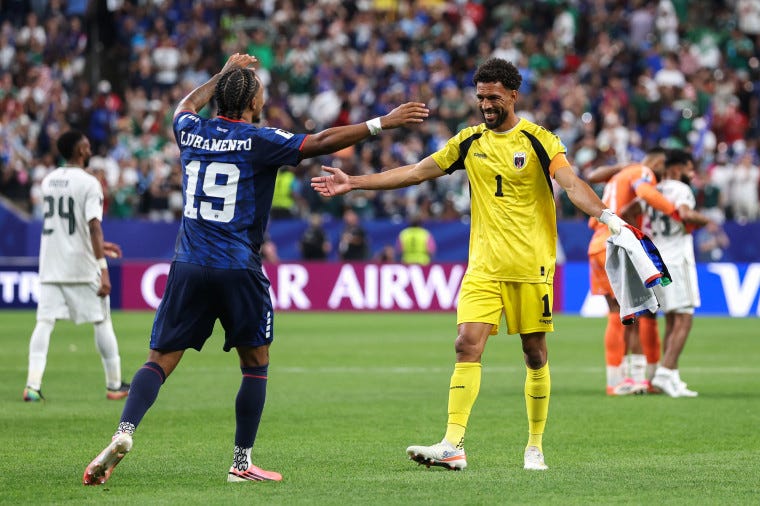
While Saudi Arabia tried to push for a goal late on to salvage their World Cup hopes, it was the Tubarões Azuis who made this an electric encounter. A running theme for me at this World Cup is the beauty of honest teams that create self-aware tactical setups and implement them on the field with one-hundred-percent buy-in from the coaches and players. Cabo Verde certainly fit this mold.
For this match, the Cabo Verdeans chose to play out from the back with short, direct passes to move the ball quickly up the field. They believed this approach could easily break through Saudi Arabia’s passive defensive structure. This plan worked, as Cabo Verde consistently found their passing targets. They stuck to their guns with this strategy even as the game wore on, with goalkeeper Vozinha showing incredible calmness on the ball to initiate their build-up from the back. Cabo Verde certainly deserved to win this game and had multiple squandered opportunities.
Their style of play was entertaining and engaging, making this one of the best matches I’ve watched at this tournament. And by not wavering from their game plan, Cabo Verde secured a historic result, becoming the smallest nation ever to qualify for the knockout stages of the World Cup. The celebrations at full-time, from the players on the field to the Cabo Verdean fans I watched the game with, were beautiful to behold. All because of a nil-nil draw. So next time some bozo tells you that soccer is boring because of goalless draws, tell them to re-watch Cabo Verde versus Saudi Arabia, or to take a hike.
#3 A Moment that Encapsulates Football Emotions (South Africa 0–1 Canada, 6/28)
In a tense affair crying out for a moment of magic, Stephen Eustáquio produced the greatest moment in Canadian men’s football history. After coolly controlling a South African clearance with his chest, the midfielder smashed an inch-perfect half-volley into the bottom-right corner from just outside the penalty area. An injury-time stunner, Eustáquio’s goal booked Canada’s place in the Round of 16, further cementing this tournament as the team’s most successful one to date.
Not only was this goal historic for Canada, but this last-gasp winner perfectly demonstrated two of the fundamental emotions of the beautiful game: ecstasy and despair. For the Canadians, this moment brought unbridled joy. Eustáquio rushed to celebrate with the bench and was engulfed by his jubilant teammates. The stadium, with a majority of Canadian fans, erupted in delight. These are the types of moments we as fans live for, and ones you watch the replays of for days, weeks, and years on end.
In contrast, this goal was heartbreaking for South Africa. After an abysmal opening display against Mexico, Bafana Bafana did incredibly well to qualify for their first knockout round, earning an impressive victory against South Korea in their final group game. Against Canada, South Africa played well and could potentially have snuck through to the next round on penalties. But it wasn’t meant to be, and Eustáquio’s dagger crushed their dreams. When you lose right at the end to an absolute worldie, the only thing you can do is what the South African players did: put your hands over your face or collapse to the ground in disbelief.
These types of moments, where the fate of both teams is decided in an instant, create pure bliss and pure misery. And it’s this wide range of emotions that gives the beautiful game its name.
COYG
메타데이터
- post_id
- d5ca093dc542
- slug
- world-cup-takeaways-3-d5ca093dc542
- url
- https://medium.com/@lucaspyleVTGooner/world-cup-takeaways-3-d5ca093dc542
- canonical_url
- https://medium.com/@lucaspyleVTGooner/world-cup-takeaways-3-d5ca093dc542
- author_url
- https://medium.com/@lucaspyleVTGooner
- status
- ok
- fetched_at
- 2026-07-16 19:53:23