Documentary #22: DMT-The Spirit Molecule (2010)
Disclaimer/Trigger warning: this article handles about psychedelic drugs. Dear reader, please be aware.
Documentary #22: DMT-The Spirit Molecule (2010)
Disclaimer/Trigger warning: this article handles about psychedelic drugs. Dear reader, please be aware.
SO…I don’t want to entertain any parasocial relationship but given how long we have now known each other, I believe, or at least I hope, dear reader, that you have come to realize that honesty is one of the core values underlying the articles I write.
This is why I can tell you without hesitation that I didn’t really like the documentary that is the subject of this article. I believe, if my memory serves me correctly, given the time space I let go between the articles on this matter, that this is the one I have enjoyed the least out of all the ones I have watched so far. I am surprised by its ranking; 22nd out of 101 on the list that serves as inspiration for me, and its IMDb score of 7.1/10! In any case, that is neither the ranking nor the score I would personally give to it if asked for my opinion.
“DMT: The Spirit Molecule” is a documentary directed by Mitch Schultz in 2010. As the title suggests, its subject is DMT (N,N-dimethyltryptamine), a substance naturally present in the human body, however classified as “psychotropic” (a term defined as “*any agent that induces changes in awareness, behaviour, mood, perception, or sensation*”).
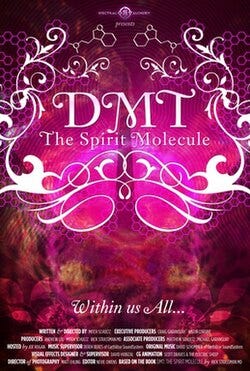
the cover poster for the documentary “DMT: The Spirit Molecule” (credits to owner for the picture)
I think what was missing from this work wasn’t its subject matter, which, in my opinion, is very much welcome in the realm of discussion and on-screen representation.
I must admit that the subject of “drugs” in general reminded me of countless references and current events: for instance, in France, just how much drug trafficking is generally a topic that is still widely discussed and one that really gets people talking on the news.
When it comes to pop culture, some celebrities are very outspoken, unapologetic, and open about their own drug use: I am thinking of Snoop Dogg, of course, the Beatles at the height of their popularity, or actor Seth Rogen — all of whom have in common that drugs are practically their trademark. Then there is comedian Chelsea Handler, who casually reveals on TV how she manages to smuggle drugs wherever she goes, or lesser-known anecdotes like Harry Styles, who consumed mushrooms while recording his second studio album, “Fine Line”, and ended up injuring his tongue as a result.
[embed]The described effects of DMT reminded me of this 2014 movie “Lucy” in which the character is forced to ingest the synthetic drug CPH4 making her develop her brain capacity very fast (video from Binge Society official Youtube Channel)
Even in my personal life, with people close to me , drugs is a topic…but that is another story for another day...
However, in my opinion, the documentary clearly falls short in how it chose to address the subject:
- In terms of form:
To start with, I can’t ignore the elephant in the room: Joe Rogan as the narrator.
His presence in this piece did not feel out of place to me; he could very well be included in the list of public figures I mentioned earlier as being fairly pro-drug, or at least avid users themselves (which is no secret). I am for instance thinking of his podcast “The Joe Rogan Experience” and that joint he shared with Elon Musk during an episode where they didn’t hide a thing about it (the USA are not a real place I swear).
Now, his presence really did not add much to the documentary beyond introducing a minimal thread to guide us through the narrative already quite easy to follow for its classic structure, in order: a presentation of DMT (what we are talking about), the history, a focus on a particular study that has shaped everything up to today, that of Rick Strassman who led in 1990 the “*first new human research with psychedelic, or hallucinogenic, drugs in the United States in over 20 years”. The order was *predictable but it isn’t objectionable in my book! And then, why have Joe Rogan appear in a suit and tie, as if in a classroom, all in black-and-white visuals? The choice took me aback.
Visually speaking, the choices are just as questionable. I believe the intention was to visually convey the central idea behind DMT: a blend of spirituality and science, hence the psychedelic imagery with colors and rhythms meant to give us a sense of what it induces, while featuring knowledgeable, credible individuals — mostly scientists to talk about DMT (but also artists). Overall, I hope I am not offending anyone by saying this, but the style felt quite dated, even though the documentary was made just a little over a decade ago. Once again, I didn’t find that the visuals added much to the subject matter because they were used merely for illustration and not fully explored! They left room for more speculation than concrete facts for me.
I was disappointed by the lack of scientific rigor, even though that’s what I understood to be the main takeaway at the end: the fact that if we want society to accept DMT, change the culture around it, we need to really combine it with science by focusing more on research to validate therapeutic applications (what benefits it can offer) rather than on meditation or personal exploration. The documentary merely features people whose names and professions are all the audience gets to know about them. We know little about their experiences or qualifications, so how can we trust what they are telling us? Especially since there are no sources, or very few that are shown on the screen, to back up what is being said. How, then, can we also delve deeper if we have become interested enough in the topic to want to learn more?
It all felt too superficial for my taste.
- And the content of the documentary!
The last thing I would like to mention is the approach that was taken.
The impression I have, several days after watching this project, is almost that of having watched a promotional campaign for DMT.
From start to finish, it did nothing but extol its merits, the good it can contribute to, and just how wonderful it can be for human beings — on many levels, no less. I wrote in my notes the following elements when watching it: it can help treat anxiety and depression, improve your relationship with death (less fear), it goes to pair with evolution, it is a beautiful experience and it allows to unlock your full potential and a new level.
I am and always will be critical of documentaries that seek to emphasize only one perspective on an issue, because the purpose of making something for the screen, in my view, is not so much to lecture the audience as it is to invite them to reflect on a question based on facts that present the full spectrum of the issue. Not only to make them think but also to learn new things — which, in my case, was rather limited for this documentary, as I honestly left it with more or less the same preconceived notions about drugs that I had at the start…
Overall, I remain skeptical about this documentary. My review is quite negative, and I apologize for that.
This is merely my opinion.
It won’t change the discussion this documentary has sparked or its overall impact, which, according to Wikipedia, appears to have been quite significant:

Extract from the Wikipedia page on the documentary (link here)
And my opinion does not get in the way of providing you the link I found to watch this documentary (how gracious of me). In case you have not yet seen it, it is directly available in full on Youtube:
[embed]
An article written by Nica — May 31th 2025 — France — DOC#22
메타데이터
- post_id
- d5d045aef893
- slug
- documentary-22-dmt-the-spirit-molecule-2010-d5d045aef893
- url
- https://medium.com/@cassandra35_68121/documentary-22-dmt-the-spirit-molecule-2010-d5d045aef893
- canonical_url
- https://medium.com/@cassandra35_68121/documentary-22-dmt-the-spirit-molecule-2010-d5d045aef893
- author_url
- https://medium.com/@cassandra35_68121
- status
- ok
- fetched_at
- 2026-06-10 21:21:38