BALANCED RANDOM FOREST
Balancing the Forest for More Accurate Predictions
BALANCED RANDOM FOREST
Balancing the Forest for More Accurate Predictions
“Imagine a dense forest where there are various types of trees. Each tree has its own role and contribution to maintain the balance of the ecosystem”. This is how we can understand the concept of Balanced Random Forest in the realm of machine learning.”
Photo by Sicheng Liu on Unsplash
What is Random Forest?
Before diving deeper into Balanced Random Forest, let’s first understand what Random Forest is. Random Forest is a popular machine learning technique used for classification and regression tasks. It consists of many decision trees that work together to make predictions. Each decision tree makes its own prediction, and the final result is the average or majority of these predictions.

The graphical illustration of random forest model. Image by the author
The Problem of Class Imbalance
In real-world scenarios, data is often imbalanced. For instance, if you are trying to predict whether someone will develop a rare disease, your data might have many examples of healthy individuals and very few examples of sick ones. This imbalance can make machine learning models inaccurate, as they tend to “learn” that most people are healthy and ignore the minority who are sick.
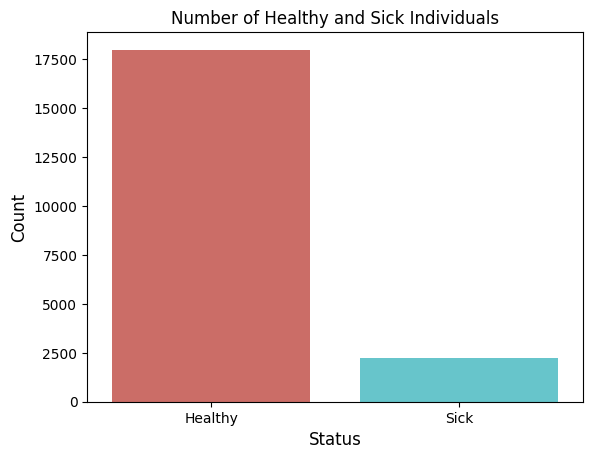
Class imbalance condition example. Image by the author.
Introducing Balanced Random Forest
This is where Balanced Random Forest comes in as a solution. Balanced Random Forest is a variation of Random Forest specifically designed to address the class imbalance problem. It works by balancing the data used to train each decision tree in the forest.
How Does Balanced Random Forest Work?
Balanced Random Forest works by changing how data is sampled to train each tree in the forest. Instead of using the entire imbalanced dataset, Balanced Random Forest performs undersampling of the majority class so that each tree gets a balanced dataset between the majority and minority classes.

Undersampling process illustration. Image by the author
Benefits of Balanced Random Forest
- Better Accuracy for Minority Class: By balancing the data, Balanced Random Forest can pay more attention to the minority class, making its predictions more accurate.
- Reduced Bias: In standard models, the majority class can dominate and cause bias. Balanced Random Forest reduces this bias by giving equal weight to both classes.
- Robust Against Overfitting: By using different samples for each tree, Balanced Random Forest also helps reduce the risk of overfitting, where the model fits too closely to the training data and does not perform well on new data.
Example with Python Code
Let's implement a Balanced Random Forest using Python and the imbalanced-learn library.
# Install necessary libraries
!pip install imbalanced-learn scikit-learn

# Import necessary libraries
from sklearn.datasets import make_classification
from imblearn.ensemble import BalancedRandomForestClassifier
from sklearn.model_selection import train_test_split
from sklearn.metrics import classification_report, accuracy_score

# Create synthetic imbalanced dataset
X, y = make_classification(n_samples=1000, n_features=20, n_informative=2,
                           n_redundant=10, weights=[0.9, 0.1], random_state=42)

# Split the dataset
X_train, X_test, y_train, y_test = train_test_split(X, y, test_size=0.3, random_state=42)

# Train the Balanced Random Forest model
model = BalancedRandomForestClassifier(n_estimators=100, random_state=42)
model.fit(X_train, y_train)

# Make predictions and evaluate
y_pred = model.predict(X_test)
print("Accuracy:", accuracy_score(y_test, y_pred))
print("Classification Report:\n", classification_report(y_test, y_pred))
메타데이터
- post_id
- d5dc9c896bb4
- slug
- balanced-random-forest-d5dc9c896bb4
- url
- https://medium.com/@fadleemt/balanced-random-forest-d5dc9c896bb4
- canonical_url
- https://medium.com/@fadleemt/balanced-random-forest-d5dc9c896bb4
- author_url
- https://medium.com/@fadleemt
- status
- ok
- fetched_at
- 2026-07-08 14:18:07




