Solving the Compliance Paradox: 5 Surprising Ways Primes and Subcontractors are Streamlining Supply…
Large organizations are adopting OpenRMF Professional as a standardized compliance engine, bridging the gap between liability and autonomy.
Solving the Compliance Paradox: 5 Surprising Ways Primes and Subcontractors are Streamlining Supply Chain Security
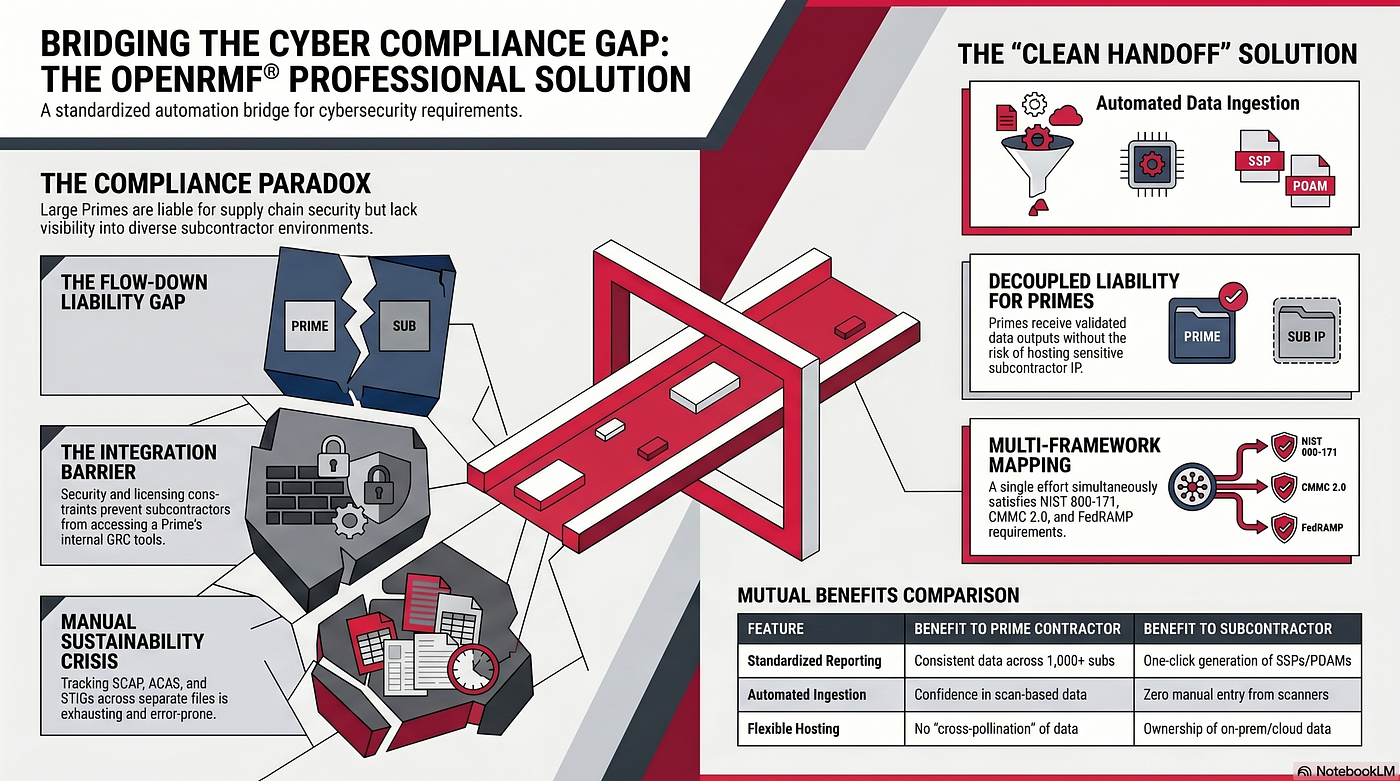
Large Prime contractors in the Defense Industrial Base (DIB) are currently navigating a “Compliance Paradox.” While they are contractually liable for the cybersecurity posture of their entire supply chain via “Flow-Down” requirements, it is functionally impossible for them to manage thousands of diverse subcontractor environments within their own internal Governance, Risk, and Compliance (GRC) tools.
The urgency of CMMC 2.0 and NIST 800–171 serves as the catalyst for this friction, demanding better protection of Controlled Unclassified Information (CUI). To resolve this, forward-thinking organizations are adopting **OpenRMF Professional** as a standardized compliance engine.
This solution bridges the gap between the Prime’s liability and the subcontractor’s autonomy, satisfying the needs of CISOs, Supplier Risk Management (SRM) leads, and Procurement officers who need to ensure their supply chain is “ready” for the next contract award without slowing down the mission.
Allow SubK’s to automate cyber compliance for hygiene, security, contract requirements, and overall survival
Decoupled Liability via “Validated Data Output”
A strategic evolution is occurring in how Primes handle vendor risk: they are moving away from mandating specific internal tools and are instead mandating a standardized data output. By using **OpenRMF Professional** as the “Local Compliance Foundation,” subcontractors maintain their own “Source of Truth” while providing the Prime with the verified data needed for SRM dashboards.
This approach is a massive win for Procurement and SRM teams because it removes the Prime from the liability of hosting sensitive subcontractor data. Instead of wasting hundreds of man-hours deciphering messy spreadsheets, PDFs, and disparate reports, Primes receive machine-generated packages that are consistent across the entire supply chain. This standardized output accelerates the validation process, ensuring that the supply chain remains a functional asset rather than a regulatory bottleneck.
The Death of “Consultant Debt” and 6-Month Deployments
Traditional GRC platforms are often synonymous with “consultant debt” — exorbitant professional service fees and implementation timelines that stretch past six months. For Tier 2 and Tier 3 partners, these costs are more than just an inconvenience; they are a threat to business viability. If a subcontractor cannot afford the high-end compliance tools required for a C3PAO assessment, they risk losing their eligibility for federal work.
The shift toward OpenRMF Professional offers a purpose-built COTS (Commercial Off-The-Shelf) solution that existing IT staff can stand up without an army of consultants. This protects the profit margins of smaller partners while ensuring the Prime’s supply chain remains resilient.
One customer, recognizing the futility of trying to build a custom internal solution, noted the financial reality:
“Getting a product like this that would avoid a company’s up front investment cost, and would not be COTS, is financially unfeasible.”
The “Live POAM” — Automation Over Guesswork
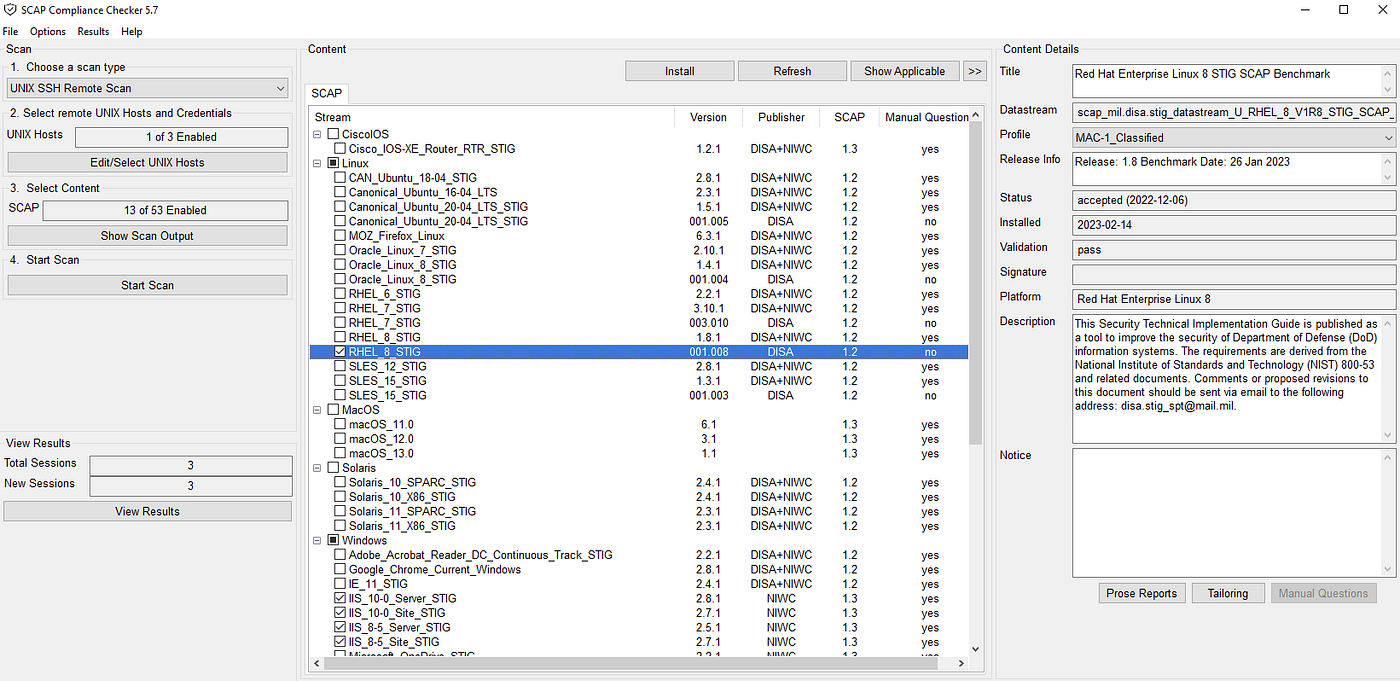
Manual compliance reporting is a static snapshot that is often obsolete the moment it is submitted. By automating the ingestion of scan data from industry-standard tools like Nessus, SCAP, and ACAS, subcontractors can transform their compliance posture into a real-time reality. This is the foundation of the “Live POAM” (Plan of Action and Milestones).
Instead of manual data entry, vulnerability tracking and “burn-down” are updated automatically as scans are ingested. This provides the Prime with a high-fidelity “Burn-down” chart of the subcontractor’s risk, offering technical confidence that simply cannot be achieved through optimistic manual reporting. For many cybersecurity directors, the transition to this level of automation is a revelation.
Multi-Framework Mapping (The “One-and-Done” Effort)
Cyber engineers are increasingly burnt out by the “compliance treadmill” — the need to satisfy overlapping requirements for NIST 800–171, CMMC 2.0, and FedRAMP. OpenRMF Professional acts as the “Connective Tissue,” allowing a single technical effort to satisfy multiple frameworks simultaneously through the use of Control Correlation Identifiers (CCIs).
This “one-and-done” approach enables features like bulk editing for STIG checklists across multiple systems, allowing engineers to pivot from administrative paper-shuffling to high-value security architecture. By automating the relationship between technical data types and compliance controls, organizations can demonstrate an active Authority to Operate (ATO) posture across all roles and frameworks with a single click.
The “Clean Handoff” Model for Disconnected Networks
One of the most critical architectural advantages of this model is its flexibility. Compliance automation is no longer restricted to a Prime’s SaaS environment; it can be hosted on-premise, in private clouds, or on air-gapped and disconnected networks used in Special Access Programs.
This facilitates the “Clean Handoff” model, which is revolutionary for supply chain security:
- Subcontractors manage their RMF, CMMC or other cyber compliance tasks locally, ensuring full ownership and control of their sensitive Intellectual Property (IP).
- The Handoff involves the subcontractor exporting an encrypted “Compliance Package” from OpenRMF Professional.
- The Prime ingests this package into their enterprise GRC for 100% visibility.
This model explicitly eliminates “cross-pollination” risks, where subcontractor vulnerabilities might otherwise be introduced into the Prime’s internal cloud environment. The result is total visibility for the Prime and total autonomy for the subcontractor.

From Compliance Burden to Competitive Advantage
The adoption of an automated compliance engine — the “Easy Button” for the DIB — is no longer just about meeting a requirement; it is about securing a competitive edge. By making compliance a repeatable, data-driven process, **OpenRMF Professional** ensures that a supply chain is perpetually “ready” for the current as well as the next contract award, rather than scrambling during an audit or contract proposals and submission.
As the regulatory environment tightens, every organization must ask themselves a fundamental question regarding their talent: “If your cyber engineers are acting as administrators of paperwork rather than architects of security, is your supply chain truly resilient or just compliant on paper?”
See more at https://www.soteriasoft.com/. Ask for a live interactive demo. Or download and evaluate fully for a month with you and your team. And see how we can help you and your subcontractors automate their cyber compliance.
메타데이터
- post_id
- d5ddd52ffa47
- slug
- solving-the-compliance-paradox-5-surprising-ways-primes-and-subcontractors-are-streamlining-supply-d5ddd52ffa47
- url
- https://medium.com/@dale-bingham-soteriasoftware/solving-the-compliance-paradox-5-surprising-ways-primes-and-subcontractors-are-streamlining-supply-d5ddd52ffa47
- canonical_url
- https://medium.com/@dale-bingham-soteriasoftware/solving-the-compliance-paradox-5-surprising-ways-primes-and-subcontractors-are-streamlining-supply-d5ddd52ffa47
- author_url
- https://medium.com/@dale-bingham-soteriasoftware
- status
- ok
- fetched_at
- 2026-06-09 14:34:10