‘PESTLE’ Framework.
Banking Industry Analysis for the Global Environmental Hypothesis.
‘PESTLE’ Framework.
Banking Industry Analysis for the Global Environmental Hypothesis.
Photo by Aditya Vyas on Unsplash
Introduction
Globalization is an important issue in the banking industry. To deal with it, the industry must analyze the external business environment. The best way to do that is to use the environmental PESTLE analysis business model.
You can read the article by clicking this link here if you are not a member of Medium.
What is the PESTLE framework business model?!
PESTLE stands for six categories of external environmental matters that global and local businesses in any industry must examine and analyze to maximize external opportunities or minimize external threats. The categories are political, economic, social, technological, legal, and environmental factors.
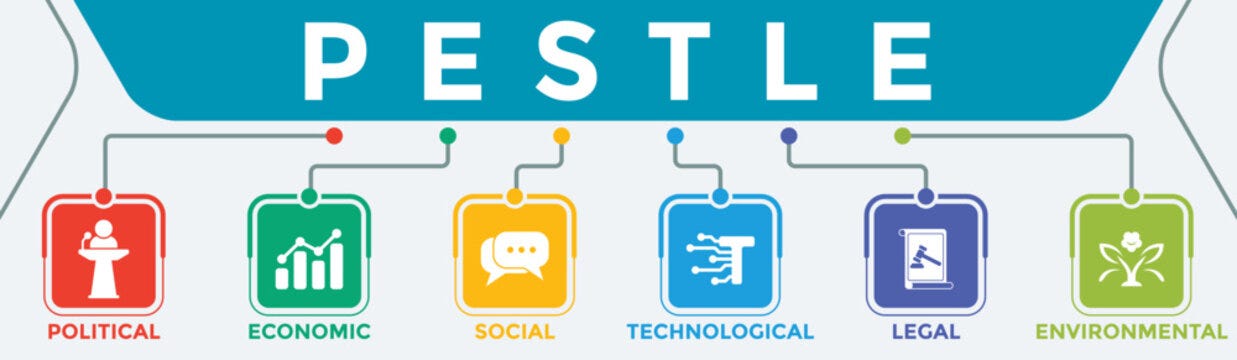
Photo Source
Analyzing The Global Banking Industry
Political:
Political instability in global banking increases risk because banks are more likely to face losses when political instability unfolds where they operate. It is recommended that the ‘global banking industry' either avoid or comply with increased international regulations. On the other hand, if there is stability, businesses and banks will grow and flourish globally to expand and prosper.
Economical:
Globalization normally increases economic growth and demand for banking services. Therefore, the banking industry has to capitalize on that and find innovative ways to cope with the increased demand by offering attractive banking services. However, globalization will also lead to increased competition. The banking industry must mitigate the threat through innovative and competitive products and services.
Social:
Globalization has increased the number of young and educated people who want more sophisticated banking products and services. Globalization lifestyle and working abroad led to a demand for cross-border banking services; therefore, they must comply with new regulations on the other side. Globalization has also increased the number of foreign businesses operating and demanding more international banking services, so they must maximize their efforts and take advantage of the opportunity to expand their businesses.
Technological:
Globalization led to the development of new technologies that have transformed the banking industry. For example, ATMs, credit cards, and online banking have made it easier and more convenient for customers to access their bank accounts and perform transactions. The development of new technologies helped banks improve their efficiency and security. Nevertheless, it has increased the chance of theft and fraud on a global level, and now banks are using big data analytics to detect and prevent fraud.
Legal:
Globalization causes several legal challenges, which banks face because they must now comply with the laws of multiple countries. Globalization increases the number of cross-border disputes that banks must mitigate and resolve. Those legal challenges will strengthen the banking industry's ability to deal with future problems and issues if they occur.
Environmental:
Globalization has increased awareness of environmental issues and demand for more sustainable banking practices, such as recycling, pollution, climate change, and environmental policies. Banks must comply with those policies for the good of their business, customers, and society to reap the benefits of a clean environment and to persuade new customers.
Recommendations
Photo by CardMapr.nl on Unsplash
The banking industry can mitigate the risks and challenges of globalization by taking the following steps:
Invest in new technologies: Banks must invest in new technologies to improve their efficiency, security, and customer service.
Expand their reach into new markets: Banks can expand and increase their reach by partnering with foreign banks or opening branches in new countries.
Develop new products and services: Banks must develop new products and services to meet the needs of their customers in a globalized world.
Strengthen their risk management capabilities: Banks need to strengthen their risk management capabilities to mitigate the risks associated with globalization, such as political instability and cross-border disputes.
Noting that, by taking these steps, the banking industry can position itself to succeed in the global economy.
Ending
Overall, globalization has had a mixed impact on the banking industry. On the one hand, globalization has led to increased economic growth and demand for banking services. On the other hand, it has also increased competition, risk, and regulatory challenges.
Note:
This analysis can be applied to any business, big or small, everywhere.
Read articles and stories from ShqairCom at:
If you have any comments or feedback, please write them. I will be happy to receive them at any time.
Please clap more than once, highlight, share, and subscribe if you like the article.
Happy day or night to you all!
메타데이터
- post_id
- d5e35dd5f71d
- slug
- pestle-framework-banking-industry-analysis-for-global-environmental-hypothesis-d5e35dd5f71d
- url
- https://medium.com/@shqaircom/pestle-framework-banking-industry-analysis-for-global-environmental-hypothesis-d5e35dd5f71d
- canonical_url
- https://medium.com/@shqaircom/pestle-framework-banking-industry-analysis-for-global-environmental-hypothesis-d5e35dd5f71d
- author_url
- https://medium.com/@shqaircom
- status
- ok
- fetched_at
- 2026-07-22 13:16:18




