The Player
Chapter 88 of Who Was WM? Investigating a Televisionary: The Life and Work of Wolfgang Menge
The Player
Chapter 88 of Who Was WM? Investigating a Televisionary: The Life and Work of Wolfgang Menge
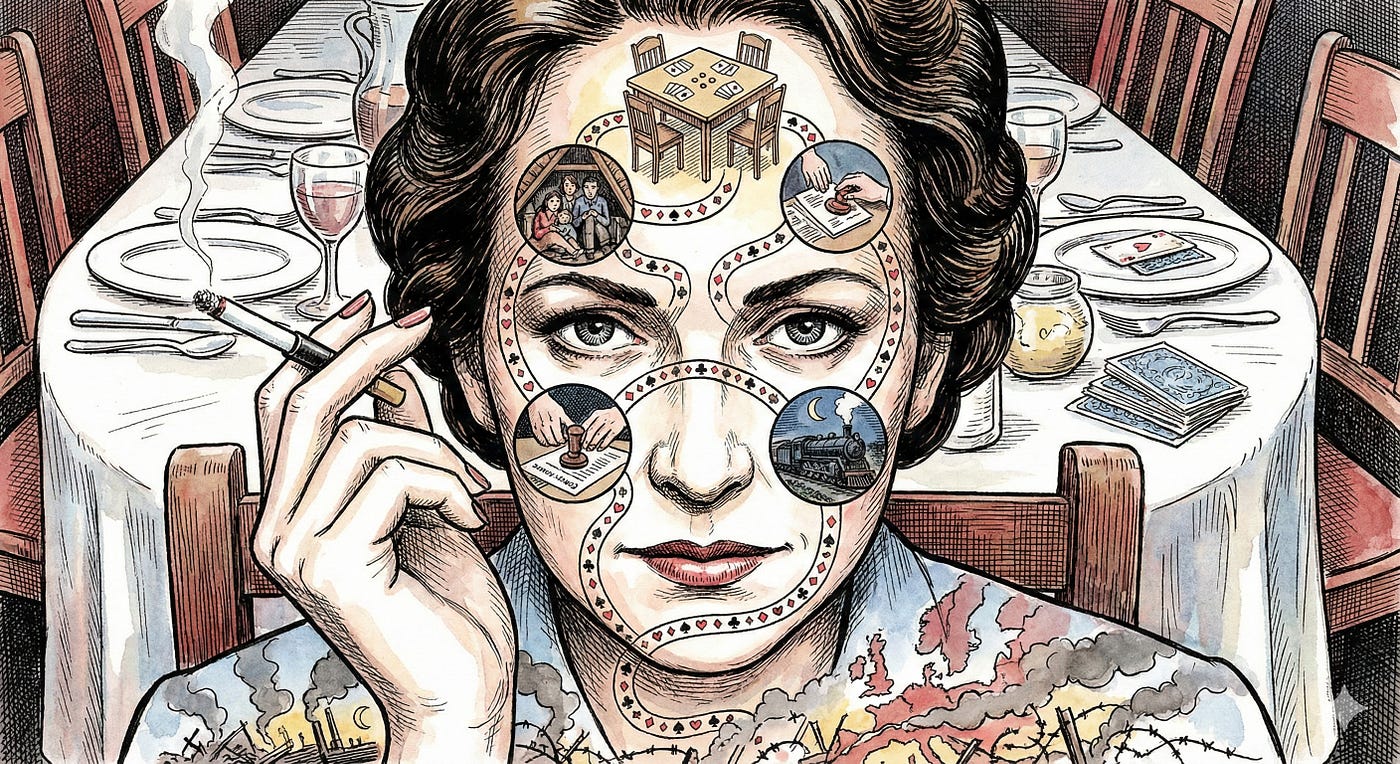
Golditza Plays and Wins: WM follows in his mother’s footsteps (llustration: Google’s Nano Banana Pro).
Playing for Life and Death
The classic definition of “play in the higher forms” appears in Dutch historian Johan Huizinga’s landmark study Homo Ludens: A Study of the Play-Element in Culture. Play, he writes in 1938, is “a contest for something or a representation of something.”
Twenty years after Huizinga, Roger Caillois, in his equally influential work Man, Play and Games, introduces the concept of “mimicry,” defining this significant variant of play as encompassing not only children’s role-playing but also the representational media of theater, film, and television.
There is no doubt that WM’s audiovisual works fall into the broad category of play as “representation of something” and “mimicry.” However, long before he writes his first screenplay in the late 1950s, his character is shaped by a passion for play as “contest for something” — for competition in all its forms. Anyone who wants to understand WM’s life and work must grasp this passion for play. What proves formative is the example his mother sets for him: role-playing survival in a hostile environment.
“This Jewish mother, Golda, born in Romania,” writes Uta Andresen in her portrait of WM for Germany’s national Jewish weekly newspaper, the Jüdische Allgemeine: “When he imagines her childhood, he sees it the way Nobel laureate Elias Canetti describes his own in The Tongue Set Free — multicultural, bourgeois, proper, and yet somehow off-kilter. A photo above the dining table shows her in a demure ruffled blouse and long skirt, but her left hand holds a cigarette — not demure at all.”
Her most striking character trait: Golditza Menge, née Schorr, of Ruse, a Bulgarian city on the Danube, is a player, in both the literal and figurative sense. She loved card games, and she took considerable risks in her life.
“She must have had nerves of steel,” Uta Andresen writes, summing up the life-and-death game of hide-and-seek that WM’s mother was forced to play in the daily reality of the Third Reich.
Play for Play’s Sake
Once the war was over, she could finally concentrate on playing cards — which she nonetheless took deadly seriously. Her daughter-in-law, Marlies, recalls this from their very first meeting. As do Golditza’s grandchildren.
“I learned to play games at my grandparents’ house,” says David Menge. “Usually with Grandmother and Father. He was relatively forgiving. But she was extremely strict. If you made a mistake, overbid, or bid wrong, you were in real trouble.”
Jakob is six years younger than David. Golditza teaches him the card game Mau-Mau in her survival-tested way: “She told me I could go ahead and play for cents. That’s how I started earning my first money in kindergarten.”
Later, when school is out for David and Jakob and their father has served lunch, dessert is table tennis or darts. And after dinner, there are board games.
“Sometimes when I came home in the evening,” Marlies remembers, “the family would be sitting in the dining nook of the living room, playing games. The children would greet me impatiently: ‘Just a minute… we’re almost done…’ — meaning: ‘You’re interrupting. Beat it, and close the door from the outside.’”
During summer vacations on Sylt, too, games are “the main thing,” says Jakob, and not just on the many rainy days. “Of course, there was a lot of chatting, but there was always playing. Card games or the board game Go, which Father had brought back from Asia. And strategy games like Reversi. I always lost at that one — eventually, I just gave up. But I was good at Boggle, the word game.”
The playing — and winning — on Sylt is also described by Sybille Ahlers, the daughter of WM’s friend Conny Ahlers: “Wolfgang usually won: a) because he already knew the games and their most important tricks; b) because he developed the greatest ambition; and c) because he also had the often necessary luck of the dice. Only once — I still bask in this triumph to this day — did I (then about twelve years old) defeat him through tactical finesse, since the course of the game naturally had nothing to do with luck. The game was called Jockey, or Horse Racing, or something like that. For a long time afterward, Wolfgang seriously tried to figure out how this disaster could have happened.”
The Art of Losing Is Overrated
Losing is not in WM’s nature. The actor Horst Bollmann recalls: “He plays Skat for fractions of a cent as if life depended on it, and if he loses, he calls for a few more rounds.” Haug von Kuenheim observes that WM likes “to play, but only when he’s sure he’ll win.” And Hanns Joachim Friedrichs is forced to admit, at the end of their Sylt debates, that he has never won. Once, WM even writes a letter of complaint to the management of the Westerland Casino:
“I must unfortunately draw your attention to an incident yesterday evening which, in my view, is not conducive to the enjoyment of playing in your establishment,” he begins, then describes in detail the clumsy, authoritarian, and factually incorrect behavior of a croupier and the pit boss. He concludes: “I would therefore like to learn from you how I might avoid being cheated out of a win by incidents of this kind.”
That the dispute concerns a trivial amount — and is therefore not about the money — goes without saying. From his mother, Golditza, WM has inherited or learned both traits: on the one hand, a love of play; on the other, the will to win at all costs. A feat that occasionally requires Golditza’s nerves of steel. In play as in life. In life as play.
“This playfulness was a primal force in him,” Jakob says of his father. “He had to learn to tame it, to cultivate it — in playing, in writing, in language, in humor, in the art of living.”
From his youth, WM is inclined toward trickery and role-playing, toward betting everything on a single card. It is through disguise, deceit, and rule-breaking that the twenty-year-old soldier escapes encirclement by the Red Army, then the German Wehrmacht and the SS, and finally internment by the British occupation forces. This is how he smuggles his friend Hannibal across Germany and France to England without a train ticket. Sometimes, of course, the playful trickery goes wrong. Black-market trading lands WM in a Hamburg prison, and “whatever it was” leads to his expulsion from Great Britain. Then again, “whatever it was” works out: the essentially penniless son manages to acquire the Berlin boarding house ABC Pension for his entirely penniless parents, paying tens of thousands of marks in cash.
Authorship: Role-Playing and Risk
Even the persona of the cultivated British eccentric that WM adopts as a successful yet suddenly bald author follows the dominant character trait of role-playing and risk-taking. At its center is his alleged stinginess.
“Cheapskate! He likes that,” his friend Jürgen Engert notes. “Anyone who isn’t a player can’t understand that a head of cabbage just ten pfennigs cheaper can feel like a win.”
When WM “takes” one ashtray after another from luxury restaurants, or swipes typewriter paper, file folders, and ballpoint pens from the offices of public broadcasters, it’s about the thrill, the skill, the trick. The game he plays is about “winning” things that have no price — whether a massive concrete standing ashtray from the lobby of a luxury hotel or more or less secret files from a government ministry in North Rhine-Westphalia.
What does this have to do with WM’s work?
***
Previous Chapter: 87 Outsider and Representative
Next Chapter: **89 Preparatory and Advanced Schools of Play**
German-Language Version: Wer war WM?
German Book Edition — published in December 2024
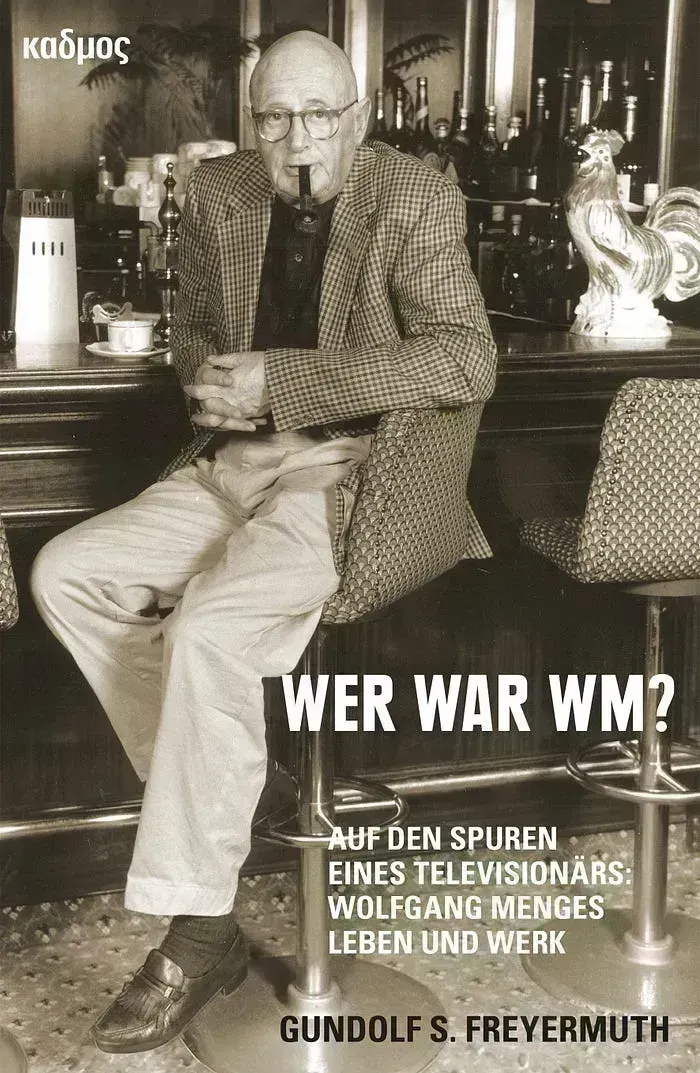
This post is part of a series: new chapters appear weekly. The book is already available in German. If you don’t want to wait — and read German — you can order it from Amazon.de or directly from the publisher Kadmos. They also offer an e-book version
메타데이터
- post_id
- d5ea98e7ca08
- slug
- the-player-d5ea98e7ca08
- url
- https://medium.com/@gundolffreyermuth/the-player-d5ea98e7ca08
- canonical_url
- https://medium.com/@gundolffreyermuth/the-player-d5ea98e7ca08
- author_url
- https://medium.com/@gundolffreyermuth
- status
- ok
- fetched_at
- 2026-08-10 03:50:09