Ukraine’s Flamingo Missile: 1,700 km Strike Cripples Russia’s Key Defence Plant
The precision attack on the Votkinsk factory — sole producer of Iskander, Yars and Bulava missiles — could halt production for up to six…
Ukraine War
Ukraine’s Flamingo Missile: 1,700 km Strike Cripples Russia’s Key Defence Plant
The precision attack on the Votkinsk factory — sole producer of Iskander, Yars and Bulava missiles — could halt production for up to six months and marks Ukraine’s longest-range strike yet

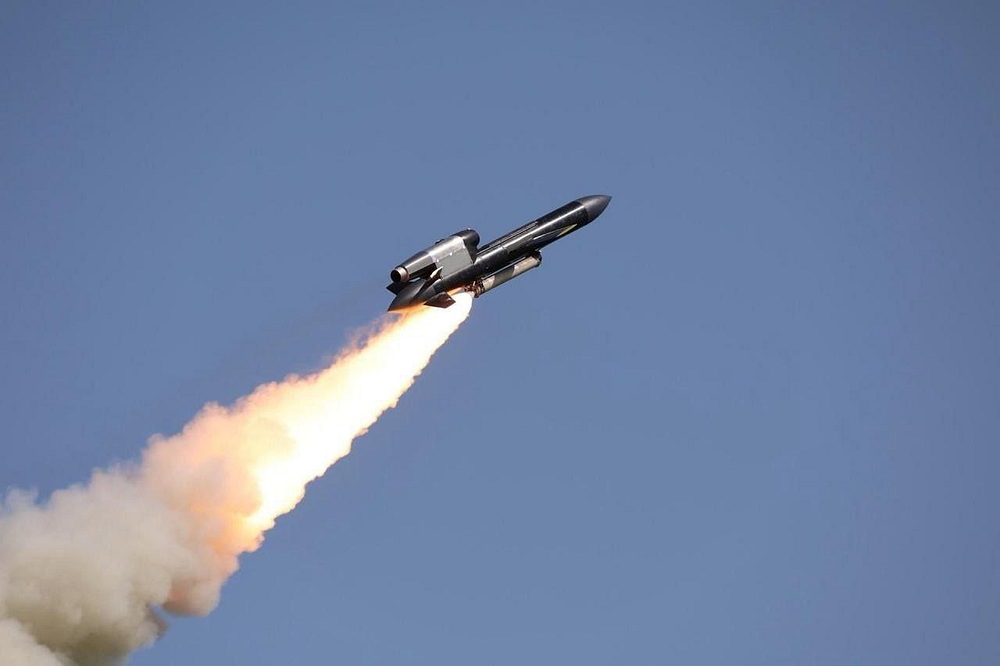
Flamingo FP-5 launch — screengrab
On the night of 20–21 February 2026, Ukraine’s domestically produced FP-5 “Flamingo” cruise missiles struck Russia’s Votkinsk Machine-Building Plant deep in the Udmurt Republic — over 1,400 km from the front lines.
President Zelenskyy confirmed that all launched missiles reached their target, with footage and satellite imagery showing precise impacts on key workshops, sparking fires, roof breaches, and visible damage.
The strike marks the longest-range confirmed use of the Flamingo to date and directly targeted the sole Russian facility producing critical systems such as Iskander, Yars, Bulava, and Oreshnik missiles.

Before and after satellite images of Votkinsk missile plant
The rise of Ukraine’s Flamingo: A homegrown long-range game-changer
The rise of the Flamingo cruise missile is a key moment in the domestic arms industry of Ukraine.
Developed by the firm Fire Point, this system signifies a departure from the reliance on Western-supplied munitions, which are frequently subject to restrictive geographical conditions. The first operational mentions of the Flamingo occurred in November 2025, when the system was deployed against petroleum depots and military infrastructure in occupied Crimea and border regions of the Russian Federation.
These initial engagements served were live testing for what has now become a powerful arrow of Ukrainian long-range capabilities.
Technically, the Flamingo is a significant piece of engineering. It possesses a launch mass of approximately six tonnes and a wingspan of seven metres.
Such dimensions place it in the category of heavy cruise missiles, capable of carrying a warhead weighing roughly one tonne. To put this in perspective, this payload is equivalent to the capacity of many modern ballistic missiles, yet it is delivered via a subsonic platform.
With a cruising speed of 650 to 700 km/h and a maximum velocity of 950 km/h, the Flamingo is not designed for speed but for endurance and persistence.
The development of the Flamingo by Fire Point suggests that Ukraine has successfully integrated advanced composite materials and propulsion systems capable of sustained flight over several hours.
The progression from short-range tactical strikes to the recent engagement at Votkinsk indicates a rapid iterative design process. By moving from the 416 km strike on the Kapustin Yar test range in early February 2026 to the 1,700 km strike on Udmurtia just weeks later, the Ukrainian military has demonstrated an unprecedented scaling of operational reach.
This homegrown solution provides a strategic autonomy that is essential for a protracted conflict.
1,700 km into enemy territory: How the strike evaded Russian defences
One FP-5 missile was confirmed to have struck one of the 19 facilities. An estimated 50 to 80 FP-5’s would be needed to destroy the sprawling Votkinsk Missile Plant. (Ukraine Battle Map on Twitter)
The success of the Votkinsk mission is particularly noteworthy given the physical characteristics of the Flamingo. In theory, a missile of its size and subsonic speed should be a relatively easy target for modern integrated air defence systems (IADS).
However, the strike on the night of February 20–21 proved that size and speed are not the only factors in survivability. The Flamingo utilised a combination of low-altitude flight profiles and sophisticated navigation to penetrate deep into Russian sovereign territory.
A primary factor in the evasion was the flight altitude. By maintaining an extremely low height relative to the terrain, the Flamingo remained within the “radar shadow,” making it difficult for ground-based sensors to distinguish the missile from ground clutter.
The route planning intentionally bypassed the most congested air defence zones. Russian defensive assets are heavily concentrated around the capital of Moscow, the occupied Crimean peninsula, and the immediate front lines. The vast interior regions of the Russian Federation exhibit a much lower density of coverage, a gap that the Ukrainian planners exploited with high precision.
Perhaps the most critical technological advancement in the Flamingo is its guidance system. The missile employs terrain contour matching (TERCOM), a method that allows the onboard computer to compare the physical features of the ground below with a pre-loaded digital map. This allows for high-precision navigation without the need for constant GPS or GLONASS signals, which are often compromised by electronic warfare.
I wrote recently about Ukraine’s home-developed terrain following system with digital image matching.

Screenshot of terrain mapping image from Ukraine SBU video
According to technical reports from Iryna Terekh, the technical director at Fire Point, the circular probable deviation during the Votkinsk strike did not exceed 10 metres. This level of accuracy at a range of 1,700 km is a testament to the sophistication of the guidance software.
Target: Votkinsk — Russia’s sole producer of Iskander, Yars and Bulava missiles
The Votkinsk Machine-Building Plant is not merely a factory; it is a critical vulnerability within the Russian strategic architecture.
Located in the Udmurt Republic, this facility is the exclusive manufacturer for several of the most significant missile systems in the Russian arsenal. It produces the Iskander-M operational-tactical ballistic missiles, which have been used extensively throughout the winter of 2025–2026 to target Ukrainian energy infrastructure and civilian centres.
Beyond tactical weapons, Votkinsk is the heartbeat of the Russian nuclear triad’s land and sea components. It is the sole assembly point for the Yars intercontinental ballistic missile (ICBM) and the Bulava submarine-launched ballistic missile (SLBM). These systems represent the primary deterrent capability of the Russian Federation.
By striking this facility, Ukraine has moved beyond tactical battlefield goals and is now directly impacting the long-term strategic viability of the Russian military. The plant’s role as a “sole producer” means there is no secondary facility capable of absorbing its production load if operations are interrupted.
The geographical location of Votkinsk was previously thought to be its greatest defence. Situated deep in the Russian heartland, it was far beyond the reach of conventional artillery or short-range drones. The Flamingo strike has fundamentally altered this perception.
In a direct line the plant is about 1,400 km from the front line. Ukraine will have launched the Flamingos from reltively safe locations well behind the front line. Allowing for flight deviations to bypass some concentrations of Russia air defence systems, the flight path of the Flamingos is likely to have been of the order of 1,700 km.

The ability of the Ukrainian Armed Forces to strike the very birthplace of the Iskander missiles that have plagued their cities provides a significant psychological and strategic counterweight.
It demonstrates that the source of the threat is no longer immune to the consequences of Russia’s genocidal war.
Direct hits confirmed: Damage, fires, and production halts
The impact of the strike on the night of February 20–21 was immediate and severe. While Russian authorities initially attempted to report the event as a minor drone attack, satellite imagery and internal reports tell a different story.
The Flamingo missile successfully struck Building №19, which houses the galvanic stamping workshop. This facility is essential for the production of missile bodies and the treatment of materials required to withstand the high stresses of ballistic flight.
The destruction of the galvanic stamping workshop creates a manufacturing bottleneck that cannot be easily bypassed. The processes performed in Building №19 involve specialised chemicals, large-scale industrial presses, and precision treatment tanks that are custom-built for the dimensions of the Iskander and Yars missiles.
Reports suggest that the intensity of the resulting fires, fed by industrial chemicals and potentially stored components, caused structural failures in the building. Analysts currently estimate that the damage will result in a production halt of at least three to six months.
A six-month cessation of production at Votkinsk has profound implications. In the short term, the Russian military will have to rely on existing stockpiles of Iskander missiles, which are reportedly already depleted due to the high tempo of strikes during the winter months. For the strategic forces, a delay in Yars and Bulava production disrupts the planned modernisation of the nuclear fleet and regiments.
The precision of the 1,700 km strike ensured that the damage was concentrated on the most difficult-to-replace infrastructure, maximising the operational downtime of the entire plant.
There is significant evidence to support the claim that the Russian military is currently deploying Iskander missiles manufactured only weeks or months prior to their use. Reports from late February 2026 confirm that debris recovered from recent strikes bears manufacturing timestamps from late 2025 and early 2026.
Evidence of “factory-to-frontline” deployment
On 24 February 2026, Serhii Beskrestnov, an advisor to the Ukrainian Ministry of Defence, reported that the ballistic missiles currently targeting Ukrainian infrastructure are emerging “straight from the factory”. This assessment is based on the serial numbers and date codes found on recovered fragments of the 9M723 (Iskander-M) missiles.
Fragments documented in early 2026 show markings indicating they were manufactured in the fourth quarter of 2025 and the first quarter of 2026.
A new phase in the war: Ukraine’s push for deep strategic deterrence
The Flamingo strike on Votkinsk signifies the beginning of a new phase of long-range deterrence. For much of the conflict, the Russian Federation has operated with a degree of industrial impunity, producing weapons in factories that were safely out of reach. Ukraine’s development of high-precision, long-range cruise missiles like the Flamingo ends this era. The ability to strike targets 1,700 km away with a 10-metre accuracy means that every major military-industrial facility in western and central Russia is now a viable target.
This development forces a difficult choice upon the Russian high command. To protect these vital internal assets, they must redeploy sophisticated air defence systems from the front lines or from the protection of Moscow and St Petersberg. Such a redistribution of assets could create opportunities for the Ukrainian Air Force and drone units in other sectors of the theatre.
The Flamingo is therefore more than just a weapon of destruction; it is a tool for strategic distraction, forcing Russia to thin its defences across a much larger geographic area.
Additionally, the Flamingo represents a technological evolution that places Ukraine amongst a small group of nations capable of producing and deploying heavy cruise missiles over such distances.

Flamingo FP-5 versus Tomahawk. Author table based on OSINT and other data. Estimates vary.
This homegrown capability serves as a powerful message of resilience and innovation. By targeting the production lines of the Iskander and Yars, Ukraine is effectively engaging in a campaign of industrial attrition.
The goal is to ensure that for every missile launched at a Ukrainian city, there is a commensurate and devastating response against the infrastructure that created it. This shift toward deep strategic strikes is likely to define the operational landscape throughout 2026.
We’ve only just seen the start of the Flamingo campaign.
Update Feb 28
Stunning proof of the terrain guidance navigation on the Flamingo FP-5s:

Source: DroneBomber on Twitter
Slava Ukrainii!
Showing Europe the way!
[embed]
메타데이터
- post_id
- d5f144a30e34
- slug
- ukraines-flamingo-missile-1-700-km-strike-cripples-russia-s-key-defence-plant-d5f144a30e34
- url
- https://medium.com/the-dock-on-the-bay/ukraines-flamingo-missile-1-700-km-strike-cripples-russia-s-key-defence-plant-d5f144a30e34
- canonical_url
- https://medium.com/the-dock-on-the-bay/ukraines-flamingo-missile-1-700-km-strike-cripples-russia-s-key-defence-plant-d5f144a30e34
- author_url
- https://medium.com/@james-marinero
- status
- ok
- fetched_at
- 2026-08-30 07:24:01