Choosing the Right Data Format: CSV, JSON, Parquet, or Avro?
In the world of data engineering, choosing a data format is not merely a technical preference — it is an architectural decision that…
Choosing the Right Data Format: CSV, JSON, Parquet, or Avro?
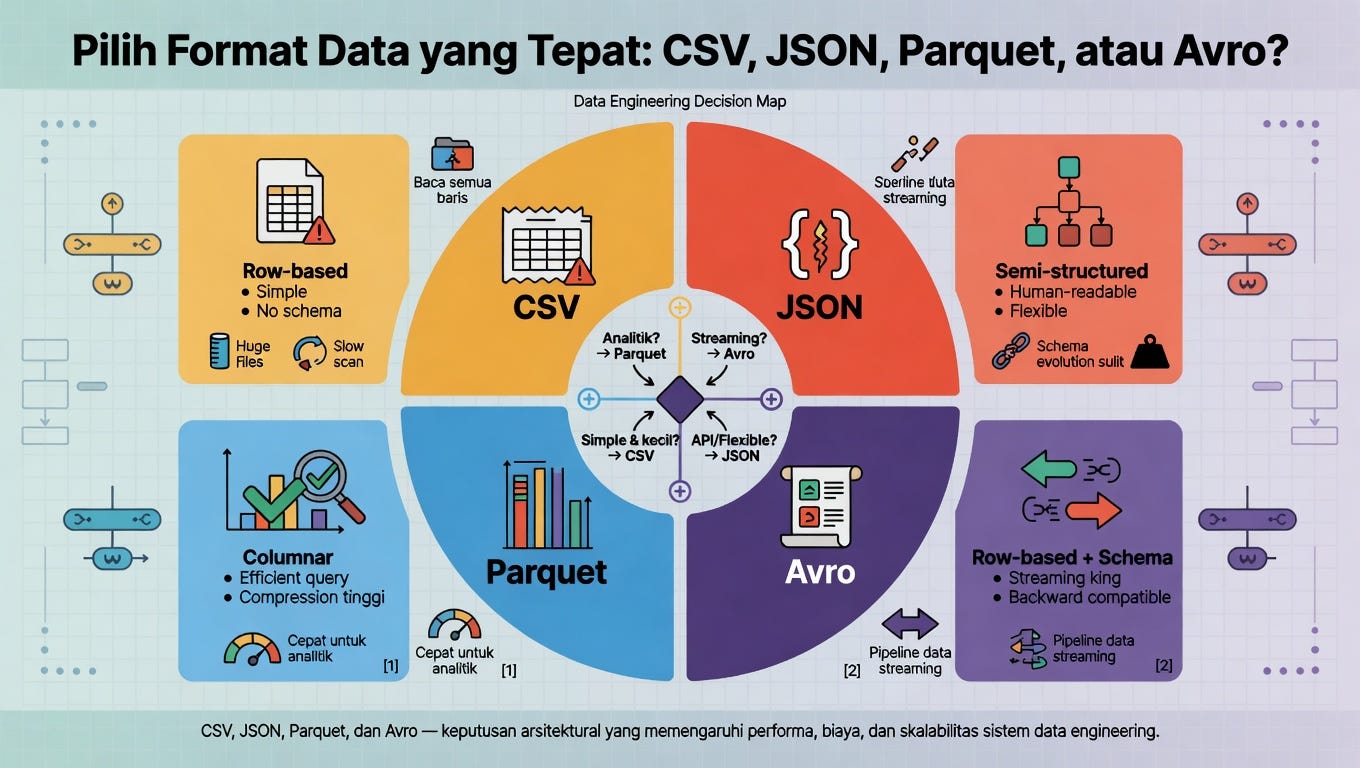
In the world of data engineering, choosing a data format is not merely a technical preference — it is an architectural decision that directly impacts performance, storage costs, and system scalability. Apache Parquet, for instance, stores data in a columnar layout so that analytical queries only need to read the relevant columns, rather than scanning every row [1]. On the other hand, Apache Avro has become the primary serialization format for streaming data pipelines thanks to its support for safe schema evolution [2].
illustration
Let us examine the four most popular data formats in modern data engineering: CSV, JSON, Parquet, and Avro.
CSV: Simple but Limited
CSV (Comma-Separated Values) is the oldest and simplest data format. It first appeared around 1972 when the IBM Fortran compiler supported list-directed input/output with comma-separated values [3]. CSV is human-readable and can be opened directly in spreadsheet applications such as Excel or Google Sheets. However, CSV has fundamental limitations: it lacks a built-in schema, meaning all values are treated as plain text; it is prone to data-type errors; and it does not support nested data structures [4].
CSV is best suited for quick data exports to non-technical teams, simple data exchanges between systems, and small-to-medium tabular datasets. For large-scale analytical workloads, however, CSV is inefficient because the entire file must be read even when only a few columns are needed [5].
JSON: Flexible but Verbose
JSON (JavaScript Object Notation) is a lightweight data-interchange format that supports nested structures through key-value pairs. JSON has become the de facto standard for API communication — the vast majority of modern REST APIs use JSON as their data-interchange format [4]. It is also widely used in NoSQL databases such as MongoDB and in application configuration files.
JSON’s strength lies in its flexibility: it supports various data types including strings, numbers, arrays, objects, booleans, and null. However, JSON has significant drawbacks in a big-data context: file sizes can be 1.5 to 3 times larger than the equivalent CSV because key names are repeated in every record [6]. Furthermore, JSON generally needs to be loaded entirely into memory for processing, making it suboptimal for very large datasets [7].
Parquet: The Analytics King
Apache Parquet is an open-source columnar storage format designed for large-scale data processing. Parquet originated from a collaboration between Twitter and Cloudera in 2013, inspired by Google’s Dremel paper [1]. Instead of storing data row by row like CSV, Parquet organizes data by column — so queries that require only a few columns do not need to read the entire dataset.
Parquet’s advantages for analytical workloads are substantial. Columnar compression yields dramatic storage savings because values of the same type are stored together and can be compressed more efficiently [5]. Parquet supports a variety of compression codecs including Snappy, Gzip, LZO, Brotli, Zstd, and LZ4 [1]. The predicate pushdown technique enables query engines to apply filters early, so only relevant data is read from storage [8].
Parquet has become the de facto standard in modern data-warehouse ecosystems. It is natively supported by frameworks such as Apache Spark, Apache Hive, Presto, and Impala [1]. Data-lake platforms on AWS S3, Azure Data Lake, and Google Cloud Storage also use Parquet as their primary storage format [8]. Modern table formats such as Delta Lake and Apache Iceberg even use Parquet as their underlying file format [9].
Avro: The Streaming Champion
Apache Avro is a data serialization system that serves as the primary format for data records and streaming data pipelines [2]. Unlike the columnar Parquet, Avro stores data in a row-based layout with the schema embedded directly in the file. The schema is defined in JSON format for readability, while the data itself is stored in a compact and efficient binary format [10].
Avro’s standout feature is its robust schema evolution. Avro supports backward, forward, and full compatibility — meaning producers and consumers of data can evolve independently without breaking existing systems [11]. This makes Avro the go-to choice for event-driven architectures and microservices communication.
Within the Apache Kafka ecosystem, Avro is the recommended serialization format. The Confluent Schema Registry provides centralized schema management that automatically validates schema compatibility when data is produced to Kafka [11]. Databricks and other frameworks also provide from_avro and to_avro functions to build streaming pipelines with Avro [12].
Data Format Comparison
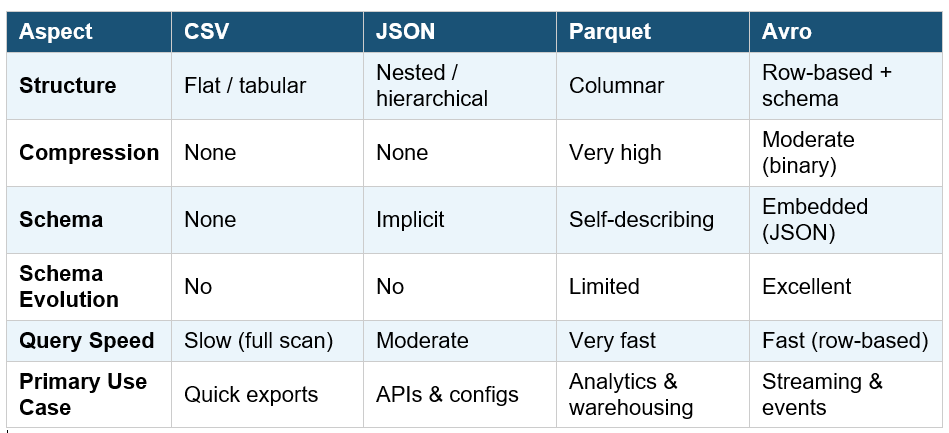
Table of comparison
Format Selection Cheatsheet
Analytics & Data Warehousing? Use Parquet — high compression, fast queries, and an industry standard [1][5].
Streaming & Event-Driven Systems? Use Avro — safe schema evolution, compact binary format, and native Kafka integration [2][11].
APIs & Web Integration? Use JSON — flexible, human-readable, and the REST API standard [4].
Quick & Simple Exports? Use CSV — universally supported and readable by anyone [3][6].
Video from article
YT : https://youtube.com/shorts/QEwOnIdbv4k?si=uBfN13uKgFo8xmqx
FB : https://www.facebook.com/share/v/1HecF27cwP/
Join the Belajar12Jam Community!
Want free learning materials, community discussions, and the latest bootcamp updates?
Join our Telegram Group: https://t.me/belajar12jam
Follow us on Medium: https://medium.com/@belajar12jam
References
[1] Apache Parquet Documentation — https://parquet.apache.org/
[2] Apache Avro Official Site — https://avro.apache.org/
[3] Wikipedia, “Comma-separated values” — https://en.wikipedia.org/wiki/Comma-separated_values
[4] Qodex.ai, “CSV vs JSON — Key Differences, Use Cases & When to Choose Each” — https://qodex.ai/blog/csv-vs-json
[5] IBM, “What is Apache Parquet?” — https://www.ibm.com/think/topics/parquet
[6] JSON Editor Online, “JSON vs CSV: What is the Difference?” — https://jsoneditoronline.org/indepth/compare/json-vs-csv/
[7] JSON.org, “Introducing JSON” — https://www.json.org/
[8] DataCamp, “Apache Parquet Explained: A Guide for Data Professionals” — https://www.datacamp.com/tutorial/apache-parquet
[9] Dremio, “Understanding Apache Parquet: Efficient Columnar Data Format” — https://www.dremio.com/resources/guides/intro-apache-parquet/
[10] IBM, “What is Apache Avro?” — https://www.ibm.com/think/topics/avro
[11] Confluent, “Schema Evolution and Compatibility” — https://docs.confluent.io/platform/current/schema-registry/fundamentals/schema-evolution.html
[12] Databricks, “Read and Write Streaming Avro Data” — https://docs.databricks.com/aws/en/structured-streaming/avro-dataframe
메타데이터
- post_id
- d641a8a5f80e
- slug
- choosing-the-right-data-format-csv-json-parquet-or-avro-d641a8a5f80e
- url
- https://medium.com/@belajar12jam/choosing-the-right-data-format-csv-json-parquet-or-avro-d641a8a5f80e
- canonical_url
- https://medium.com/@belajar12jam/choosing-the-right-data-format-csv-json-parquet-or-avro-d641a8a5f80e
- author_url
- https://medium.com/@belajar12jam
- status
- ok
- fetched_at
- 2026-06-15 20:49:13