Media over QUIC is finally real. Here’s what it actually changes.
For about fifteen years, every live video stack I have built has been a relay race between protocols that were never designed to hand off…
Media over QUIC is finally real. Here’s what it actually changes.
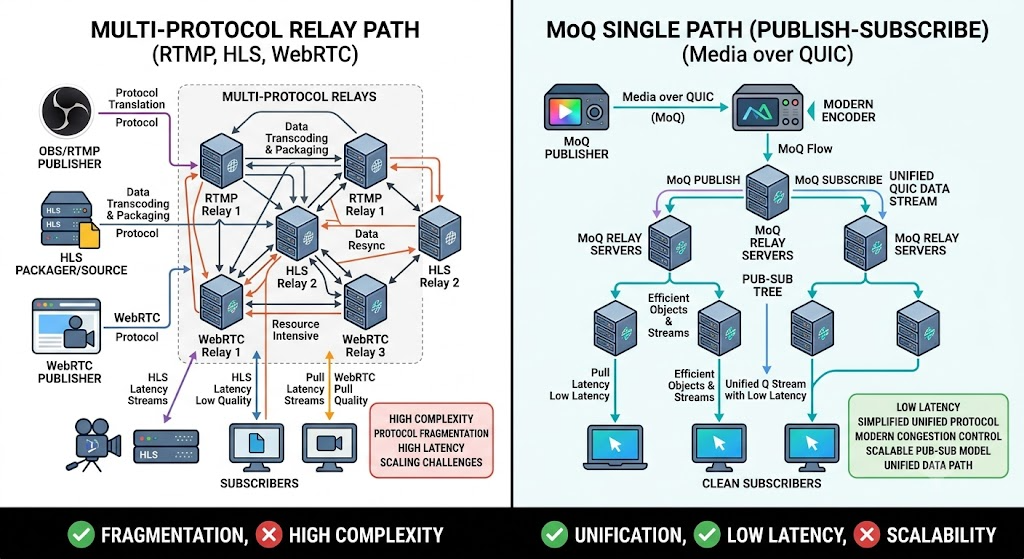
For about fifteen years, every live video stack I have built has been a relay race between protocols that were never designed to hand off to each other. RTMP carries the contribution feed because that is what encoders speak. Then something repackages it into HLS or DASH so browsers can play it. Then, when somebody finally asks for “real” low latency, you bolt WebRTC onto the side for the handful of streams that need sub-second delivery, and you maintain two delivery paths forever.
It works. It also explains why your live infrastructure diagram looks like a subway map.
Media over QUIC, usually shortened to MoQ, is the first serious attempt I have seen to collapse that relay race into a single transport. And in 2026 it crossed the line from “interesting IETF mailing list” to “you should actually understand this,” so it is worth explaining what it is, what changed this year, and whether any of it should touch your roadmap.
What MoQ actually is
MoQ is a publish and subscribe transport for media that runs on top of QUIC. The working specification, draft-ietf-moq-transport, reached its seventeenth draft in March 2026. That detail matters more than it looks: this is a living IETF effort with real working-group momentum, not a single vendor's proprietary pitch dressed up as a standard.
The mental model is the interesting part. In HLS, a player pulls segments over HTTP. In WebRTC, two peers negotiate a session and push frames at each other. MoQ throws out both shapes and says: a producer publishes named objects, and any number of subscribers consume them through relays. If that sounds like a message broker for video, you have the right intuition. The same publish-subscribe structure that makes Kafka or MQTT scale is being applied to media frames, with QUIC underneath doing the heavy lifting.
Because it runs on QUIC, MoQ inherits a set of properties that the older stack had to fake or live without. There is no head-of-line blocking across independent streams, so a dropped audio packet does not stall your video. TLS 1.3 encryption is built in rather than bolted on. Connections can migrate when a phone switches from Wi-Fi to cellular without tearing down the session. And 0-RTT resumption means a returning viewer can start receiving media faster than a fresh TCP-plus-TLS handshake would ever allow.
MoQ is not “WebRTC but newer” and it is not “HLS but faster.” It is a different shape: one transport that can serve both the sub-second case and the scale-out case.
Why 2026 is the year it got real
I have ignored plenty of promising streaming protocols because the gap between a conference demo and something a browser can actually do was measured in years. Two things closed that gap this year.
The first is browser support for WebTransport, the API that gives JavaScript access to QUIC. As of April 2026, WebTransport is supported in Safari and iOS 26.4, alongside the Chromium browsers and Firefox that already had it. That “and Safari” is the whole story. Until Apple shipped it, any browser-based MoQ plan had an asterisk the size of the iPhone install base next to it. Now all the major browsers can speak the underlying transport, which means a MoQ player can be a normal web app instead of a native-only experiment.
The second is interoperability. At NAB Show 2026, eleven vendors demonstrated MoQ implementations that actually talked to each other: Ant Media, AWS, Bitmovin, Broadpeak, CacheFly, Cloudflare, Nomad Media, Norsk, Oracle, Red5, and Synamedia. Interop demos are not glamorous, but they are the signal I trust. A protocol that only works inside one company’s lab is a research project. A protocol where a producer from one vendor and a relay from another and a player from a third all agree on the bytes is on its way to being infrastructure.
The latency question, honestly
The headline everyone repeats is that MoQ hits sub-second latency where low-latency HLS and low-latency DASH sit somewhere around two to six seconds. That is roughly accurate, and it is also the number you should be most careful with.
Those sub-second figures come from demos and controlled tests, not from a guarantee you can put in a contract. Latency in the real world is a negotiation between how fast you deliver and how much you buffer to survive a bad network, and MoQ does not repeal that tradeoff. What it gives you is a transport where the low-latency path and the scalable path are the same path, instead of two separate systems with two separate failure modes. If your honest latency requirement today is “a few seconds is fine,” LL-HLS already does that and you do not need MoQ to hit it. MoQ matters when you genuinely need WebRTC-class delay at HLS-class scale, which is exactly the case the old stack handled worst.
Should you do anything about it
Here is where I will be blunt, because the hype around MoQ is starting to outrun what it can do in production today.
Do not rewrite your live stack this quarter. The spec is still a draft. The tooling, while real, is young: the Rust implementation moq-rs and the libraries around it are where most of the experimentation lives, and the relay infrastructure you would lean on is still maturing across providers. Cloudflare has been unusually public about treating MoQ as the future of the real-time media stack, and that is worth watching, but "a major CDN is building toward this" is a reason to pay attention, not a reason to migrate.
What you should do is spend an afternoon with it. Stand up a WebTransport connection in a browser, read the draft-17 transport spec closely enough to understand the object model, and run one of the open implementations end to end so the publish-subscribe shape stops being abstract. The teams that adopted HLS smoothly in the 2010s were the ones who had already played with it before their boss asked. The same will be true here.
The thing I keep coming back to is that MoQ is not trying to make your existing stack faster. It is trying to make the relay race unnecessary. After fifteen years of gluing contribution, packaging, and real-time delivery together with tape, a single transport that does all three is the first idea in live video in a long time that feels less like an optimization and more like a simplification. Those are rare, and they are worth tracking even before they are worth shipping.
So clone an implementation this week. When the asterisks fall off, you will already know whether it belongs in your stack.
메타데이터
- post_id
- d6460ae05cc4
- slug
- media-over-quic-is-finally-real-heres-what-it-actually-changes-d6460ae05cc4
- url
- https://medium.com/@nikodev1/media-over-quic-is-finally-real-heres-what-it-actually-changes-d6460ae05cc4
- canonical_url
- https://medium.com/@nikodev1/media-over-quic-is-finally-real-heres-what-it-actually-changes-d6460ae05cc4
- author_url
- https://medium.com/@nikodev1
- status
- ok
- fetched_at
- 2026-07-15 16:48:10