MCP, A2A, ANP, and ADK: Unlocking the Power of AI Agent Ecosystems
The rapid evolution of AI agents has introduced a suite of protocols and frameworks to enhance their capabilities and interoperability…
MCP, A2A, ANP, and ADK: Unlocking the Power of AI Agent Ecosystems
The rapid evolution of AI agents has introduced a suite of protocols and frameworks to enhance their capabilities and interoperability. This article explores four key components shaping the AI agent ecosystem: the Model Context Protocol (MCP) for tool and data integration, the Agent-to-Agent Protocol (A2A) for seamless inter-agent collaboration, the Agent Network Protocol (ANP) for decentralized, open-web coordination, and the Agent Development Kit (ADK) for building and deploying robust agents. By comparing their purposes, features, and use cases, we highlight how these complementary technologies enable scalable, autonomous, and interoperable AI systems, offering insights for developers navigating the future of agent-based AI solutions.
If you’re not a Medium subscriber, click here to read the full article.
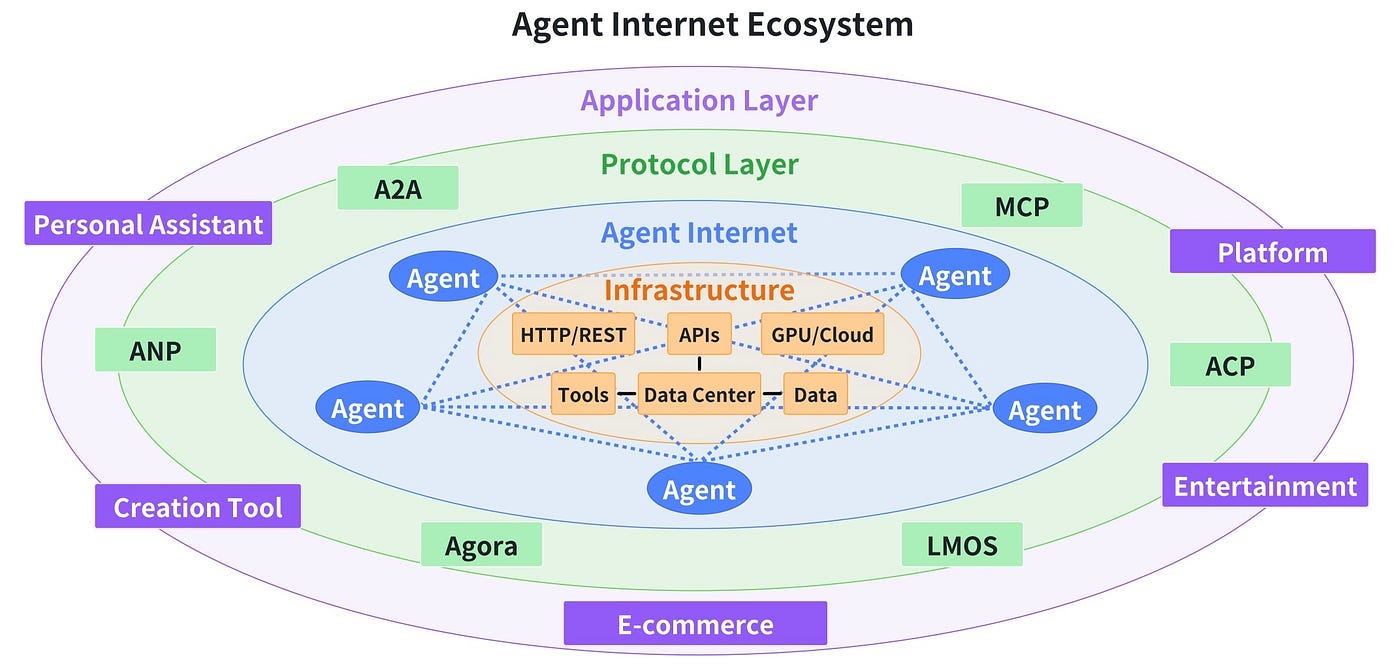
1. Model Context Protocol (MCP)
- Developed by: Anthropic
- Purpose: MCP is designed to standardize how AI agents, particularly those powered by large language models (LLMs), connect to external tools, data sources, or services.
- Focus: Vertical integration — enabling individual AI agents to access structured context (e.g., APIs, databases, or tools) to enhance their reasoning and task execution.

https://medium.com/@cobusgreyling/using-mcp-with-openai-mcp-servers-1c479b5dc8a2
Key Features:
- Acts as a “universal connector” (like a USB-C port) for LLMs to interface with external systems.
- Uses a JSON-RPC client-server interface for secure, structured data exchange.
- Supports dynamic prompt construction and tool invocation (e.g., fetching real-time data from a weather API or querying a database).
- Compatible with enterprise tools like Salesforce, SAP, or internal knowledge bases.
- Transport mechanisms include Server-Sent Events (SSE) for remote connections and Standard Input/Output (STDIO) for local interactions.
Use Case:
- An AI coding assistant uses MCP to connect to a version control system like GitHub to manage repositories or pull requests autonomously.
Strengths:
- Simplifies integration of LLMs with external tools and data.
- Model-agnostic, allowing compatibility with various LLMs.
Limitations:
- Focuses on individual agent-tool interactions, not inter-agent communication.
- Limited context window size can restrict broad inferences across complex tasks.
Analogy:
- MCP is like a power adapter that lets an AI plug into various tools and data sources to perform its tasks.
2. Agent-to-Agent Protocol (A2A)
- Developed by: Google, with contributions from over 50 partners (e.g., Salesforce, Atlassian, PayPal).
- Purpose: A2A standardizes communication and collaboration between multiple AI agents across different platforms, frameworks, or vendors.
- Focus: Horizontal integration — enabling interoperable, peer-to-peer task coordination and communication among autonomous agents.

https://medium.com/@cobusgreyling/using-mcp-with-openai-mcp-servers-1c479b5dc8a2
Key Features:
- Uses HTTP-based JSON-RPC 2.0 and Server-Sent Events (SSE) for secure, asynchronous communication.
- Agents expose an “Agent Card” (JSON metadata) detailing their identity, capabilities, and endpoints for discoverability.
- Supports multimodal interactions (text, audio, video, forms) and long-running tasks with state tracking.
- Designed for enterprise-scale workflows, such as customer service or supply chain management.
- Framework-agnostic, compatible with tools like LangGraph, CrewAI, or custom solutions.
Use Case:
- In a customer service scenario, a chatbot agent uses A2A to delegate a billing query to a specialized billing agent, coordinating seamlessly to resolve the issue.
Strengths:
- Enables modular, scalable multi-agent systems across vendors.
- Supports complex workflows with secure, asynchronous communication.
- Open-source with broad industry support.
Limitations:
- Ecosystem is still maturing, with potential overlap with MCP in certain workflows.
- Requires clear agent-tool distinction, which can blur in practice.
Analogy:
- A2A is like a network cable enabling different AI agents to talk and collaborate as a team, regardless of who built them.
3. Agent Network Protocol (ANP)
- Developed by: Community-driven (e.g., Chang, 2024), often associated with open, decentralized initiatives.
- Purpose: ANP enables decentralized, open-web communication and discovery among AI agents, emphasizing autonomy and flexibility.
- Focus: Decentralized, peer-to-peer agent ecosystems with self-sovereign identities and semantic discoverability.
Key Features:
- Uses decentralized identity mechanisms (e.g., W3C Decentralized Identifiers, DID) and JSON-LD for agent discovery and trust management.
- Supports open-web coordination, allowing agents to operate across the internet without centralized control.
- Designed for cross-domain communication, enabling agents to build rich, multiscale world models for reasoning.
- Less focused on enterprise-specific workflows compared to A2A, more on open, scalable networks.
Use Case:
- Autonomous agents in a decentralized supply chain network discover and negotiate with suppliers using ANP to coordinate logistics without a central orchestrator.
Strengths:
- Promotes open, vendor-neutral agent ecosystems.
- Enables semantic discovery and decentralized trust, ideal for open-web applications.
Limitations:
- Less suited for tightly controlled enterprise environments compared to A2A.
- Requires more infrastructure for decentralized identity and discovery, which may add complexity.
Analogy:
- ANP is like a decentralized internet for AI agents, allowing them to find and interact with each other freely across a global network.
4. Agent Development Kit (ADK)
- Developed by: Google
- Purpose: ADK is a comprehensive framework for building, deploying, and managing AI agents, integrating protocols like MCP and A2A.
- Focus: Development and deployment — providing a toolkit for creating robust, enterprise-grade AI agents that can leverage both tool access (via MCP) and agent collaboration (via A2A).
Key Features:
- Open-source framework optimized for Google’s Vertex AI and Gemini models but compatible with other frameworks like LangGraph or CrewAI.
- Supports MCP for tool integration and A2A for inter-agent communication.
- Includes Agent Garden (sample agents) and Agent Engine (managed runtime for deployment).
- Enables developers to build agents that connect to enterprise data sources (e.g., Google Maps, APIs) and collaborate across ecosystems.
- Supports local debugging and containerized production deployment (e.g., Cloud Run, Kubernetes).
Use Case:
- A developer uses ADK to build a travel planning agent that uses MCP to access Google Flights and A2A to coordinate with hotel and activity booking agents.
Strengths:
- Comprehensive toolkit for end-to-end agent development.
- Seamlessly integrates MCP and A2A for combined tool access and agent collaboration.
- Optimized for enterprise scalability and deployment.
Limitations:
- Heavily tied to Google’s ecosystem (e.g., Vertex AI), which may limit flexibility for non-Google users.
- Higher learning curve for developers unfamiliar with Google’s tools.
Analogy:
- ADK is like a full workshop for building AI agents, providing the tools (MCP) and communication systems (A2A) needed to create and deploy them.
Key Differences Summarized

Complementary Nature
- MCP and A2A: MCP equips individual agents with tools and data, while A2A enables those agents to collaborate with others. For example, an agent might use MCP to fetch data from a CRM system and A2A to share that data with another agent for further processing. Google explicitly positions A2A as complementary to MCP.
- ANP: ANP extends the vision of A2A to decentralized, open-web scenarios, focusing on autonomy and semantic discovery rather than enterprise-specific workflows.
- ADK: ADK integrates MCP and A2A into a unified development framework, enabling developers to build agents that leverage both tool access and inter-agent communication. It’s a higher-level toolkit, not a protocol, but it relies on MCP and A2A for functionality.
Practical Considerations
- When to Use MCP: Choose MCP for scenarios where an AI agent needs to integrate with external tools or data sources (e.g., connecting to a database or API). It’s ideal for enhancing individual agent capabilities.
- When to Use A2A: Use A2A for multi-agent systems requiring collaboration across platforms, such as enterprise automation or customer service workflows.
- When to Use ANP: Opt for ANP in decentralized, open-web scenarios where agents need to discover and interact with others autonomously across domains.
- When to Use ADK: Select ADK when building and deploying complex AI agents that need both tool integration (via MCP) and collaboration (via A2A), especially within Google’s ecosystem.
- Interoperability: MCP and A2A are designed to be framework-agnostic, working with tools like LangGraph or CrewAI. ANP emphasizes open standards, while ADK provides a structured development environment but is optimized for Google’s platforms.
Conclusion
MCP, A2A, ANP, and ADK address different layers of the AI agent ecosystem:
- MCP connects agents to tools and data.
- A2A enables agents to collaborate with each other.
- ANP fosters decentralized, open-web agent networks.
- ADK provides a toolkit to build and deploy agents using MCP and A2A.
Together, they form a foundation for scalable, interoperable, and autonomous AI systems. Developers should choose based on their specific needs: tool integration (MCP), agent collaboration (A2A), decentralized networks (ANP), or end-to-end development (ADK). As these protocols evolve, monitoring their interoperability and ecosystem traction will be key to building robust AI solutions.
메타데이터
- post_id
- d654c05ff76f
- slug
- mcp-a2a-anp-and-adk-unlocking-the-power-of-ai-agent-ecosystems-d654c05ff76f
- url
- https://medium.com/@lmpo/mcp-a2a-anp-and-adk-unlocking-the-power-of-ai-agent-ecosystems-d654c05ff76f
- canonical_url
- https://medium.com/@lmpo/mcp-a2a-anp-and-adk-unlocking-the-power-of-ai-agent-ecosystems-d654c05ff76f
- author_url
- https://medium.com/@lmpo
- status
- ok
- fetched_at
- 2026-07-19 17:48:15





